
Jaguar cichlid
Large predatory cichlid from Central American lakes
The jaguar cichlid is a robust freshwater fish native to Central America, ranging from Honduras to Costa Rica. It thrives in warm, murky lakes and serves as both a food source and a popular aquarium specimen due to its striking appearance.
- Males reach 65 cm in length
- Thrives in low-oxygen turbid water
- Native from Honduras to Costa Rica
- Popular in the aquarium trade
What it is
This large cichlid features a robust body with colours shifting from silvery or golden-green to purple. A dark moss green shade covers the back, while the belly appears whitish or yellowish. Distinctive black dots run horizontally along the side, and a black stripe extends from the eye to the gill cover. Males grow larger than females and develop elongated dorsal fin extensions, which females lack. The fins often turn dark during spawning periods.
Where it lives
Native waters stretch from the Ulúa River in Honduras to the Matina River basin in Costa Rica. The species name references Lake Managua in Nicaragua, where the type specimen was collected. It has been introduced to other Central American nations and the United States for food, aquarium keeping, and population control. These fish inhabit tropical lakes and can also be found in ponds and springs.
How it lives
As a carnivorous predator, this fish hunts small fish as an adult, while juveniles consume various macroinvertebrates. It prefers turbid environments with mud bottoms but adapts to sandy substrates covered in plant debris. The species tolerates low oxygen levels and eutrophic conditions. Ideal water parameters include a pH between 7.0 and 8.7, hardness of 10–15 dGH, and temperatures from 25 to 36 °C.
Fish and people
Local communities value it as a food fish, particularly in Costa Rica where it is called guapote tigre. The aquarium trade also prizes it under names like Aztec cichlid or jaguar guapote. Its introduction to non-native regions often aims to support fisheries or manage other fish populations. It remains a notable species in freshwater aquarium lists due to its size and predatory nature.
Status and threats
The International Union for Conservation of Nature lists this species as least concern. It faces no immediate threat of extinction and occurs within protected areas such as the Maquenque National Wildlife Refuge. Its tolerance for poor water quality likely contributes to its stable population status across its native range.

Questions people ask about Jaguar cichlid
How big do jaguar cichlids get?
Males grow to a total length of 65 centimetres, while females are smaller, reaching up to 40 centimetres. Males also develop elongated dorsal fin extensions that females do not have.
What do jaguar cichlids eat?
They are carnivorous predators. Adults feed mainly on small fish, whereas juveniles rely on a variety of macroinvertebrates found in their habitat.
Where are jaguar cichlids found?
They are native to freshwater habitats in Central America, ranging from the Ulúa River in Honduras to the Matina River basin in Costa Rica. They have also been introduced to the United States.
Good reading and sources
- Parachromis managuensis on WikipediaEncyclopedia
- More photos on Wikimedia CommonsPhotos
- Wikidata recordOpen data
The facts on this page come from the Wikipedia article "Parachromis managuensis", written by its contributors and used under the CC BY-SA 4.0 licence, and from its Wikidata record (CC0). EveryFish rewrote the text in its own words, with AI assistance, and compares every page with the article to make sure no passage is copied. It may be reused under the same CC BY-SA 4.0 licence with a link back.
It may contain mistakes, and figures change over time. Nothing here is investment or buying advice. If something is wrong, tell us. Last refreshed 2026-11-15.
Like Jaguar cichlid
All cichlids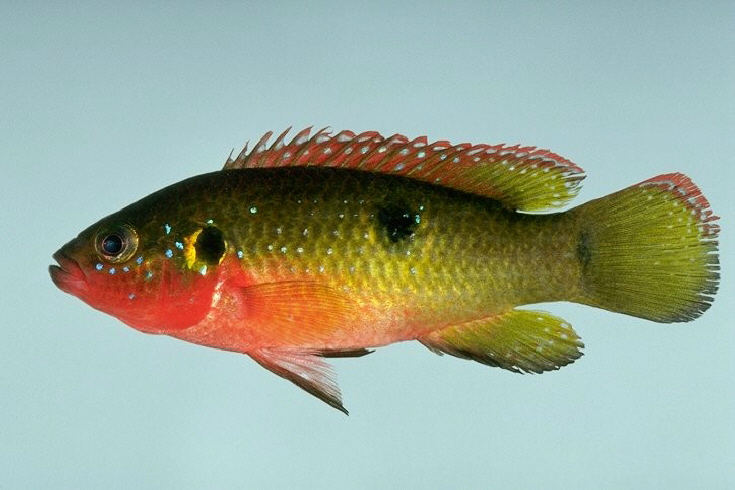 Sub-Saharan AfricaJewel cichlid
Brightly colored African cichlids kept in aquariums for their vivid breeding colours and parental care.Cichlid · Rivers and lakes
 🇧🇷 Brazil and 3 moreSpeckled peacock bass
A large South American cichlid prized for sport and food.Cichlid · Rivers and lakes
 🇨🇷 Costa Rica and 1 moreMidas cichlid
Large aggressive cichlid from Central AmericaCichlid · Rivers and lakes
 🇧🇮 Burundi and 3 moreGiant cichlid
The largest living cichlid species, native to Lake Tanganyika in Africa.Cichlid · Rivers and lakes · 1899
More from Cichlidae
All of them 🇹🇿 Tanzania and 2 moreSingida tilapia
A cichlid fish native to the Lake Victoria basin in East Africa.Cichlid · Rivers and lakes
 Sub-Saharan AfricaPrincess cichlid
A cooperative schooling cichlid from Lake Tanganyika.Cichlid · Rivers and lakes
 WorldAuratus cichlid
Small, colourful cichlid from Lake MalawiCichlid · Rivers and lakes
 🇧🇷 Brazil and 2 morePeacock bass
Large predatory cichlids from South American rivers known for sport fishing and invasive impact.Cichlid · Rivers and lakes