
Convict cichlid
Striped Central American cichlid popular in home aquariums
The convict cichlid is a small freshwater fish native to Central America. It features distinct vertical black stripes and exhibits strong parental care. Aquarists value it for its hardiness, while scientists study its complex social and breeding behaviours.
- Named for black vertical stripes resembling prison uniforms
- Both parents care for eggs and fry in caves
- Reaches sexual maturity in as little as 16 weeks
- Invasive in Australia, Japan and the USA
- Females are more brightly coloured than males
What it is
This fish belongs to the cichlid family and is easily recognised by eight or nine vertical black bars on a blue-grey body. Males grow larger than females and develop pointed fins, while females display brighter colours with pink or orange tones on their belly and dorsal fin. Wild specimens reach about twelve centimetres in total length. Selective breeding has produced leucistic strains that lack dark markings, often called white or gold convicts. The common name refers to the striped pattern resembling old prison uniforms.
Where it lives
Native populations inhabit lakes and flowing streams across Central America. They occur on the Pacific slope from El Salvador to Guatemala and on the Atlantic slope from Honduras to Costa Rica. These fish prefer habitats offering shelter among rocks or submerged branches. They tolerate cool water well, allowing them to live in volcanic lakes at high elevations. Water conditions in their natural range typically feature a pH between 6.6 and 7.8 and temperatures around 26 to 29 degrees Celsius.
How it lives
Convict cichlids are omnivores that eat plants, algae, insects, worms and small crustaceans. Their protrusible jaws help them handle varied food sources. They are highly territorial and aggressive, especially when breeding. Aggression levels can increase with higher water temperatures. In the wild, they form monogamous pairs and defend specific areas. Studies show that females prefer larger males who can better defend territories and raise offspring. Population density influences mate choice and spacing between nests.
Breeding and life cycle
Sexual maturity arrives between sixteen weeks and six months. Pairs excavate caves under stones to lay eggs on the walls. Both parents guard the clutch, fanning it to provide oxygen. The eggs hatch after roughly seventy-two hours. Larvae absorb their yolk sacs before becoming free-swimming fry. Parents retrieve the young at night, using smell to navigate in darkness. Brood care lasts four to six weeks in the wild. In captivity, females may breed repeatedly with short intervals between spawns.
Fish and people
Aquarists keep these fish due to their hardiness and interesting behaviour. Tanks should include rocks and caves to mimic natural shelters. A twenty-gallon tank is recommended for a pair. Scientists frequently study them to understand aggression, mating systems and parental roles. Feral populations have established themselves outside their native range, including in Australia, Japan and the United States. In some regions, they thrive in warm water discharged from power stations.
Status and threats
Wild populations face pressure from habitat changes, but the species remains widespread. Introduced groups in other countries can become invasive, outcompeting local fauna. Conservation efforts focus mainly on managing non-native spread rather than protecting the core Central American range. The species adapts well to various water conditions, which aids its survival in both natural and artificial environments.


Questions people ask about Convict cichlid
Why is it called the convict cichlid?
The name comes from the eight or nine vertical black bars on its body. These stripes look like the uniforms worn by prisoners in British jails during the nineteenth century. The scientific name also refers to these black stripes.
Do convict cichlids make good pets?
They are popular in aquariums because they are hardy and accept most foods. However, they are aggressive and territorial. Keepers should provide a tank of at least twenty gallons with rocks and caves for shelter and breeding sites.
How do they care for their young?
Both parents participate in raising offspring. They guard the nest, fan the eggs for oxygen and retrieve fry at night. The male typically chases intruders while the female stays closer to the brood, though roles can shift if one parent is absent.
Where do convict cichlids live in the wild?
They are native to Central America, found in lakes and streams from Guatemala to Panama. They prefer water with rocky cover or sunken branches. They can survive in cool volcanic lakes at high elevations as well as warmer lowland streams.
Good reading and sources
- Convict cichlid on WikipediaEncyclopedia
- More photos on Wikimedia CommonsPhotos
- Wikidata recordOpen data
The facts on this page come from the Wikipedia article "Convict cichlid", written by its contributors and used under the CC BY-SA 4.0 licence, and from its Wikidata record (CC0). EveryFish rewrote the text in its own words, with AI assistance, and compares every page with the article to make sure no passage is copied. It may be reused under the same CC BY-SA 4.0 licence with a link back.
It may contain mistakes, and figures change over time. Nothing here is investment or buying advice. If something is wrong, tell us. Last refreshed 2026-11-15.
Like Convict cichlid
All cichlids WorldHaplochromis
A large ray-finned fish genus from East Africa known for rapid evolution and aquarium popularity.Cichlid · Rivers and lakes · 1888
 🇧🇷 BrazilPterophyllum
A genus of laterally compressed freshwater cichlids known as angelfish.Cichlid · Rivers and lakes · 1824
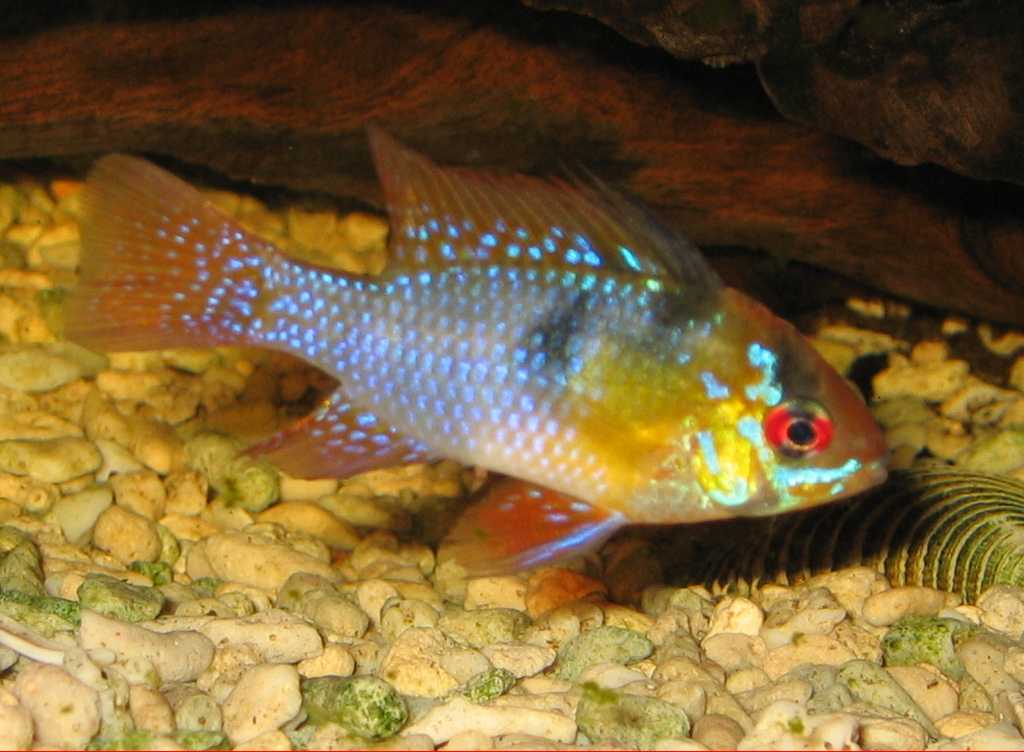 🇻🇪 Venezuela and 1 moreRam cichlid
Small colourful freshwater fish from South AmericaCichlid · Rivers and lakes · 1948
 Sub-Saharan AfricaZebra mbuna
Small rock-dwelling cichlid from Lake MalawiCichlid · Rivers and lakes
More from Cichlidae
All of them 🇧🇷 BrazilDiscus
Round, colourful cichlids from the Amazon basin.Cichlid · Rivers and lakes · 1840
 WorldUaru
A large South American cichlid from clear Amazon streams.Cichlid · Rivers and lakes · 1840
 Sub-Saharan AfricaRedbreast tilapia
Herbivorous cichlid from southern African freshwatersCichlid · Rivers and lakes · 1897
WorldCichlid
Diverse freshwater fish family known for parental care and rapid evolution.Cichlid · Rivers and lakes · 1835