
Zebra mbuna
Small rock-dwelling cichlid from Lake Malawi
The zebra mbuna is a small cichlid fish found only in Lake Malawi. It lives among rocks and feeds on algae scraped from surfaces. Females carry eggs in their mouths for protection. This species is popular in home aquariums due to its striking colours.
- Endemic to Lake Malawi in Africa
- Reaches a maximum length of 11.3 cm
- Female broods eggs in mouth for up to 24 days
- Feeds on algae scraped from rock surfaces
- Popular species in the aquarium trade
What it is
The zebra mbuna is a small cichlid species native to Lake Malawi. It grows to a maximum length of 11.3 cm. Males display bright blue bodies with grey or black vertical bars. Their fins often feature orange or yellow spots. Females appear in two distinct colour forms. One morph is pale brownish-grey with clear fin membranes. The other is dark brown or black with blue highlights and yellow spots on the anal fin. Both sexes have specialised teeth for scraping food from rocks.
Where it lives
This fish is endemic to Lake Malawi in Africa. It inhabits rocky zones within the lake. These areas may have sediment cover or bare rock surfaces. The species lives at depths ranging from 6 to 28 metres. It does not occur naturally outside this specific lake system. The environment provides the hard surfaces needed for its feeding habits.
How it lives
The zebra mbuna feeds primarily on aufwuchs. This is a layer of algae and organisms growing on rocks. It also eats zooplankton and small invertebrates. The fish positions its body perpendicular to the rock surface. It scrapes food by opening and closing its mouth against the stone. Its teeth include bicuspid front teeth and tricuspid rear teeth. This method allows it to remove loose material efficiently.
Breeding and life cycle
Females practice maternal mouthbrooding. They hold eggs and young fry in their mouths for 18 to 24 days. During this period, the female cannot eat and loses weight. Once the young are mature enough, she releases them into open water. The fry immediately seek shelter. Studies suggest male mate choice depends on the colour morph of his mother rather than his own rearing experience.
Fish and people
This species is common in the aquarium trade. Hobbyists value it for its vibrant colours and active behaviour. Scientists have also studied its genetics. A draft nuclear genome was published in 2008. Improved versions followed in 2014 and 2015 using advanced sequencing methods. These studies help researchers understand cichlid evolution and diversity.


Questions people ask about Zebra mbuna
Where does the zebra mbuna live?
It is endemic to Lake Malawi in Africa. It lives in rocky areas at depths between 6 and 28 metres. It is not found naturally in any other location.
What does the zebra mbuna eat?
It primarily feeds on aufwuchs, which is an algae-based community on rocks. It also consumes zooplankton and small invertebrates by scraping them from surfaces.
How does the zebra mbuna reproduce?
It is a maternal mouthbrooder. The female holds eggs and young in her mouth for 18 to 24 days. She does not feed during this time and loses weight.
Why are there different coloured females?
Females are polymorphic, meaning they occur in two colour forms. One is pale brownish-grey and the other is dark brown or black. Male mate preference is linked to their mother's colour.
Good reading and sources
The facts on this page come from the Wikipedia article "Zebra mbuna", written by its contributors and used under the CC BY-SA 4.0 licence, and from its Wikidata record (CC0). EveryFish rewrote the text in its own words, with AI assistance, and compares every page with the article to make sure no passage is copied. It may be reused under the same CC BY-SA 4.0 licence with a link back.
It may contain mistakes, and figures change over time. Nothing here is investment or buying advice. If something is wrong, tell us. Last refreshed 2026-11-15.
Like Zebra mbuna
All cichlids Sub-Saharan AfricaPrincess cichlid
A cooperative schooling cichlid from Lake Tanganyika.Cichlid · Rivers and lakes
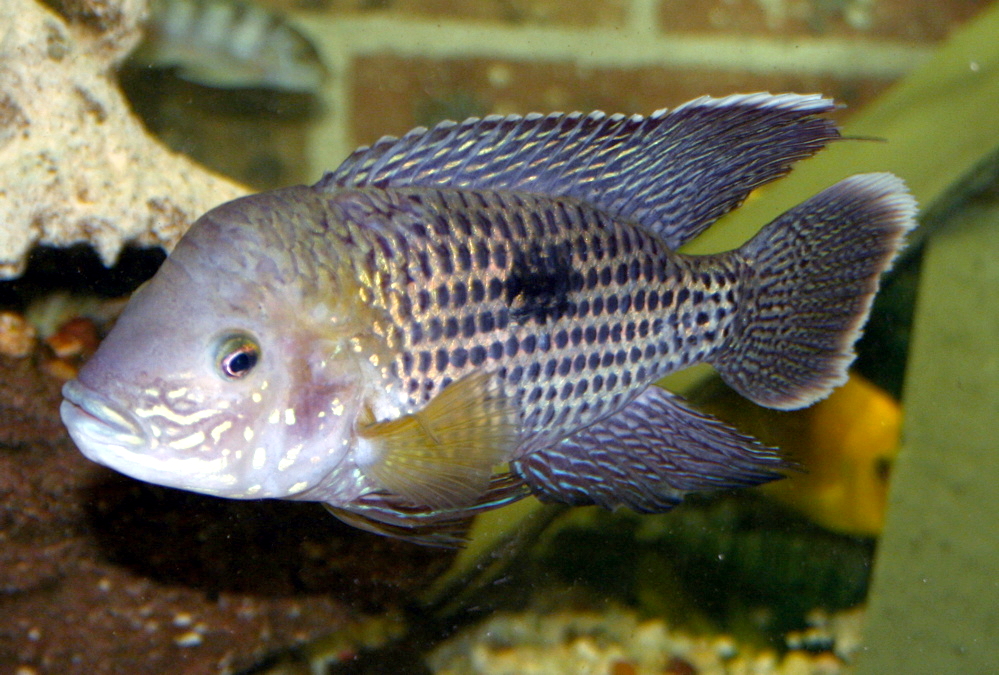 🇵🇪 Peru and 1 moreGreen terror
A large, aggressive South American cichlid kept in aquariums.Cichlid · Rivers and lakes
 🇧🇷 BrazilPterophyllum
A genus of laterally compressed freshwater cichlids known as angelfish.Cichlid · Rivers and lakes · 1824
 🇬🇹 Guatemala and 4 moreConvict cichlid
Striped Central American cichlid popular in home aquariumsCichlid · Rivers and lakes · 1867
More from Cichlidae
All of them 🇹🇿 Tanzania and 2 moreSingida tilapia
A cichlid fish native to the Lake Victoria basin in East Africa.Cichlid · Rivers and lakes
 🇭🇳 Honduras and 3 moreJaguar cichlid
Large predatory cichlid from Central American lakesCichlid · Rivers and lakes
 WorldAuratus cichlid
Small, colourful cichlid from Lake MalawiCichlid · Rivers and lakes
 🇧🇷 Brazil and 2 morePeacock bass
Large predatory cichlids from South American rivers known for sport fishing and invasive impact.Cichlid · Rivers and lakes