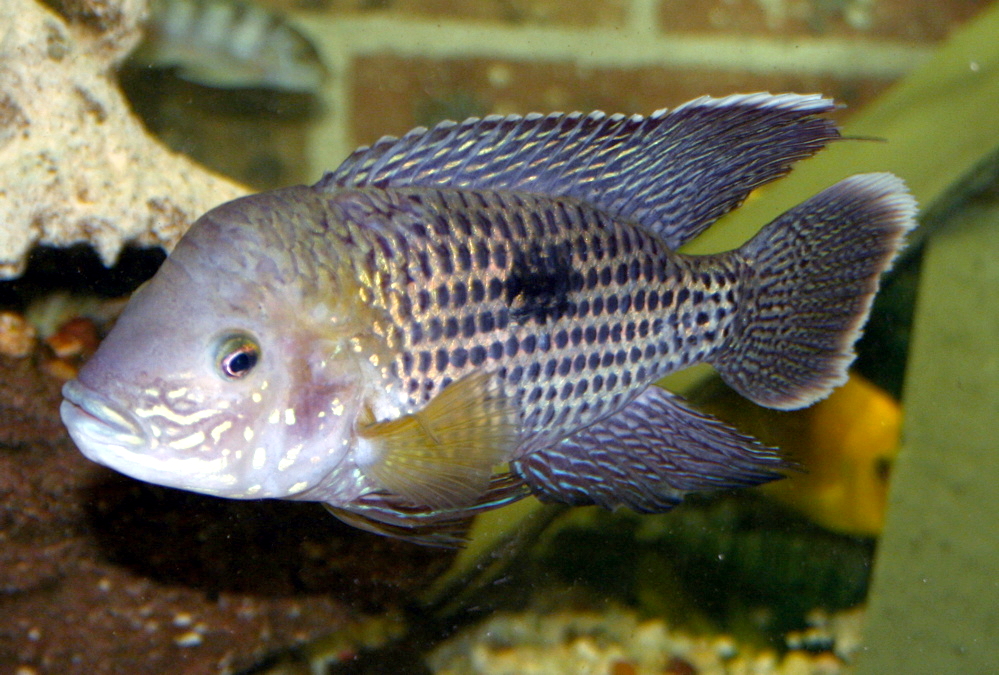
Green terror
A large, aggressive South American cichlid kept in aquariums.
The green terror is a freshwater fish from the Andes region of Peru and Ecuador. It is widely kept in home tanks for its striking colours and hardiness, though it requires careful tank mates due to its temperament.
- Reaches up to 30 cm in length with a fatty forehead hump on males.
- Native to rivers in Peru and Ecuador along the Pacific slope.
- Popular in aquariums due to hardiness and bright iridescent colours.
- Used in scientific studies regarding testosterone and lateralization.
- Can cohabit with other large aggressive cichlids if space permits.
What it is
This species belongs to the cichlid family and displays a deep body with a prominent forehead. Adult males often develop a fatty hump on their head. The colouring varies, but adults show iridescent blue, green, and orange hues with flowing fins. Juveniles are tan with silver-blue flecks and lack the bright adult patterns. The fish can reach thirty centimetres in length, although fifteen to twenty centimetres is more common. It is sometimes mistaken for the blue acara or the gold saum, but those species differ in size and aggression levels.
Where it lives
The natural habitat lies along the Pacific side of South America. The range extends from the Tumbes River in Peru northward to the Esmeraldas River in Ecuador. These waters maintain a tropical climate. The fish prefers specific water conditions including a pH between 6.5 and 8.0. Water hardness should be around 25 degrees dGH. Temperatures ideally stay between 20 and 24 degrees Celsius.
How it lives
Adult specimens are known for high aggression, especially during late juvenile and adult phases. However, some individuals remain peaceful. Males grow larger than females and reach sexual maturity at smaller sizes. In captivity, they can survive alongside other large aggressive cichlids like wolf cichlids or jaguar cichlids. They avoid prey that fits within their jaw span. This adaptability allows them to thrive in community tanks with similarly sized robust fish.
Fish and people
Aquarium hobbyists value this fish for its hardiness and visual appeal. It is frequently sold in pet stores as a juvenile. Owners must manage its aggressive nature by selecting appropriate tank mates. It coexists well with species like the Jack Dempsey or midas cichlid. Researchers also utilize this species to study how testosterone affects lateralization in brain function. It serves as a model organism for these specific hormonal effects.


Questions people ask about Green terror
How big does a green terror get?
They can reach thirty centimetres, though fifteen to twenty centimetres is typical. Size does not depend on tank volume.
Is the green terror aggressive?
Yes, adults are often very aggressive. They can live with other large cichlids but may attack smaller fish.
Where is the green terror native?
It comes from the Pacific side of South America, specifically the Tumbes River in Peru to the Esmeraldas River in Ecuador.
What water conditions do they need?
They prefer tropical water between 20 and 24 degrees Celsius. pH should be 6.5 to 8.0 with moderate hardness.
Good reading and sources
The facts on this page come from the Wikipedia article "Green terror", written by its contributors and used under the CC BY-SA 4.0 licence, and from its Wikidata record (CC0). EveryFish rewrote the text in its own words, with AI assistance, and compares every page with the article to make sure no passage is copied. It may be reused under the same CC BY-SA 4.0 licence with a link back.
It may contain mistakes, and figures change over time. Nothing here is investment or buying advice. If something is wrong, tell us. Last refreshed 2026-11-15.
Like Green terror
All cichlids Sub-Saharan AfricaZebra mbuna
Small rock-dwelling cichlid from Lake MalawiCichlid · Rivers and lakes
 Sub-Saharan AfricaPrincess cichlid
A cooperative schooling cichlid from Lake Tanganyika.Cichlid · Rivers and lakes
 🇧🇷 BrazilPterophyllum
A genus of laterally compressed freshwater cichlids known as angelfish.Cichlid · Rivers and lakes · 1824
 🇬🇹 Guatemala and 4 moreConvict cichlid
Striped Central American cichlid popular in home aquariumsCichlid · Rivers and lakes · 1867
More from Cichlidae
All of them 🇹🇿 Tanzania and 2 moreSingida tilapia
A cichlid fish native to the Lake Victoria basin in East Africa.Cichlid · Rivers and lakes
 🇭🇳 Honduras and 3 moreJaguar cichlid
Large predatory cichlid from Central American lakesCichlid · Rivers and lakes
 WorldAuratus cichlid
Small, colourful cichlid from Lake MalawiCichlid · Rivers and lakes
 🇧🇷 Brazil and 2 morePeacock bass
Large predatory cichlids from South American rivers known for sport fishing and invasive impact.Cichlid · Rivers and lakes