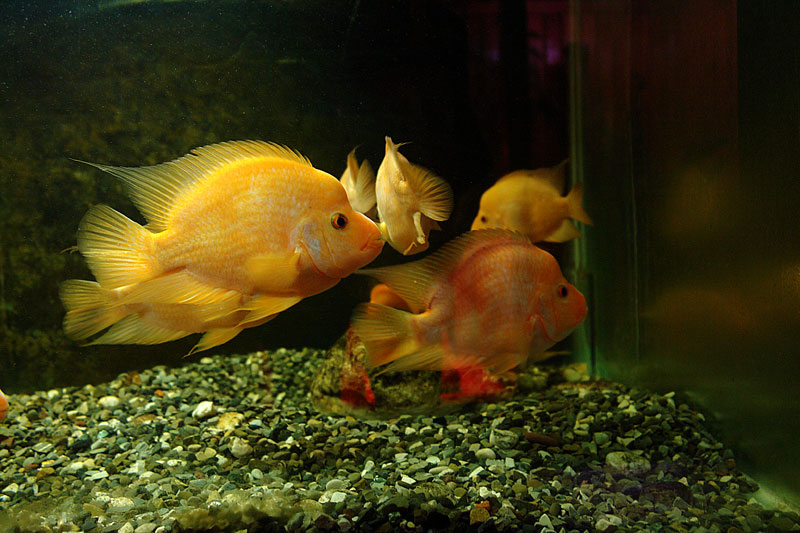
Blood parrot cichlid
A bright orange hybrid cichlid bred for the aquarium trade.
The blood parrot cichlid is a man-made hybrid fish created in Taiwan around 1986. It belongs to the cichlid family and is popular in home aquariums for its vivid colours and unique shape. Breeders cross two species to produce these hardy but deformed fish, which require specific care due to their anatomical issues.
- First bred in Taiwan around 1986
- Grows up to 20 centimetres long
- Has a beak-shaped mouth that may not close
- Lifespan ranges from 10 to 15 years
- Males are generally infertile without hormone treatment
What it is
This fish is a hybrid cichlid, meaning it results from crossing two different species. It typically displays bright orange, red, yellow, or grey scales. The most distinctive feature is its beak-shaped mouth, which often cannot close fully. Adults grow to about twenty centimetres in length. They possess a deformed nuchal hump and compressed vertebrae. Some individuals have large or misshapen irises. Despite these physical traits, they are robust survivors in tank environments.
Where it lives
These fish do not exist in the wild. They were first developed by breeders in Taiwan during the mid-1980s. Today, they live exclusively in artificial freshwater habitats such as home aquariums. They thrive under various water conditions but require clean environments due to their feeding habits. They are not found in natural rivers, lakes, or oceans anywhere in the world.
How it lives
Blood parrots are semi-aggressive and will defend their space. They can hold their own against other tank mates but may eat smaller fish that fit in their mouths. They are voracious eaters and produce significant waste, requiring strong filtration. Due to their mouth structure, they crush food using throat muscles rather than biting. They are hardy and can live singly or in groups if provided with enough space.
Breeding and life cycle
Male blood parrots are usually infertile, though successful breeding has occurred. Most females remain fertile and lay eggs on hard surfaces. Both parents typically guard the clutch unless fungus develops, in which case they may consume the eggs. To improve fertility rates, some farms inject males with hormones. Selective breeding has recently produced variants with fully functioning mouths, such as the King Kong parrot.
Fish and people
Aquarists value these fish for their unusual appearance and hardiness. A single fish needs a fifty-five gallon tank, with extra space for each additional individual. Controversy surrounds the ethics of breeding them due to their deformities. Some breeders dye the fish or cut their tails to create heart shapes, practices widely condemned by enthusiasts. Specialised foods help them eat despite their narrow mouth opening.
Status and threats
As a captive-bred hybrid, this fish has no conservation status in the wild. Ethical concerns focus on the welfare of the individual animals. Anatomical defects like swim bladder issues cause awkward swimming. The practice of creating heart-shaped tails has declined due to public pressure. Most stockists now refuse to sell such modified specimens, favouring healthier lines.


Questions people ask about Blood parrot cichlid
Can blood parrot cichlids breed naturally?
Males are generally infertile, but females are fertile and lay eggs. Successful breeding sometimes occurs, and farms may use hormones to increase male fertility. Parents usually guard the eggs unless fungus appears.
Why do they have strange mouths?
The beak-shaped mouth is a genetic defect from hybridisation. It often cannot close fully, so the fish uses throat muscles to crush food. This can make feeding difficult and risks malnutrition if not managed.
What size tank do they need?
A single blood parrot requires a fifty-five gallon aquarium. For every additional fish, you should add twenty gallons of volume. Strong filtration is needed because they produce significant waste while eating.
Good reading and sources
- Blood parrot cichlid on WikipediaEncyclopedia
- More photos on Wikimedia CommonsPhotos
- Wikidata recordOpen data
The facts on this page come from the Wikipedia article "Blood parrot cichlid", written by its contributors and used under the CC BY-SA 4.0 licence, and from its Wikidata record (CC0). EveryFish rewrote the text in its own words, with AI assistance, and compares every page with the article to make sure no passage is copied. It may be reused under the same CC BY-SA 4.0 licence with a link back.
It may contain mistakes, and figures change over time. Nothing here is investment or buying advice. If something is wrong, tell us. Last refreshed 2026-11-15.
Like Blood parrot cichlid
All cichlids 🇻🇪 Venezuela and 1 moreRam cichlid
Small colourful freshwater fish from South AmericaCichlid · Rivers and lakes · 1948
 🇳🇬 Nigeria and 1 moreKribensis
Small colourful cichlid from West AfricaCichlid · Rivers and lakes · 1901
 🇧🇮 Burundi and 3 moreGiant cichlid
The largest living cichlid species, native to Lake Tanganyika in Africa.Cichlid · Rivers and lakes · 1899
 WorldHaplochromis
A large ray-finned fish genus from East Africa known for rapid evolution and aquarium popularity.Cichlid · Rivers and lakes · 1888
More from Cichlidae
All of them Sub-Saharan AfricaRedbreast tilapia
Herbivorous cichlid from southern African freshwatersCichlid · Rivers and lakes · 1897
 🇬🇹 Guatemala and 4 moreConvict cichlid
Striped Central American cichlid popular in home aquariumsCichlid · Rivers and lakes · 1867
 WorldUaru
A large South American cichlid from clear Amazon streams.Cichlid · Rivers and lakes · 1840
 🇧🇷 BrazilDiscus
Round, colourful cichlids from the Amazon basin.Cichlid · Rivers and lakes · 1840