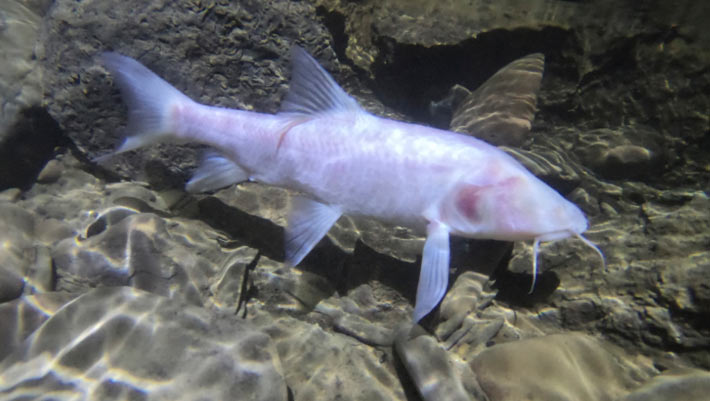
Neolissochilus pnar
The largest known subterranean fish, found in the caves of Meghalaya, India.
Neolissochilus pnar is a white, blind cyprinid living in underground pools. It was formally studied in 2019 but local stories about it date back a century. It holds the record for size among cave-dwelling fish.
- Largest known subterranean fish, exceeding 400 mm in length.
- Found exclusively in the Siju Caves of Meghalaya, India.
- White and blind, with eyes hidden under skin in adults.
- Named after the Khasi sub-tribe Pnar.
- Formally studied in 2019 after century-old local legends.
What it is
This species belongs to the carp family and lives entirely underground. It is a pale fish with no pigment, appearing white or pinkish. Its eyes are tiny and hidden under the skin in adults, though visible in young ones. The head is large, making up more than a quarter of its body length. It has two pairs of whiskers called barbels near its mouth. All fins are clear and see-through. A continuous line of sensory scales runs along its side. This fish is the biggest known creature that lives permanently in dark caves.
Where it lives
The fish is found only in the Siju Caves within the Garo Hills of Meghalaya in northeast India. These caves drain into the Meghna River system. The habitat consists of rocky floors with pools of standing water. The entrance to one main cave lies in a dry stream bed surrounded by forest. The area experiences seasonal flooding, which brings debris into the water. This seasonal change shapes the environment where the fish survives.
How it lives
The fish feeds on organic matter washed into the caves during floods. Invertebrates like crickets, spiders, shrimp, snails, and insect larvae also live in these pools. Tadpoles share the space with the fish. There are no major bat colonies providing guano in the main cave. The fish grows larger as it ages, and its eyes shrink proportionally. Smaller juveniles have clearly visible dark eye spots beneath their skin.
Breeding and life cycle
Information regarding spawning habits, egg production, and juvenile growth rates is not provided in the available records. The mitogenome of the species is known to be 16,440 base pairs long, but reproductive details remain unstated.
Fish and people
Local communities in Meghalaya have told stories about white cavefish for over a hundred years. Early observers thought they were just pale versions of the golden mahseer seen under torchlight. The specific name honors the Khasi sub-tribe known as Pnar. Scientific collection and photography for study occurred in 2019. Prior to this, the fish had only been observed informally since the 1990s.
Status and threats
The conservation status is currently listed as data deficient. The restricted range inside isolated caves makes the population potentially vulnerable, but formal assessment data is absent from the provided text.
Questions people ask about Neolissochilus pnar
What makes this fish unique?
It is the largest known fish that lives permanently in underground caves. It lacks pigment, appearing white or pink, and is blind with eyes hidden under the skin in adults.
Where can you find Neolissochilus pnar?
It is found only in the Siju Caves in the Garo Hills of Meghalaya, northeast India. These caves contain pools of standing water connected to the Meghna River system.
How big does this fish get?
The holotype specimen measured 329.2 mm. However, individuals sighted in their natural habitat have exceeded 400 mm in standard length, making them very large for cave fish.
What do these fish eat?
They likely feed on organic debris washed into the caves during seasonal floods. They also share their habitat with various invertebrates like crickets, shrimp, and snails.
Good reading and sources
The facts on this page come from the Wikipedia article "Neolissochilus pnar", written by its contributors and used under the CC BY-SA 4.0 licence, and from its Wikidata record (CC0). EveryFish rewrote the text in its own words, with AI assistance, and compares every page with the article to make sure no passage is copied. It may be reused under the same CC BY-SA 4.0 licence with a link back.
It may contain mistakes, and figures change over time. Nothing here is investment or buying advice. If something is wrong, tell us. Last refreshed 2026-11-15.
Like Neolissochilus pnar
All carps and minnows 🇮🇳 India and 1 moreTor khudree
A large freshwater carp native to Indian rivers, known for its silvery body and red fins.Carp · Rivers and lakes · 1838
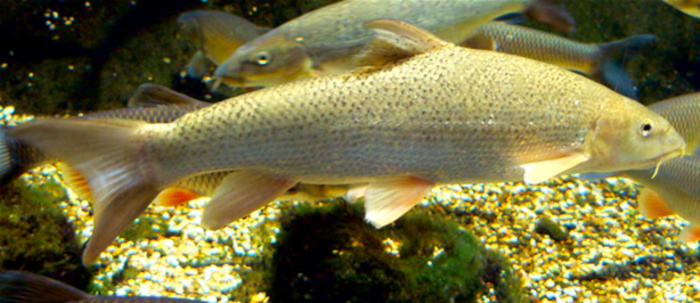 🇬🇧 United Kingdom and 4 moreBarbel
Carp-like freshwater fish with distinctive mouth barbelsCarp · Rivers and lakes
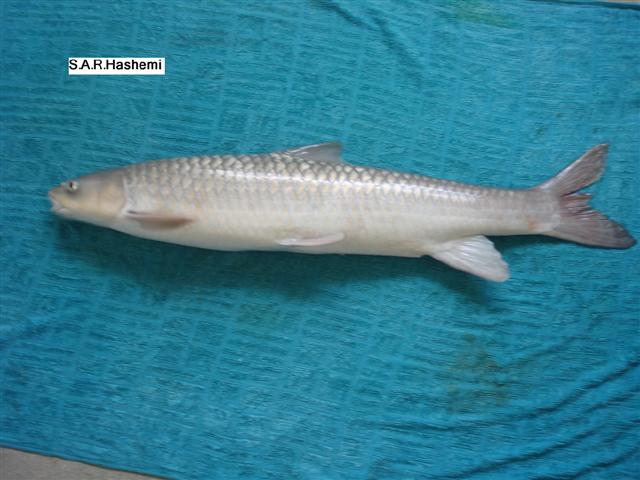 🇮🇷 Iran and 1 moreShabout
A large freshwater carp native to the Tigris-Euphrates basin in Western Asia.Carp · Rivers and lakes
 🇹🇭 Thailand and 2 moreEmpurau
A large Southeast Asian river fish prized for its high market value.Carp · Rivers and lakes
More from Cyprinidae
All of them 🇲🇲 MyanmarOdessa barb
Small colourful cyprinid from Myanmar popular in home aquariumsCarp · Rivers and lakes · 2008
 🇮🇳 IndiaOrange-finned mahseer
Critically endangered freshwater game fish from India.Carp · Rivers and lakes · 2007
 🇹🇭 ThailandRed-tailed black shark
A critically endangered Thai carp kept widely in aquariums for its black body and red tail.Carp · Rivers and lakes · 1931
 🇱🇰 Sri Lanka and 2 moreCherry barb
Small tropical freshwater fish from Sri Lanka, popular in aquariums for its bright red colour.Carp · Rivers and lakes · 1929