
Tor khudree
A large freshwater carp native to Indian rivers, known for its silvery body and red fins.
The Deccan mahseer is a cyprinid fish found in the major river systems of India and Sri Lanka. Originally described by Sykes in 1838, it inhabits rocky streams and reservoirs, though artificial breeding efforts have complicated genetic identification.
- Originally described by Sykes in 1838 as Barbus khudree.
- Type locality is the Mula-Mutha River near Pune, India.
- Artificial breeding attempts since the 1970s complicate identification.
- Predatory diet includes plants, insects, and smaller fish.
- Recent conservation focus in the Chambal river basin.
What it is
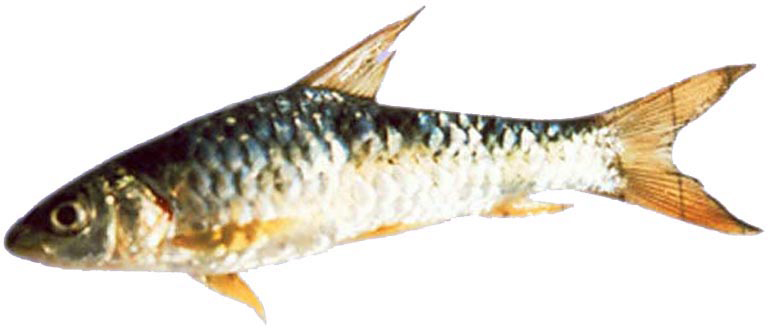
The Deccan mahseer is a freshwater carp belonging to the Cyprinidae family. It features thick lips with an uninterrupted fold across the lower jaw and barbels that extend below the eye. The dorsal fin arises opposite the ventral fin and is roughly three-quarters as high as the body. Its colouration varies from silvery-blue to greenish on the upper half, becoming silvery with gold shots on the sides. The lower fins are reddish-yellow, while other fins may be tipped with blue. Specimens from different regions show variation in spine strength and lip development.
Where it lives
This species occurs throughout India and in Sri Lanka. It thrives in mountain or rocky streams where it reaches its largest sizes and greatest abundance. Artificial introductions have spread artificially-bred fish across the country, making pure populations difficult to identify. Recent reports also place it as a winter-exclusive fish in the Chambal river basin in Central India, specifically near Indore in Madhya Pradesh.
How it lives
Adults are predatory, feeding on plants, fruits, insects, shrimps, molluscs, and even smaller mahseer. They inhabit rocky streams and reservoirs, moving to upper reaches of small streams for spawning. Historical accounts describe them as exceptionally thick and heavy fish. One notable specimen measured sixty inches in length with a thirty-eight inch girth, estimated at significant weight, though such massive individuals are no longer found in the original type locality.
Breeding and life cycle
Mahseers typically move to the upper reaches of small streams to spawn. Efforts to artificially breed this species began in the early 1970s. However, determining if bred fish are genuine Tor khudree is challenging because populations in the type locality have gone extinct. Hatchery samples from Karnataka and Maharashtra show genetic identity but physical variation, complicating conservation tracking.
Fish and people
The fish is grown in ponds and caught for food and sport. Large specimens have been recorded weighing over forty-five kilograms, with recent catches in the River Cauvery exceeding thirty kilograms. Historical angling records mention enormous catches, though some museum specimens were later reclassified as different species. Conservationists recommend ranching and creating protected winter areas in the Chambal basin to support remaining populations.
Status and threats
Populations in the type locality near Pune have gone extinct, making accurate identification of current stocks difficult. Artificial breeding programs since the 1970s have introduced genetically identical but physically varied fish. Conservation measures include recommendations for ranching and establishing protected freshwater areas in the Chambal river basin. Taxonomic investigations continue to clarify species boundaries, as some historically cited specimens belong to related endemic species like Tor remadevii.

Questions people ask about Tor khudree
What does the Deccan mahseer eat?
It feeds on plants, fruits, insects, shrimps, and molluscs. Being predatory, it also preys on smaller mahseer fish.
Where was this fish first scientifically described?
The type locality is the Mula-Mutha River close to Pune, which is part of the Krishna River basin in India.
Why is identifying pure Tor khudree difficult today?
Populations in the original type locality have gone extinct. Artificial breeding since the 1970s has released fish that are genetically identical but physically variable.
How large can this fish grow?
Large fish over one metre and 45 kg have been recorded. Recent catches in the Cauvery River exceed 30 kg, though huge historical specimens are rare now.
Good reading and sources
The facts on this page come from the Wikipedia article "Tor khudree", written by its contributors and used under the CC BY-SA 4.0 licence, and from its Wikidata record (CC0). EveryFish rewrote the text in its own words, with AI assistance, and compares every page with the article to make sure no passage is copied. It may be reused under the same CC BY-SA 4.0 licence with a link back.
It may contain mistakes, and figures change over time. Nothing here is investment or buying advice. If something is wrong, tell us. Last refreshed 2026-11-15.
Like Tor khudree
All carps and minnows 🇮🇳 India and 4 moreRohu
A large silver carp from South Asian rivers, farmed for food and prized as a game fish.Carp · Rivers and lakes
 🇹🇭 Thailand and 2 moreEmpurau
A large Southeast Asian river fish prized for its high market value.Carp · Rivers and lakes
 🇮🇷 Iran and 3 moreMangar
Large cyprinid fish of the Tigris and Euphrates rivers.Carp · Rivers and lakes · 1843
 🇰🇪 Kenya and 4 moreRipon barbel
A large freshwater cyprinid from East African lakes and rivers.Carp · Rivers and lakes · 1900
More from Cyprinidae
All of them 🇹🇭 Thailand and 4 moreTinfoil barb
A large Southeast Asian freshwater fish known for its red fins and silvery body.Carp · Rivers and lakes · 1853
 🇮🇳 India and 4 moreIndian flying barb
A silver cyprinid with long barbels and jumping ability.Carp · Rivers and lakes · 1822
🇮🇳 India and 4 morePool barb
Small tropical cyprinid from Asian inland watersCarp · Rivers and lakes · 1822
 EuropeCommon nase
A migratory European cyprinid with orange tail fins.Carp · Rivers and lakes · 1758