
Mrigal carp
A farmed freshwater carp native to South Asia.
The mrigal carp is a ray-finned fish from the carp family, native to Indian rivers. It is a key species in South Asian aquaculture, often farmed with other major carps, though wild populations are now vulnerable.
- Only wild population remains in the Cauvery River.
- Grows to 60 cm and 2 kg by age two.
- Annual farm production reaches up to 550,000 tonnes.
- Considered invasive in China's Pearl River basin.
- Requires induced breeding for pond cultivation.
What it is
This ray-finned fish belongs to the carp family and is commonly called the white carp. It has a streamlined body suited for river life and can grow up to one metre in length. The species is distinct from Cirrhinus mrigala. While it thrives in fast-moving water, it also handles higher salt levels than many freshwater relatives. Its scientific name is Cirrhinus cirrhosus.
Where it lives
Originally found in streams and rivers across India, the only remaining wild group lives in the Cauvery River. Farmers have moved this fish to many other parts of Asia since the 1940s. It is now established in Bangladesh, Pakistan, and Nepal. In southern China, specifically Guangdong province, it was brought in for farming but has spread into the Pearl River basin, where it is now seen as an invasive presence.
How it lives
The mrigal feeds on plankton and lives near the bottom or in mid-water columns. It prefers fast currents but can survive in brackish conditions. This potamodromous species moves within river systems rather than migrating to the sea. It grows quickly, reaching sixty centimetres and two kilograms by its second year. This rapid development helps it become a substantial food source in a short time.
Breeding and life cycle
Natural reproduction does not happen in still pond water, so farmers use induced breeding techniques. In the wild, spawning takes place in shallow zones, typically fifty to one hundred centimetres deep. The fish chooses spots with sandy or clay bottoms along the edges of water bodies. A single female weighing six kilograms can release up to one million eggs during this process.
Fish and people
It is a staple in South Asian diets and a high-value crop in aquaculture. Farmers often raise it alongside roho labeo and catla in polyculture systems. Production figures fluctuate between 250,000 and 550,000 tonnes annually, with India and Bangladesh leading output. Local names include mrigél in Bengali, morakhi in Pakistan, and naini in Nepal. It sells for more than exotic carp varieties due to its perceived quality.
Status and threats
The International Union for Conservation of Nature lists the species as vulnerable. Wild numbers have dropped significantly, with the Cauvery River holding the last known natural population. Despite this decline in the wild, farmed numbers remain high due to extensive aquaculture programmes. The spread into non-native waters like the Pearl River basin poses ecological risks to local ecosystems there.
Questions people ask about Mrigal carp
Where does the mrigal carp live in the wild?
It is native to Indian rivers and streams. Currently, the only surviving wild population is found in the Cauvery River, which has led to its vulnerable conservation status.
Why is it farmed so widely in South Asia?
It is a popular food fish that commands higher prices than exotic carp. It grows rapidly and is a key part of polyculture systems with other major Indian carps.
Can mrigal carp breed in ordinary fish ponds?
No, they do not breed naturally in still pond water. Farmers must use induced breeding methods to reproduce them in aquaculture settings, unlike their natural spawning in shallow river margins.
Good reading and sources
The facts on this page come from the Wikipedia article "Mrigal carp", written by its contributors and used under the CC BY-SA 4.0 licence, and from its Wikidata record (CC0). EveryFish rewrote the text in its own words, with AI assistance, and compares every page with the article to make sure no passage is copied. It may be reused under the same CC BY-SA 4.0 licence with a link back.
It may contain mistakes, and figures change over time. Nothing here is investment or buying advice. If something is wrong, tell us. Last refreshed 2026-11-15.
Like Mrigal carp
All carps and minnows 🇨🇳 China and 1 moreBlack carp
A large freshwater fish native to East Asia, known for eating snails and causing ecological issues in the US.Carp · Rivers and lakes
 🇹🇭 Thailand and 4 moreJava barb
A silvery freshwater fish farmed across Southeast Asia.Carp · Rivers and lakes
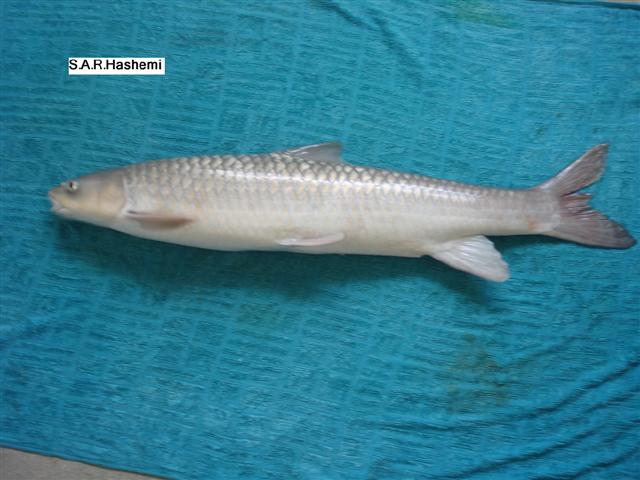 🇮🇷 Iran and 1 moreShabout
A large freshwater carp native to the Tigris-Euphrates basin in Western Asia.Carp · Rivers and lakes
 🇦🇺 Australia and 2 moreCommon carp
A widespread freshwater fish native to Europe and Asia, now farmed globally and often invasive.Carp · Rivers and lakes
More from Cyprinidae
All of them 🇮🇳 India and 4 moreRohu
A large silver carp from South Asian rivers, farmed for food and prized as a game fish.Carp · Rivers and lakes
 🇮🇳 India and 4 moreCommon snowtrout
A cold-water cyprinid from Himalayan rivers.Carp · Rivers and lakes
🇵🇰 Pakistan and 3 moreGolden barb
Small Asian cyprinid found in rivers and aquariumsCarp · Rivers and lakes
 🇲🇾 Malaysia and 1 moreHarlequin rasbora
A small, colourful freshwater fish popular in home aquariums for its distinctive black body marking.Carp · Rivers and lakes