
Black carp
A large freshwater fish native to East Asia, known for eating snails and causing ecological issues in the US.
The black carp is a large freshwater species from East Asia that feeds on mollusks. It was introduced to the United States for aquaculture but became invasive, leading to strict legal controls.
- Grows up to 1.9 metres long and weighs 35 kilograms
- Feeds exclusively on snails, clams, and mussels
- Introduced to the US in the 1970s and 1980s
- Illegal to transport in the US under the Lacey Act
- One of four famous domestic fishes in China
What it is
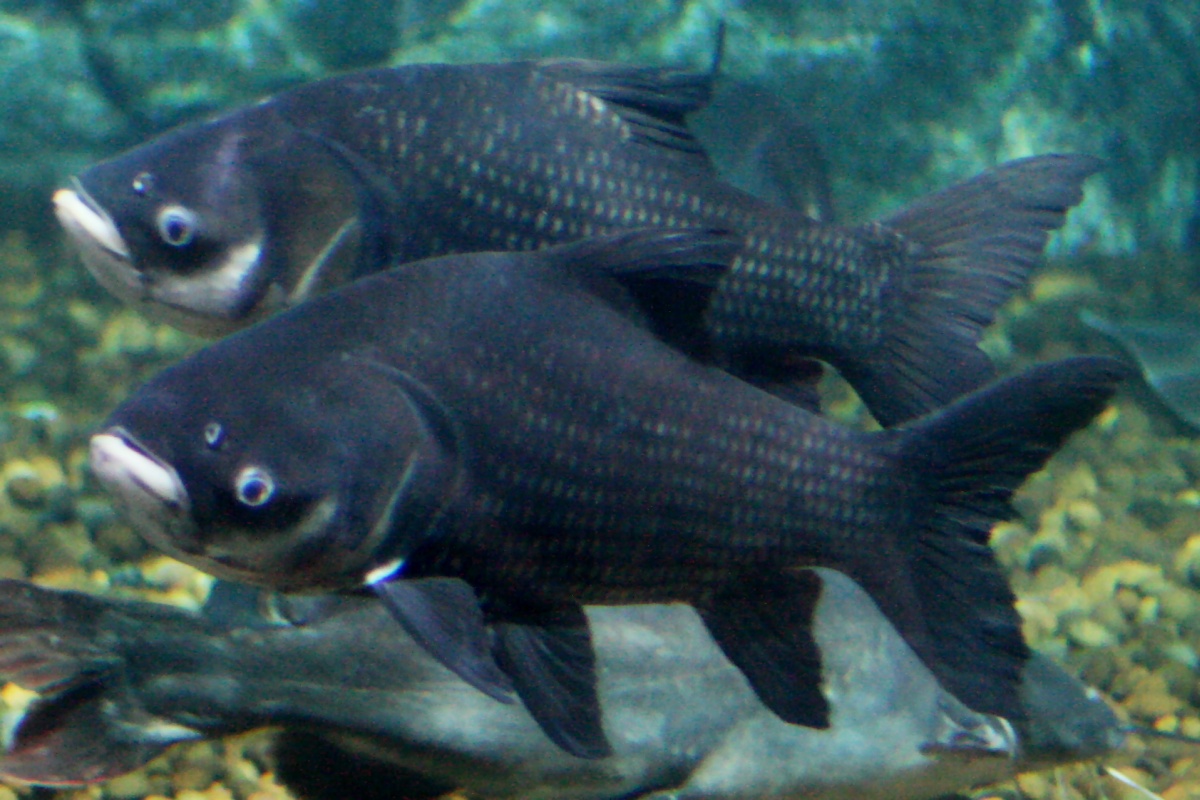
This elongated ray-finned fish has a fusiform body that appears dusky gray, brown, or bluish black with dark fins. The dorsal fin stands high and pointed. Adults reach typical lengths of 60 to 120 centimetres, though specimens can grow to 1.9 metres and weigh 35 kilograms. The head lacks scales, featuring a long distance from the eye to the jaw edges. Large cycloid scales cover the rest of the body, ending in a forked tail fin behind a broad caudal peduncle.
Where it lives
Native habitats span lakes and rivers across East Asia, extending from the Amur Basin through China to Vietnam. In the United States, the species established wild populations after accidental and intentional introductions. These fish spread through the Mississippi and Missouri Rivers following flooding events. Captured individuals have been found in connected systems including the White River in Arkansas, the Atchafalaya and Red Rivers in Louisiana, and the Kaskaskia and Illinois Rivers in Illinois.
How it lives
The black carp acts as a carnivore, primarily consuming invertebrates like snails, clams, and mussels. Anatomical features include enameloid pharyngeal teeth located between the cleithral bones, used to crush hard-shelled prey. A horny patch above these teeth helps position food during crushing. The fish replaces its pharyngeal teeth multiple times throughout its life. This specific diet drives its role in controlling mollusk populations in aquaculture settings.
Breeding and life cycle
However, natural reproduction has been confirmed in the wild. Two diploid fingerlings were captured near Cape Girardeau, Missouri, in 2016, indicating that fertile adults are successfully breeding outside their native range.
Fish and people
In China, this species is one of the culturally important "four famous domestic fishes," cultivated for over a millennium. It is highly esteemed as an expensive food fish and used in traditional Chinese medicine. In the United States, it was intentionally introduced in the 1980s to manage aquatic snail populations in retention ponds. Current efforts encourage locals to catch and eat invasive carp to reduce population numbers.
Status and threats
The species is listed as an injurious organism under the Lacey Act of 1900 in the United States. Transporting live black carp across state lines or into the country is illegal in most cases due to threats posed to native mollusks. Control methods include mechanical barriers, chemical poisoning, and research into pheromone-based management. Many states require aquaculture facilities to breed sterile triploid versions to prevent escape and self-sustaining wild populations.


Questions people ask about Black carp
What does the black carp eat?
It is a carnivore that primarily consumes invertebrates such as snails, clams, and mussels. It uses specialized pharyngeal teeth to crush the hard shells of these prey items.
Why is the black carp considered invasive in the US?
It threatens native mollusk populations, many of which are critically endangered. It spreads through river systems via flooding and has formed wild populations in the Mississippi watershed.
How is the black carp used in aquaculture?
It is used to control yellow grub and aquatic snail populations in retention ponds. Snails host trematode pests that damage crops, so the carp helps protect aquaculture yields.
Is it legal to own black carp in the United States?
Transporting live black carp across state lines or into the US is illegal under the Lacey Act. Most states prohibit intentional release, even for sterile triploid fish bred for aquaculture.
Good reading and sources
The facts on this page come from the Wikipedia article "Black carp", written by its contributors and used under the CC BY-SA 4.0 licence, and from its Wikidata record (CC0). EveryFish rewrote the text in its own words, with AI assistance, and compares every page with the article to make sure no passage is copied. It may be reused under the same CC BY-SA 4.0 licence with a link back.
It may contain mistakes, and figures change over time. Nothing here is investment or buying advice. If something is wrong, tell us. Last refreshed 2026-11-15.
Like Black carp
All carps and minnows 🇮🇳 India and 4 moreRohu
A large silver carp from South Asian rivers, farmed for food and prized as a game fish.Carp · Rivers and lakes
 🇺🇸 United States and 1 moreGolden shiner
A North American minnow used widely as bait and in pond culture.Carp · Rivers and lakes
 🇰🇭 Cambodia and 2 moreGiant barb
The largest cyprinid fish, native to major river basins in Southeast Asia.Carp · Rivers and lakes
 🇹🇭 Thailand and 2 moreEmpurau
A large Southeast Asian river fish prized for its high market value.Carp · Rivers and lakes

