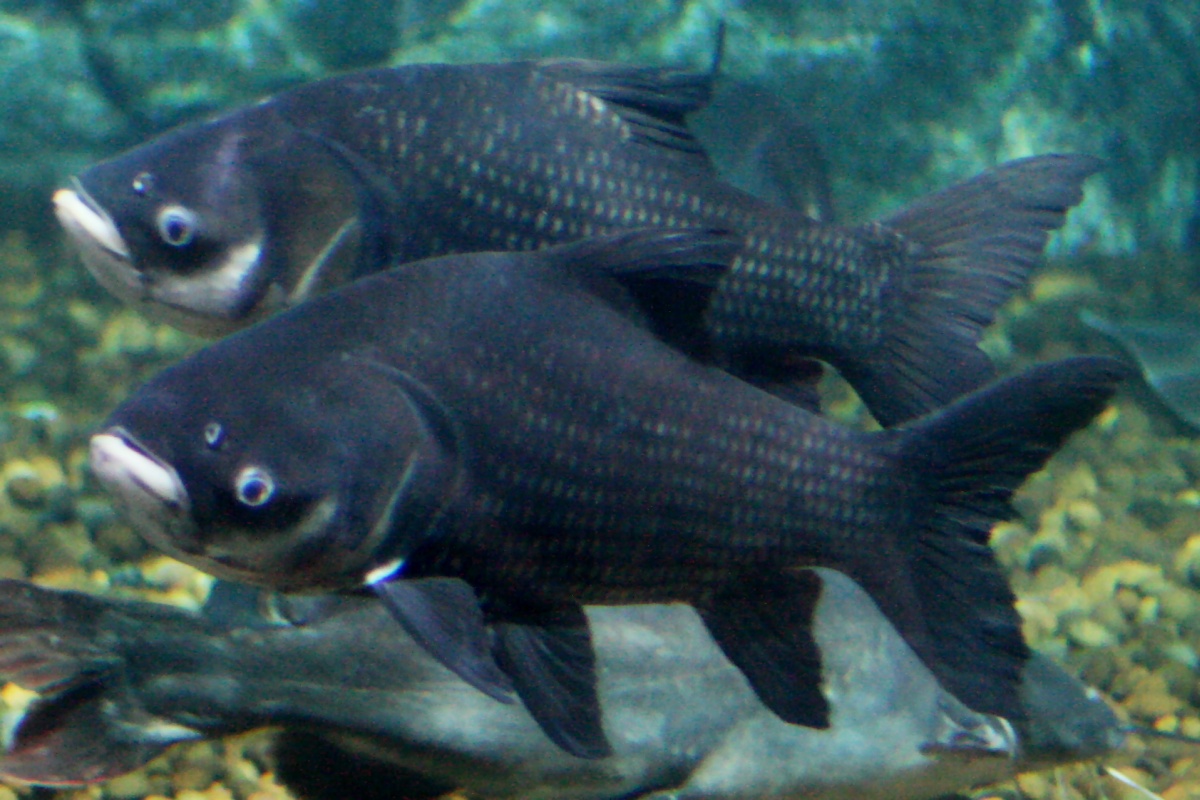
Giant barb
The largest cyprinid fish, native to major river basins in Southeast Asia.
The giant barb is a massive freshwater fish found only in Indochina. It is critically endangered due to habitat loss and overfishing, though farming efforts continue in Vietnam.
- Largest cyprinid fish, reaching 3 m and 300 kg.
- Critically endangered due to overfishing and dams.
- Tetraploid with four sets of chromosomes.
- National fish of Cambodia since 2005.
- Farmed extensively in Vietnam for food.
What it is
The giant barb is the largest known member of the carp family. It has a large head without barbels and grows slowly. Adults can reach three metres long and weigh up to three hundred kilograms, though modern catches are smaller. The species is tetraploid, possessing four sets of chromosomes. It is a slow-moving fish that typically lives in pairs within large river systems.
Where it lives
This fish is restricted to Indochina, specifically the Mae Klong, Mekong, and Chao Phraya River basins. It inhabits large pools along river edges, entering smaller canals and flooded forests seasonally. Young fish prefer smaller tributaries and swamps but can adapt to ponds. The species has been completely removed from the Chao Phraya River.
How it lives
Giant barbs migrate to different areas for feeding and breeding throughout the year. They feed primarily on algae, phytoplankton, and plant fruits, rarely consuming active animals. They are slow swimmers that form pairs. In the lower Mekong, young fish appear mainly in October.
Breeding and life cycle
The species migrates to favorable areas for spawning. Domesticated reproduction was first achieved in Vietnam in 2005. Subsequent releases of tens of thousands of juveniles into rivers showed low survival rates to adulthood. Breeding centers in Vietnam now produce millions of breeders annually for aquaculture purposes.
Fish and people
The giant barb is an important food source and holds cultural significance. Cambodia designated it as its national fish in 2005 to raise conservation awareness. In Vietnam, farming is common due to high economic value. Fish grow rapidly in floating cages or ponds, often harvested after three years at six to ten kilograms, or kept longer for larger sizes.
Status and threats
The population has declined drastically due to overfishing and habitat destruction from dams and pollution. Catch data from Cambodia shows a drop from two hundred tonnes in 1964 to just ten fish by 2000. Few individuals survive to maturity. The IUCN lists the species as Critically Endangered.
Questions people ask about Giant barb
How big does a giant barb get?
They can reach three metres in length and weigh up to three hundred kilograms. Modern records show smaller sizes, with a recent catch weighing one hundred five kilograms.
Where is the giant barb found?
It lives only in the Mae Klong, Mekong, and Chao Phraya River basins in Indochina. It prefers large river pools, canals, and flooded forests during seasonal migrations.
What do giant barbs eat?
They subsist on algae, phytoplankton, and the fruits of inundated terrestrial plants. They rarely, if ever, feed on active animals.
Is the giant barb farmed?
Yes, farming is common in Vietnam. Breeding centers release millions of breeders annually. Fish grow quickly in cages or ponds and are harvested after three years or more.
Good reading and sources
The facts on this page come from the Wikipedia article "Giant barb", written by its contributors and used under the CC BY-SA 4.0 licence, and from its Wikidata record (CC0). EveryFish rewrote the text in its own words, with AI assistance, and compares every page with the article to make sure no passage is copied. It may be reused under the same CC BY-SA 4.0 licence with a link back.
It may contain mistakes, and figures change over time. Nothing here is investment or buying advice. If something is wrong, tell us. Last refreshed 2026-11-15.
Like Giant barb
All carps and minnows 🇮🇳 India and 4 moreRohu
A large silver carp from South Asian rivers, farmed for food and prized as a game fish.Carp · Rivers and lakes
 🇹🇭 Thailand and 2 moreEmpurau
A large Southeast Asian river fish prized for its high market value.Carp · Rivers and lakes
 🇮🇷 Iran and 1 moreShabout
A large freshwater carp native to the Tigris-Euphrates basin in Western Asia.Carp · Rivers and lakes
 🇹🇭 Thailand and 4 moreJullien's golden carp
Endangered Southeast Asian river fish with five stripesCarp · Rivers and lakes
More from Cyprinidae
All of them 🇲🇾 Malaysia and 1 moreHarlequin rasbora
A small, colourful freshwater fish popular in home aquariums for its distinctive black body marking.Carp · Rivers and lakes
 WorldLabeobarbus
A genus of mid-sized ray-finned fish widely distributed in eastern and southern Africa.Carp · Rivers and lakes
 🇹🇭 Thailand and 2 moreSiamese mud carp
Freshwater cyprinid native to Mekong and Chao Phraya riversCarp · Rivers and lakes
 🇯🇵 JapanNigorobuna
Wild carp from Lake Biwa used for fermented sushi.Carp · Rivers and lakes