
Guppy
Small tropical livebearer known for bright male colours and rapid reproduction.
The guppy is a small freshwater fish native to South America. It has become one of the most popular aquarium species worldwide due to its hardiness and vivid appearance.
- Males display bright colours influenced by thyroid hormones.
- Introduced globally for mosquito larva control.
- Females give birth to fully developed young.
- Used extensively as a model organism in science.
- Shoaling behaviour reduces individual predation risk.
What it is
The guppy is a small tropical fish belonging to the livebearer family. Males are notably smaller than females and display ornamental dorsal and caudal fins with splashes of colour. Wild females typically appear grey, while males exhibit spots or stripes influenced by thyroid hormones. Domestic strains often feature larger bodies and more elaborate fin shapes than their wild counterparts. These fish thrive in various ecological conditions and are highly adaptable to different environments.
Where it lives
Originally found in Venezuela, Trinidad and Tobago, Guyana, Brazil, Barbados, and Antigua and Barbuda, guppies now inhabit nearly every continent except Antarctica. They were frequently introduced to new regions for mosquito control, as they consume insect larvae. While native to coastal freshwater streams in South America, they also tolerate brackish water and have colonised many accessible freshwater bodies worldwide, including some full saltwater areas.
How it lives
Wild guppies feed on algae, diatoms, insect larvae, and detritus, often switching diets based on local food abundance. They forage in groups to reduce time spent on anti-predator behaviour, though this increases competition for food. In high-predation areas, shoaling is more common to enhance survival. Guppies face threats from larger fish and birds, leading to evolutionary changes in male colouration and female mate preference depending on predation pressure.
Breeding and life cycle
Guppies are livebearers that reproduce rapidly, with two generations per year in the wild. Females give birth to fully developed young capable of independent existence. Maturity occurs quickly, with males maturing in seven weeks and females in ten to twenty weeks. Females can mate with multiple males, storing sperm to produce offspring over several months. Brood size varies based on environmental factors like predation levels and resource availability.
Fish and people
Guppies are among the most popular freshwater aquarium fish globally due to their ease of care and vibrant colours. Selective breeding has created numerous fancy strains with unique patterns and fin types. Historically, they were introduced to various countries to control mosquito populations and reduce malaria spread. Today, they serve as important model organisms in research fields such as ecology, evolution, and behavioural studies.
Status and threats
As an introduced species in many regions, guppies can negatively impact native fish populations by competing for resources. However, their native status in South America remains stable. Their adaptability allows them to thrive in diverse habitats, making them resilient to environmental changes. Conservation efforts focus primarily on managing their introduction effects rather than protecting the species itself, which faces no significant global threats.


Questions people ask about Guppy
What do guppies eat in the wild?
Wild guppies primarily consume algal remains, diatoms, aquatic insect larvae, zooplankton, and detritus. Their diet shifts based on local food availability, sometimes including invertebrates or even native fish eggs when other sources are scarce.
How big do guppies get?
Male guppies are typically 1.5 to 4 centimetres long, while females are larger, ranging from 3 to 7 centimetres. Domestic breeds may be slightly larger due to selective breeding for specific traits.
Why are guppies used in research?
They serve as model organisms in ecology, evolution, and behavioural studies. Their rapid reproduction, adaptability, and observable behaviours like predator inspection make them ideal for scientific experiments.
Do guppies help control mosquitoes?
Yes, guppies are often introduced to new areas specifically to eat mosquito larvae. This practice aims to reduce the spread of diseases like malaria, though it can sometimes harm native fish populations.
How do guppies avoid predators?
Guppies school together to confuse predators and use predator inspection tactics to assess danger. Males may darken their irises to divert attacks toward their head, allowing them to pivot away quickly.
Good reading and sources
The facts on this page come from the Wikipedia article "Guppy", written by its contributors and used under the CC BY-SA 4.0 licence, and from its Wikidata record (CC0). EveryFish rewrote the text in its own words, with AI assistance, and compares every page with the article to make sure no passage is copied. It may be reused under the same CC BY-SA 4.0 licence with a link back.
It may contain mistakes, and figures change over time. Nothing here is investment or buying advice. If something is wrong, tell us. Last refreshed 2026-11-15.
Like Guppy
All killifish and livebearers 🇺🇸 United States and 1 moreSailfin molly
Small livebearing fish with a large dorsal fin in males.Livebearer · Rivers and lakes · 1821
 🇧🇷 Brazil and 1 moreLargescale four-eyes
Surface-dwelling fish with split eyes for dual vision.Livebearer · Rivers and lakes · 1758
 🇺🇸 United StatesLeast killifish
A tiny North American fish that gives birth to live young and measures just two centimetres long.Livebearer · Rivers and lakes
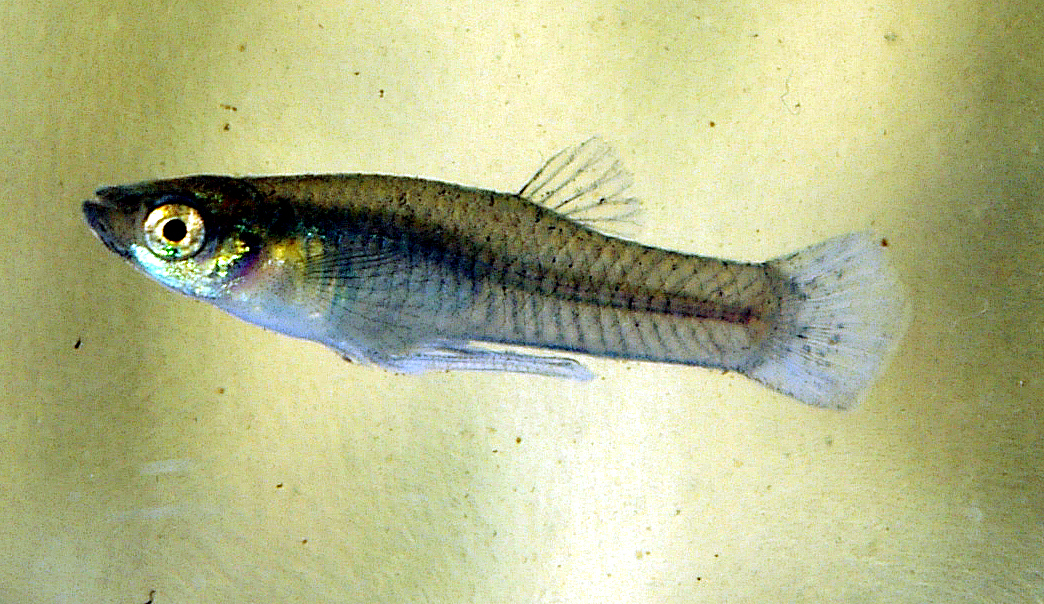 🇺🇸 United States and 4 moreMosquitofish
Small North American fish introduced globally for mosquito control.Livebearer · Rivers and lakes
More from Poeciliidae
All of them 🇺🇸 United StatesEastern mosquitofish
A small livebearing fish native to the eastern US, now invasive in many regions.Livebearer · Rivers and lakes · 1859
 🇲🇽 Mexico and 1 moreGreen swordtail
A hardy live-bearing fish popular in home aquariums.Livebearer · Rivers and lakes · 1848
 🇻🇪 VenezuelaEndler's livebearer
A small, colourful freshwater fish from Venezuela known for its bright patterns and ease of breeding in home aquariums.Livebearer · Rivers and lakes · 2005
 🇲🇽 MexicoVariable platyfish
Small livebearing fish from Mexico popular in home aquariumsLivebearer · Rivers and lakes