
Least killifish
A tiny North American fish that gives birth to live young and measures just two centimetres long.
The least killifish is one of the smallest vertebrates on Earth, reaching only three centimetres in length. It lives in slow-moving waters across the southeastern United States and belongs to the same family as guppies.
- Males reach only 2 cm in length.
- Females grow slightly larger at 3 cm.
- Endemic to the southeastern United States.
- Releases up to 40 fry over several weeks.
- One of the smallest known vertebrates.
What it is
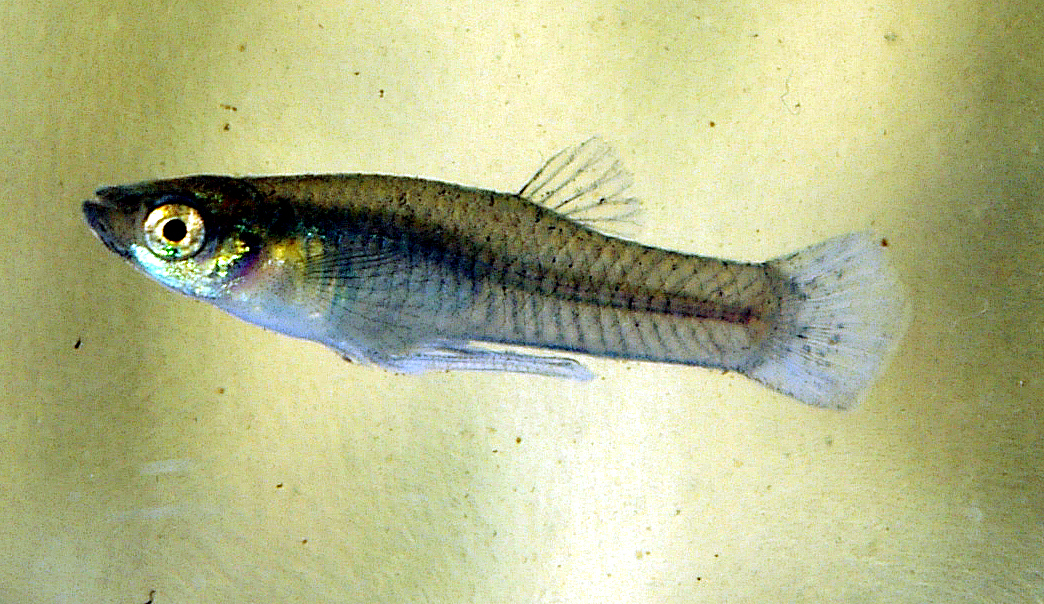
The least killifish is a very small fish found in North America. Males grow to about two centimetres, while females reach three centimetres. The body is olive with a dark stripe down the side. Males have a modified anal fin called a gonopodium used for mating. Females show a dark spot on their anal fin, and males display one on their dorsal fin. This species is among the smallest known vertebrates.
Where it lives
This fish lives in the southeastern United States. Its range extends from North Carolina south to Georgia and Florida. It also appears along the Gulf Coast to Louisiana. Recent collections include eastern Texas near the Sabine River basin. Some populations were found in sand pit ponds after Hurricane Harvey floods. It is an endemic species native to this region.
How it lives
These fish inhabit slow-moving or standing water full of plants. They also tolerate brackish conditions. Their diet consists of aquatic invertebrates like worms and crustaceans. They consume plant matter as well. Predators are not detailed in the provided text.
Breeding and life cycle
The least killifish is a livebearer. Males use a gonopodium to transfer sperm to females. Eggs develop inside the female until hatching. Unlike many relatives, females release young gradually. Up to forty fry may be born over ten to fourteen days. Occasionally, this process takes longer. Inbreeding reduces reproductive success and viability.
Fish and people
The least killifish is kept in aquaria but is less common than guppies. It serves as a subject for scientific research. Studies examine how inbreeding affects reproduction and growth. It holds cultural significance as an endemic North American fish.
Status and threats
The conservation status is listed as least concern. The population remains stable within its native range. Protection measures are not detailed in the provided material.
Questions people ask about Least killifish
Is the least killifish a true killifish?
No, despite its common name, it belongs to the family Poeciliidae. This is the same group that contains guppies and mollies. True killifishes belong to entirely different biological families.
How big does the least killifish get?
Males grow to approximately two centimetres. Females are slightly larger, reaching about three centimetres. This makes them one of the smallest vertebrates known to science.
Where can you find this fish in the wild?
It is endemic to the southeastern United States. Its range spans from North Carolina to Florida and west to Louisiana. Recent sightings also occur in eastern Texas.
What does the least killifish eat?
They primarily consume aquatic invertebrates such as worms and crustaceans. They also feed on plant matter found in their vegetated habitats.
Good reading and sources
- Heterandria formosa on WikipediaEncyclopedia
- More photos on Wikimedia CommonsPhotos
- Wikidata recordOpen data
The facts on this page come from the Wikipedia article "Heterandria formosa", written by its contributors and used under the CC BY-SA 4.0 licence, and from its Wikidata record (CC0). EveryFish rewrote the text in its own words, with AI assistance, and compares every page with the article to make sure no passage is copied. It may be reused under the same CC BY-SA 4.0 licence with a link back.
It may contain mistakes, and figures change over time. Nothing here is investment or buying advice. If something is wrong, tell us. Last refreshed 2026-11-15.
Like Least killifish
All killifish and livebearers 🇧🇷 Brazil and 1 moreLargescale four-eyes
Surface-dwelling fish with split eyes for dual vision.Livebearer · Rivers and lakes · 1758
 🇺🇸 United States and 4 moreMosquitofish
Small North American fish introduced globally for mosquito control.Livebearer · Rivers and lakes
 🇲🇽 Mexico and 3 moreXiphophorus
A genus of small livebearing fish native to Mexico and Central America, known for aquarium use and genetic research.Livebearer · Rivers and lakes
 WorldKillifish
Small egg-laying fish known for hardiness and short lifespansLivebearer · Rivers and lakes
