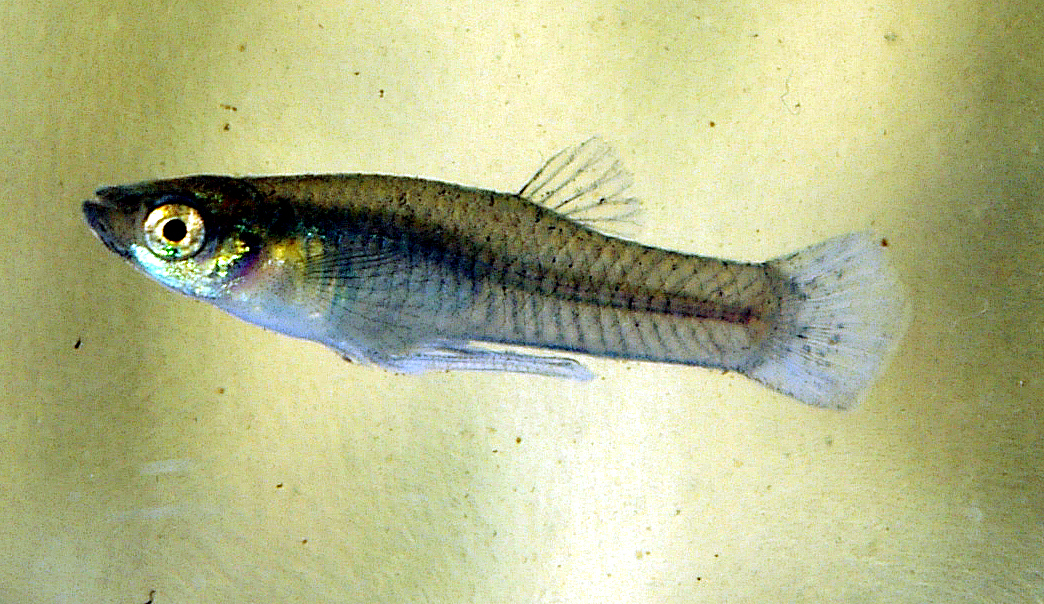
Mosquitofish
Small North American fish introduced globally for mosquito control.
The western mosquitofish is a tiny freshwater fish native to the Mississippi basin. It was spread worldwide to eat larvae, but often harms local ecosystems by outcompeting native species.
- Females reach 7 cm while males max out at 4 cm.
- Introduced globally to eat mosquito larvae.
- Classified as a noxious pest in Australia.
- Banned from import and release in the European Union.
- Can survive temperatures up to 42 degrees Celsius briefly.
What it is
The western mosquitofish is a small freshwater fish with dull grey colouring and a large abdomen. Females grow up to 7 cm while males stay under 4 cm. They have rounded dorsal fins and an upturned mouth. A gravid spot marks the female's rear. Males use a modified anal fin called a gonopodium to transfer sperm. This structure differs slightly between western and eastern species. Other similar fish include guppies and swordtails, which are often confused with them.
Where it lives
Native waters stretch from southern Illinois and Indiana down the Mississippi River to northern Mexico. They thrive in shallow areas shielded from bigger predators like bass and catfish. Their adaptability allows survival in low oxygen, high salt, and hot conditions. This resilience helped them become widespread globally through human introduction for pest control.
How it lives
These fish eat zooplankton, beetles, mayflies, and detritus. Mosquito larvae form only part of their diet. They can consume huge amounts relative to their size. Growth peaks in warm water between 24 and 30 degrees Celsius. Temperatures above 35 degrees or below 10 degrees stop growth or kill them. They sometimes eat their own young when resources are scarce.
Breeding and life cycle
Males use a tube-like fin to fertilize females internally. Eggs develop inside the ovary without a uterus. Gestation lasts 16 to 28 days. Young hatch fully formed with a yolk sac attached. Brood sizes vary by female size but often exceed 60 offspring. Sexual maturity arrives quickly, within weeks depending on temperature and season.
Fish and people
Humans introduced this fish globally to reduce mosquito numbers. Programs in California and Nevada distribute them freely for private ponds. India used them in Chennai ponds to fight disease vectors. Historically, they aided malaria reduction efforts in South America and Russia. However, they are now banned in the European Union due to ecological damage.
Status and threats
Outside their native range, they act as invasive pests. In Australia, they threaten native frogs and fish while failing to control mosquitoes effectively. Scientists label them highly problematic animals. Climate change models suggest further expansion into tropical Asian regions. Conservation efforts focus on preventing release into natural habitats.


Questions people ask about Mosquitofish
Does the mosquitofish actually control mosquitoes?
They eat larvae but also consume other insects. In some places like Australia, they fail to reduce mosquito numbers while harming native wildlife. Their effectiveness varies greatly by region.
How do you tell male and female mosquitofish apart?
Females are larger and have a dark gravid spot near the tail. Males have a pointed anal fin called a gonopodium used for mating. Females have rounded anal fins like their dorsal fins.
Are they dangerous to humans?
No, they pose no direct threat to people. They are small fish that do not bite or sting humans. Their danger lies in disrupting local ecosystems by outcompeting native species.
Why are they considered invasive?
They were introduced worldwide for pest control but often harmed local ecology. They compete with native fish for food and space. In places like Australia, they are listed as serious environmental pests.
Good reading and sources
The facts on this page come from the Wikipedia article "Mosquitofish", written by its contributors and used under the CC BY-SA 4.0 licence, and from its Wikidata record (CC0). EveryFish rewrote the text in its own words, with AI assistance, and compares every page with the article to make sure no passage is copied. It may be reused under the same CC BY-SA 4.0 licence with a link back.
It may contain mistakes, and figures change over time. Nothing here is investment or buying advice. If something is wrong, tell us. Last refreshed 2026-11-15.
Like Mosquitofish
All killifish and livebearers 🇺🇸 United StatesLeast killifish
A tiny North American fish that gives birth to live young and measures just two centimetres long.Livebearer · Rivers and lakes
 🇧🇷 Brazil and 1 moreLargescale four-eyes
Surface-dwelling fish with split eyes for dual vision.Livebearer · Rivers and lakes · 1758
 🇺🇸 United States and 2 morePupfish
Small killifish known for surviving in extreme isolated waters.Livebearer · Rivers and lakes
 🇲🇽 Mexico and 3 moreXiphophorus
A genus of small livebearing fish native to Mexico and Central America, known for aquarium use and genetic research.Livebearer · Rivers and lakes
