
Eastern mosquitofish
A small livebearing fish native to the eastern US, now invasive in many regions.
The eastern mosquitofish is a freshwater species from the Poeciliidae family. It was described by Charles Frédéric Girard in 1859 and is known for its aggressive nature and ability to survive in poor water conditions.
- Females reach 6.4 cm while males stay around 3.8 cm.
- Introduced globally for mosquito control with mixed results.
- Listed as invasive in the European Union since recent regulations.
- Can survive in water temperatures up to 35 degrees Celsius.
- Aggressive males reduce female foraging efficiency by over half.
What it is
This small freshwater fish belongs to the livebearing family Poeciliidae. Males typically grow to about 3.8 centimetres, while females reach roughly 6.4 centimetres. The body is light-coloured with semitransparent fins. Females often show a dark stripe near the eye and light spots on their dorsal and tail fins. A darker patch on the belly indicates pregnancy. The species can sometimes display black spots resembling a dalmatian pattern. Its rounded female shape and size make it easy to confuse with guppies.
Where it lives
The species originates from the eastern and southern United States, ranging from Florida to New Jersey and inland to Alabama and Tennessee. It has been introduced to many parts of the world, including Australia and Europe, where it has become invasive. In these new areas, it occupies shallow ponds, lakes, and slow-moving sloughs rich in rooted plants. It tolerates high temperatures between 31 and 35 degrees Celsius and survives in water conditions that kill other fish.
How it lives
These fish are planktivores that eat algae, detritus, and zooplankton. They adapt their diet based on competition and maturity, switching to invertebrates and larvae when necessary. Males and juveniles often specialise on single prey types, while females consume a variety evenly. The species is highly aggressive, particularly males towards females, which reduces female feeding efficiency. Females form groups to avoid harassment. They also prey on the larvae of frogs and other fish, causing ecological disruption in invaded areas.
Breeding and life cycle
The eastern mosquitofish gives birth to live young rather than laying eggs. Breeding occurs from mid-spring to mid-autumn, peaking in summer. Gestation lasts 22 to 25 days, and females can produce up to nine broods annually. Brood sizes range from five to 100 offspring, influenced by temperature and nutrition. Higher temperatures increase reproduction rates. Juveniles mature quickly, allowing multiple generations per season. Predation stress can lead to higher numbers of stillborn offspring.
Fish and people
The fish was originally introduced to control mosquitoes, such as in New South Wales during the 1920s. However, it proved less effective than native species and caused significant harm to local wildlife. It harasses other fish by nipping fins and threatens native aquatic invertebrates and amphibians. In Australia, it contributed to the extinction of some rainbowfish populations. Conservation efforts have included chemical treatments and electrocution, though these methods faced challenges due to the fish's resilience and habitat preferences.
Status and threats
The species is classified as least concern in its native range due to its high adaptability. However, it is listed as an invasive alien species of Union concern in the European Union, prohibiting its trade or release. In Australia, it poses a serious threat to native fauna, including the endangered dwarf galaxias. Management plans aim to protect local ecosystems from its aggressive predation and competition. Climate change models suggest further expansion into tropical regions and Europe.


Questions people ask about Eastern mosquitofish
How can I tell an eastern mosquitofish apart from a western mosquitofish?
You can distinguish them by examining the male's gonopodium. The eastern species has a hooked third ray, whereas the western species does not. Additionally, eastern individuals usually possess one or two extra dorsal fin rays compared to their western counterparts.
Why is this fish considered dangerous to native ecosystems?
It acts as an invasive predator that eats the larvae of native frogs and fish. It also aggressively nips the fins of other species, reducing their survival chances. This behaviour has led to the decline or extinction of certain native Australian fish populations like rainbowfish.
What kind of environment does this fish prefer?
It thrives in shallow, slow-moving or standing freshwater bodies like ponds and lakes. It prefers clear water with rooted plants for shelter and can tolerate high temperatures and chemical levels that would kill other fish species.
How fast do eastern mosquitofish reproduce?
They reproduce rapidly, giving birth to live young every 22 to 25 days. Females can produce up to nine broods per season, with each containing five to 100 offspring. High temperatures accelerate this process, allowing several generations to develop within a single breeding period.
Good reading and sources
- Eastern mosquitofish on WikipediaEncyclopedia
- More photos on Wikimedia CommonsPhotos
- Wikidata recordOpen data
The facts on this page come from the Wikipedia article "Eastern mosquitofish", written by its contributors and used under the CC BY-SA 4.0 licence, and from its Wikidata record (CC0). EveryFish rewrote the text in its own words, with AI assistance, and compares every page with the article to make sure no passage is copied. It may be reused under the same CC BY-SA 4.0 licence with a link back.
It may contain mistakes, and figures change over time. Nothing here is investment or buying advice. If something is wrong, tell us. Last refreshed 2026-11-15.
Like Eastern mosquitofish
All killifish and livebearers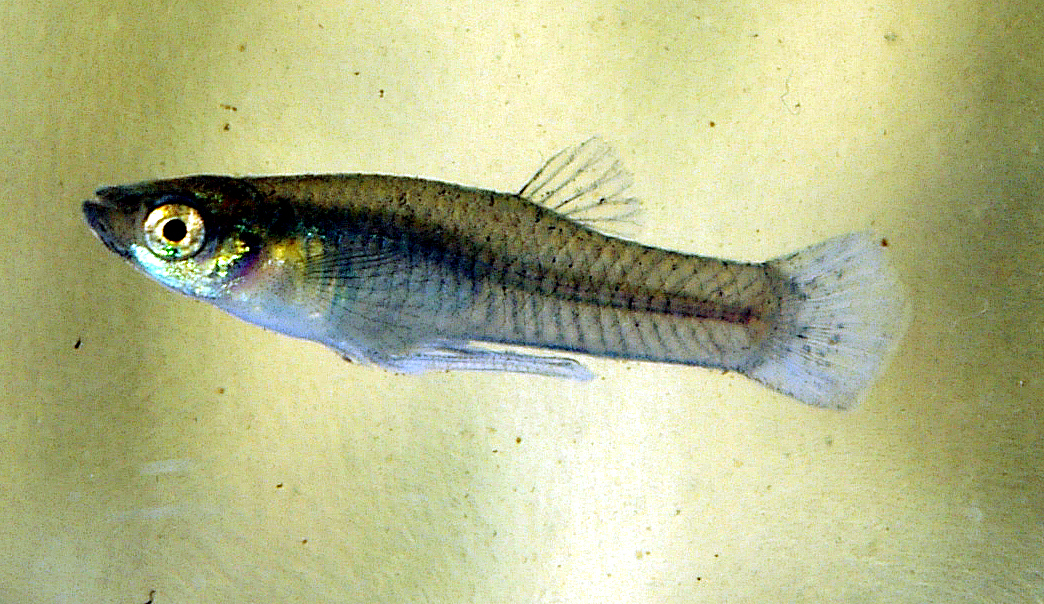 🇺🇸 United States and 4 moreMosquitofish
Small North American fish introduced globally for mosquito control.Livebearer · Rivers and lakes
 🇧🇷 Brazil and 1 moreLargescale four-eyes
Surface-dwelling fish with split eyes for dual vision.Livebearer · Rivers and lakes · 1758
 🇺🇸 United StatesLeast killifish
A tiny North American fish that gives birth to live young and measures just two centimetres long.Livebearer · Rivers and lakes
 🇳🇬 Nigeria and 1 moreBlue lyretail
A colourful West African killifish kept in home aquariums.Livebearer · Rivers and lakes · 1911
