
Sailfin molly
Small livebearing fish with a large dorsal fin in males.
The sailfin molly is a small livebearer native to coastal waters of the southeastern United States and Mexico. It thrives in brackish estuaries and freshwater marshes, tolerating high salinity. Males display a prominent dorsal fin used in mating. The species is popular in aquariums and helps control mosquito larvae in the wild.
- Males have a large dorsal fin with fewer than 15 rays.
- Tolerates salinity levels as high as 87 ppt.
- Feeds on mosquito larvae helping control pests.
- Females give birth to live young after 3–4 weeks.
- Listed as Least Concern by the IUCN.
What it is
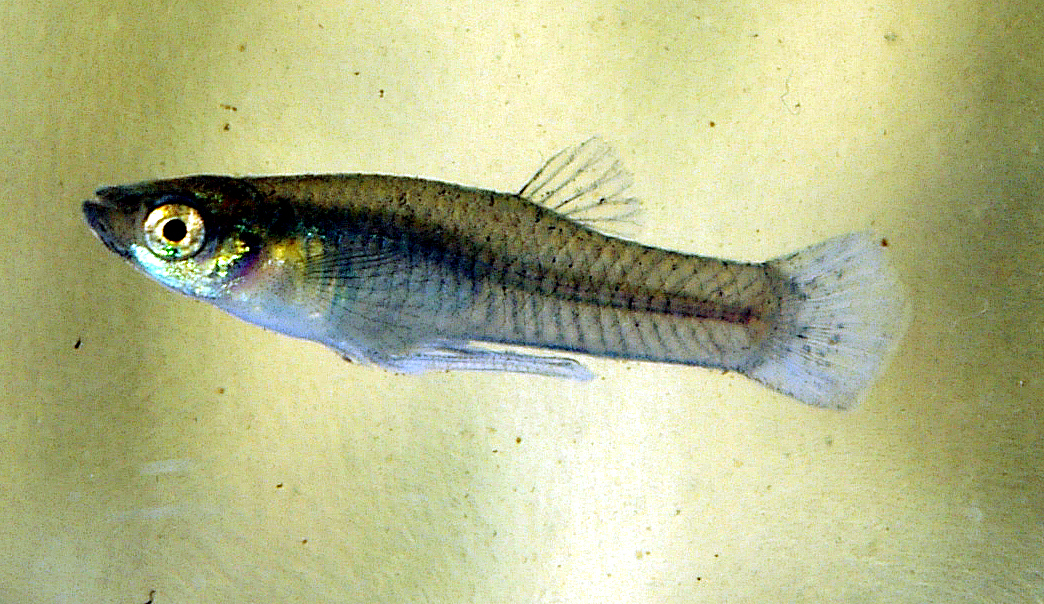
This small fish has an oblong body and a flattened head with an upturned mouth. Mature males possess a greatly enlarged dorsal fin that gives the species its name. This fin forms a trapezoid shape when spread and serves as a key feature for female mate choice. Females are larger but plainer in colour. The body is usually light grey with rows of spots that may merge into stripes. Breeding males can appear greenish-blue. The caudal fin is large and rounded, sometimes with black tips.
Where it lives
Native populations inhabit the East Coast of the United States from North Carolina to Florida. They extend around the Gulf of Mexico to Texas and south to the Yucatán Peninsula in Mexico. These fish prefer coastal marshes, river deltas, lagoons, and mangrove swamps. They tolerate saline environments and are often found near ocean inflows. Introduced populations exist in New Zealand, Hawaii, western United States, Iraq, and Canada. In California, they threaten the endangered desert pupfish.
How it lives
Sailfin mollies occupy the lower food chain and serve as prey for birds, reptiles, amphibians, and larger fish. Predators include largemouth bass, American alligators, bullfrogs, and raccoons. They feed primarily on algae and plant matter but also consume aquatic invertebrates and mosquito larvae. The species can survive in oxygen-depleted water by breathing at the surface. They form aggregations under floating vegetation to avoid detection. Parasites such as trematodes and protozoans affecting other fish also infect them.
Breeding and life cycle
Reproduction involves internal fertilization via a modified anal fin called a gonopodium in males. Females give birth to live young rather than laying eggs. Brood sizes range from 10 to 140 fry depending on the mother’s size. Gestation lasts three to four weeks. Females can store sperm and produce multiple broods annually. Adult populations skew female because males die younger due to predation and disease linked to their bright colours and active breeding behaviour. No parental care occurs.
Fish and people
Aquarists value this species for its hardiness and varied colour forms, including albino and melanistic types. It is commonly sold simply as a molly. Hybridization with the black molly produces popular tank varieties with yellow-rimmed fins. Wild populations help control mosquito numbers by eating larvae. They are occasionally bred as feeder fish for larger carnivores. The species was introduced to Banff Hot Springs in Canada in the 1920s. Its tolerance for different water conditions makes it easy to keep.
Status and threats
The International Union for Conservation of Nature lists the sailfin molly as Least Concern. It remains common throughout its native range in the southeastern United States and Mexico. However, introduced populations pose risks to local ecosystems. In California, they compete with the federally protected desert pupfish. In Iraq, they threaten endemic killifish species in the Tigris and Euphrates deltas. Their ability to thrive in varied saline conditions aids their spread as an invasive species.


Questions people ask about Sailfin molly
What water conditions do sailfin mollies need?
They thrive in both freshwater and brackish environments. They are euryhaline, meaning they tolerate a wide range of salinities up to 87 ppt. They are often found in coastal estuaries and mangrove swamps where fresh and salt water mix.
How can you tell male and female sailfin mollies apart?
Males have a significantly enlarged dorsal fin that forms a trapezoid shape. They are smaller than females and often display brighter colours like greenish-blue. Females are larger, plainer in appearance, and lack the prominent dorsal sail.
Do sailfin mollies lay eggs?
No, they are livebearers. Fertilization is internal, and females give birth to free-swimming young. A single brood can contain between 10 and 140 fry. The gestation period typically lasts three to four weeks depending on temperature.
Are sailfin mollies invasive outside their native range?
Yes, established populations exist in New Zealand, Hawaii, Iraq, and parts of the western United States. In California, they threaten the endangered desert pupfish. In Iraq, they outcompete native killifish species in river deltas.
Good reading and sources
- Sailfin molly on WikipediaEncyclopedia
- More photos on Wikimedia CommonsPhotos
- Wikidata recordOpen data
The facts on this page come from the Wikipedia article "Sailfin molly", written by its contributors and used under the CC BY-SA 4.0 licence, and from its Wikidata record (CC0). EveryFish rewrote the text in its own words, with AI assistance, and compares every page with the article to make sure no passage is copied. It may be reused under the same CC BY-SA 4.0 licence with a link back.
It may contain mistakes, and figures change over time. Nothing here is investment or buying advice. If something is wrong, tell us. Last refreshed 2026-11-15.
Like Sailfin molly
All killifish and livebearers 🇧🇷 Brazil and 1 moreLargescale four-eyes
Surface-dwelling fish with split eyes for dual vision.Livebearer · Rivers and lakes · 1758
 🇺🇸 United States and 4 moreMosquitofish
Small North American fish introduced globally for mosquito control.Livebearer · Rivers and lakes
 🇺🇸 United StatesLeast killifish
A tiny North American fish that gives birth to live young and measures just two centimetres long.Livebearer · Rivers and lakes
 🇲🇽 Mexico and 2 moreMexican molly
Small livebearing fish from Mexico and Central America.Livebearer · Rivers and lakes
More from Poeciliidae
All of them 🇲🇽 Mexico and 1 moreGreen swordtail
A hardy live-bearing fish popular in home aquariums.Livebearer · Rivers and lakes · 1848
 🇺🇸 United StatesEastern mosquitofish
A small livebearing fish native to the eastern US, now invasive in many regions.Livebearer · Rivers and lakes · 1859
 🇻🇪 VenezuelaEndler's livebearer
A small, colourful freshwater fish from Venezuela known for its bright patterns and ease of breeding in home aquariums.Livebearer · Rivers and lakes · 2005
 🇲🇽 Mexico and 3 moreXiphophorus
A genus of small livebearing fish native to Mexico and Central America, known for aquarium use and genetic research.Livebearer · Rivers and lakes