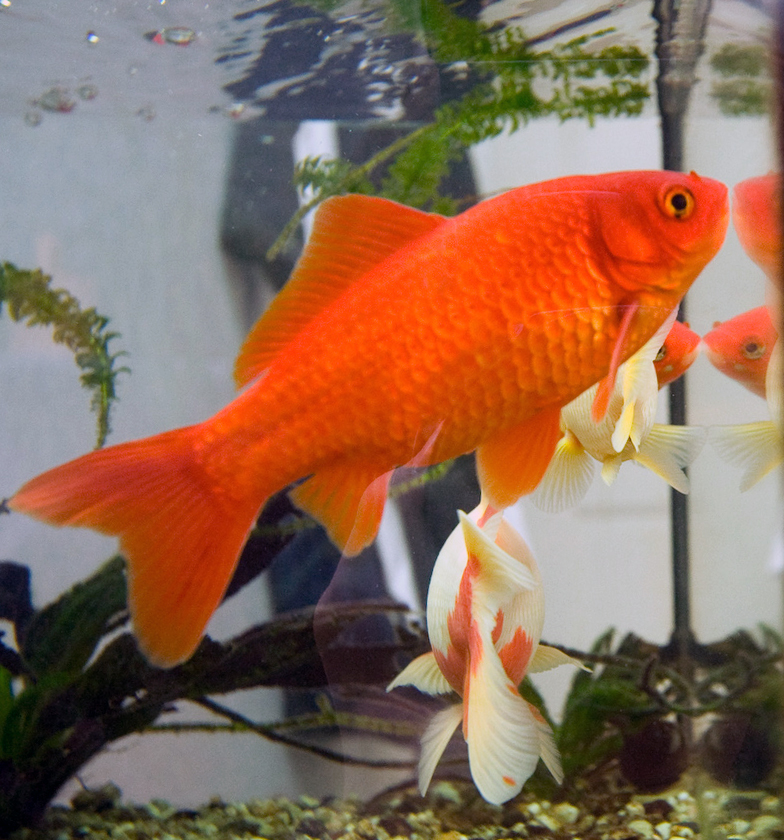
Goldfish
A domesticated freshwater carp from China, kept worldwide as a pet and aquarium fish.
Native to East Asia, this small carp was selectively bred for colour in imperial ponds over a millennium ago. It is now one of the most popular aquarium species globally, with hundreds of distinct breeds.
- Selective breeding in imperial China produced hundreds of distinct breeds.
- Goldfish are tetrachromats, seeing four primary colours including ultraviolet.
- Released goldfish become invasive pests in North America and Australia.
- They can survive short periods without oxygen using liver glycogen.
- Record size reached 48 cm length and 4.1 kg weight in captivity.
What it is
The goldfish is a small freshwater member of the carp family, native to China. Wild individuals typically display silver or grey tones, while captive varieties exhibit extensive colour diversity including orange, red, white, and black. They possess a streamlined body shape, though selective breeding has created numerous forms with varied fin structures and eye configurations. The species belongs to the genus Carassius, sharing lineage with the crucian carp and Prussian carp. Genetic analysis confirms they are domesticated descendants of southern Chinese populations rather than subspecies of other carps.
Where it lives
Originally confined to China, the goldfish has been introduced to many regions worldwide. It is now established in parts of North America and Australia, where it often becomes an invasive pest after release. In its native range, it inhabits slow-moving rivers and lakes. The species demonstrates remarkable adaptability, surviving in various freshwater environments and even tolerating brackish conditions with moderate salinity levels.
How it lives
Goldfish are gregarious and exhibit schooling behaviour. They are generalist feeders with diverse strategies for finding food and avoiding predators. Their vision is highly developed, classifying them as tetrachromats capable of seeing red, green, blue, and ultraviolet light. They also possess acute hearing facilitated by specialized ear bones connected to their swim bladder. These fish show strong associative learning and social skills, recognising individual humans and responding to feeding cues.
Breeding and life cycle
Reproduction occurs primarily in pond settings following significant temperature shifts, usually in spring. Males chase females, prompting egg release onto aquatic vegetation or spawning mops. Eggs hatch within three days. Fry grow rapidly to avoid predation but may be eaten by adults. Some fancy breeds cannot breed naturally due to physical alterations and require manual assistance. Young fish appear metallic brown before developing mature colours over time.
Fish and people
Selective breeding began in imperial China over a thousand years ago, initially for colour mutations. Goldfish spread to Japan, Europe, and North America through trade and cultural exchange. They are among the most popular aquarium pets globally, with hundreds of recognised breeds. Historically, they symbolised good luck in Europe, though this tradition faded as availability increased. They are also raised for food in some Asian cultures, continuing a long history of carp cultivation.
Status and threats
The species is classified as least concern due to its widespread domestication and popularity. However, released individuals pose ecological threats in non-native ranges like North America and Australia, where they disrupt local ecosystems. Conservation efforts focus on managing these invasive populations rather than protecting wild stocks, which remain stable in their native habitat.


Questions people ask about Goldfish
What is the scientific name of the goldfish?
The scientific name is Carassius auratus. It belongs to the family Cyprinidae and the order Cypriniformes. Modern genetics confirm it is a domesticated variety native to southern China, distinct from the crucian carp and Prussian carp.
How long do goldfish live?
In captivity, goldfish can live beyond ten years if provided with adequate space and care. Their lifespan depends heavily on tank size, water quality, and diet. Contrary to myths, they do not stay small in tiny bowls but suffer stunted growth and health issues.
Are goldfish intelligent?
Yes, goldfish demonstrate strong associative learning and social skills. They can recognise individual humans, distinguish between shapes and sounds, and learn tricks using positive reinforcement. Their memory span lasts at least three months.
Why are goldfish considered invasive?
When released into the wild in regions like North America and Australia, goldfish thrive and outcompete native species. They alter local ecosystems by disturbing vegetation and preying on smaller organisms, leading to their classification as invasive pests in those areas.
Good reading and sources
- Surrey schoolboy catches 5lb goldfish in Dorset lakeBBC, Article
- Goldfish recovering after 'high-risk' tumour removalBBC, Article
- Goldfish dumped in lakes growing to more than 1ft, threatening ecosystemsThe Guardian, Article
- In the Wild, Goldfish Turn From Pet to Pest (Published 2016)The New York Times, Article
The facts on this page come from the Wikipedia article "Goldfish", written by its contributors and used under the CC BY-SA 4.0 licence, and from its Wikidata record (CC0). EveryFish rewrote the text in its own words, with AI assistance, and compares every page with the article to make sure no passage is copied. It may be reused under the same CC BY-SA 4.0 licence with a link back.
It may contain mistakes, and figures change over time. Nothing here is investment or buying advice. If something is wrong, tell us. Last refreshed 2026-11-15.
Like Goldfish
All carps and minnows 🇨🇳 China and 1 moreBlack carp
A large freshwater fish native to East Asia, known for eating snails and causing ecological issues in the US.Carp · Rivers and lakes
 🇹🇭 Thailand and 4 moreTinfoil barb
A large Southeast Asian freshwater fish known for its red fins and silvery body.Carp · Rivers and lakes · 1853
 🇲🇲 Myanmar and 1 moreCelestial pearl danio
A tiny, brightly coloured freshwater fish from Myanmar and Thailand, popular in the aquarium trade.Carp · Rivers and lakes · 2006
 🇲🇾 Malaysia and 1 moreHarlequin rasbora
A small, colourful freshwater fish popular in home aquariums for its distinctive black body marking.Carp · Rivers and lakes
More from Cyprinidae
All of them 🇹🇭 Thailand and 2 moreSiamese mud carp
Freshwater cyprinid native to Mekong and Chao Phraya riversCarp · Rivers and lakes
 🇮🇳 India and 4 moreRohu
A large silver carp from South Asian rivers, farmed for food and prized as a game fish.Carp · Rivers and lakes
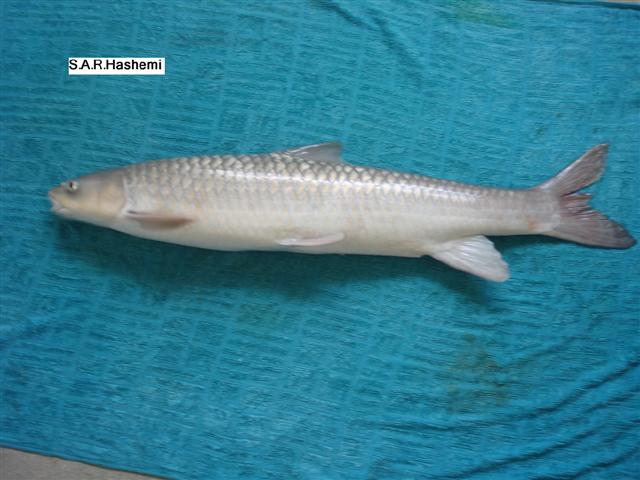 🇮🇷 Iran and 1 moreShabout
A large freshwater carp native to the Tigris-Euphrates basin in Western Asia.Carp · Rivers and lakes
 WorldLabeobarbus
A genus of mid-sized ray-finned fish widely distributed in eastern and southern Africa.Carp · Rivers and lakes