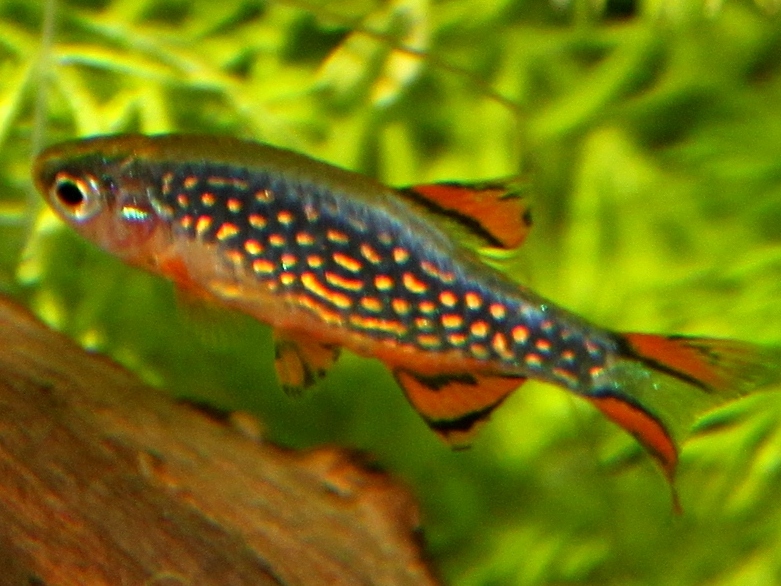
Celestial pearl danio
A tiny, brightly coloured freshwater fish from Myanmar and Thailand, popular in the aquarium trade.
Discovered in 2006, this small ray-finned fish belongs to the family Danionidae and originates from the Salween basin in Myanmar and Northern Thailand. Its striking appearance made it an immediate success in the global aquarium hobby, leading to widespread captive breeding that now protects wild populations.
- Maximum length reaches just three centimetres.
- Found only in the Salween basin near Hopong.
- Males show bright blue colour and red fins.
- Spawns small egg batches in dense vegetation.
- Captive breeding has lowered market prices.
What it is
The celestial pearl danio is a minute freshwater fish with a plump body and blunt snout. It measures roughly two to three centimetres in length. Males display vivid blue-green hues with bright red fins marked by black lines. Females are duller, showing yellowish-white bellies. Both sexes feature pearly white dots across their bodies. The gill covers are transparent, revealing red internal structures. This compact shape suits its life in shallow, vegetated waters.
Where it lives
This species inhabits a limited area in the Salween river basin. It is found near Hopong, east of Inle Lake, at elevations above one thousand metres. Specific locations include the Nam Lang and Nam Pawn rivers. The habitat consists of small ponds fed by groundwater or spring overflow. These pools are shallow and warm quickly during hot periods. Water conditions are slightly alkaline. The environment supports dense growth of water weeds similar to Elodea.
How it lives
Adults hover quietly among plants rather than swimming actively. They do not form large shoals but prefer small groups. Males defend patches of dense vegetation during courtship. A male displays his fins to attract a female, followed by a brief chase. The pair then deposits eggs within the plant matter. Predators include the dwarf snakehead. Locally, people catch these fish for food, drying them as a protein source. They share their ponds with other small species like loaches.
Breeding and life cycle
Females release small batches of approximately thirty eggs into vegetation. There is no single spawning season. Eggs hatch within three to four days at twenty-four degrees Celsius. Newborn larvae are dark and hide between substrate and debris. After three days, they become lighter and begin free swimming. Metamorphosis into adult form occurs around eight to ten weeks. Colour patterns emerge from the twelfth week onwards. Captive breeders use spawning mops or java moss to protect eggs.
Fish and people
The fish entered the aquarium trade shortly after its discovery in 2006. Its small size and bright colours made it highly desirable. Initial wild collection raised concerns about population decline. British magazines advised hobbyists to buy only captive-bred specimens. Myanmar banned exports in early 2007. Subsequent surveys found multiple healthy populations. Commercial and hobbyist breeding now supplies the market. Prices have dropped significantly due to abundant captive stock. The fish remains undemanding in well-planted tanks with neutral to alkaline water.
Status and threats
Early reports suggested severe depletion of wild stocks. These warnings proved unfounded as the species reproduces rapidly. Ponds thought to be empty often restock within months through natural reproduction. The fish adapts well to ephemeral habitats. Removal of part of a local population allows recolonisation within a year. Government bans on export helped curb direct pressure. Widespread captive breeding reduces demand for wild-caught individuals. Current conservation status reflects stable populations across known sites.


Questions people ask about Celestial pearl danio
What is the scientific name of the celestial pearl danio?
The scientific name is Danio margaritatus. It belongs to the family Danionidae within the order Cypriniformes. Researchers originally considered placing it in the genus Microrasbora before confirming its placement in Danio based on phylogenetic studies.
Where does this fish live naturally?
It lives in small, shallow ponds created by groundwater seepage or spring overflow. These habitats are located near Hopong in Myanmar, specifically in the Nam Lang and Nam Pawn rivers within the Salween basin. Elevations exceed one thousand metres above sea level.
Is it dangerous to humans or other fish?
No, it is not dangerous. It is a peaceful fish suitable for community tanks. However, it cannot coexist with large or aggressive bully fish. It may exhibit minor fin-nipping towards very slow-moving tank mates. It poses no threat to humans.
How did conservation concerns affect its trade?
Initial fears of overexploitation led to calls for buying only captive-bred fish. Myanmar banned exports in February 2007. Surveys later revealed robust wild populations capable of rapid recovery. Successful captive breeding programmes now meet global demand, reducing pressure on wild stocks.
Good reading and sources
- Danio margaritatus on WikipediaEncyclopedia
- More photos on Wikimedia CommonsPhotos
- Wikidata recordOpen data
The facts on this page come from the Wikipedia article "Danio margaritatus", written by its contributors and used under the CC BY-SA 4.0 licence, and from its Wikidata record (CC0). EveryFish rewrote the text in its own words, with AI assistance, and compares every page with the article to make sure no passage is copied. It may be reused under the same CC BY-SA 4.0 licence with a link back.
It may contain mistakes, and figures change over time. Nothing here is investment or buying advice. If something is wrong, tell us. Last refreshed 2026-11-15.
Like Celestial pearl danio
All carps and minnows 🇰🇪 Kenya and 4 moreRipon barbel
A large freshwater cyprinid from East African lakes and rivers.Carp · Rivers and lakes · 1900
 🇮🇳 India and 4 moreRohu
A large silver carp from South Asian rivers, farmed for food and prized as a game fish.Carp · Rivers and lakes
 🇲🇾 Malaysia and 1 moreHarlequin rasbora
A small, colourful freshwater fish popular in home aquariums for its distinctive black body marking.Carp · Rivers and lakes
 🇹🇭 Thailand and 2 moreSiamese mud carp
Freshwater cyprinid native to Mekong and Chao Phraya riversCarp · Rivers and lakes
More from Danionidae
All of them WorldDanio
A genus of small striped freshwater fish from Asia kept in aquaria.Other · Rivers and lakes · 1822
 WorldRasbora
A diverse genus of small freshwater fish native to South and Southeast Asia.Carp · Rivers and lakes · 1822
 🇺🇬 Uganda and 2 moreSilver cyprinid
A small pelagic fish from Lake Victoria that supports regional food security.Other · Rivers and lakes
 🇮🇩 IndonesiaChili rasbora
Tiny red and black fish from Borneo swamps kept in aquariums.Other · Rivers and lakes