🇮🇩 Fish of Indonesia
48 fish from Indonesia, best known first.
Indonesia is a global leader in aquaculture, ranking fourth worldwide with an output of 14.4 million tons in 2014. The sector has grown significantly, now supplying over forty percent of the nation's fish needs. This expansion relies on extensive coastal resources and diverse farming methods.
- Indonesia ranked fourth globally in aquaculture with 14.4 million tons in 2014.
- Aquaculture supplied 40.2% of Indonesia's fish needs by 2014.
- Eight species accounted for roughly 90% of production in 2014.
- Shrimp output was 490,000 tons in 2004, making up 8% of world production.
- Brackish water ponds covered 60% of aquaculture area in 1999.
Fish of Indonesia
The Indonesian archipelago supports massive aquatic farming due to its long coastline and tropical climate. Production reached fourteen point four million tons in two thousand fourteen, placing the country fourth globally. Aquaculture supply rose from ten point six percent in nineteen sixty to forty point two percent by twenty fourteen. Projections suggest this sector will exceed wild capture fisheries soon. Government initiatives since two thousand have focused on hatcheries, training, and market access to sustain this growth trajectory across the islands.
Notable species
Eight species dominated production in twenty fourteen, accounting for ninety percent of the total. These include Nile tilapia (Oreochromis niloticus), clarias catfish (Clarias spp.), milkfish (Chanos chanos), white-leg shrimp (Litopenaeus vannamei), common carp (Cyprinus carpio), pangasius catfish (Pangasianodon hypophthalmus), and Asian tiger shrimp (Penaeus monodon). This mix highlights both freshwater and marine farming capabilities within the national industry.
Seas and rivers
Farming occurs in inland rivers, lakes, swamps, reservoirs, dams, fields, and ponds. Operations split into brackish and freshwater categories. Brackish water sites concentrate along Java’s north coast, Aceh’s east coast, and parts of Riau and Sumatra. In nineteen ninety nine, fifty seven thousand five hundred thirteen hectares were used, with sixty percent as brackish ponds and twenty eight percent as integrated rice-fish systems. Freshwater ponds made up the remaining twelve percent of that area.
Fishing and farming
Shrimp production hit four hundred ninety thousand tons in two thousand four, representing eight percent of global output. Export products feature shrimp, fish, and seaweed prominently. The government established development zones and private hatcheries to boost capacity. Support includes marketing channels for fingerlings, improved information systems, and certification assistance. Despite growth, challenges like mangrove loss, pollution, and disease outbreaks persist alongside social tensions involving local farmers.
Today
The industry continues expanding its share of domestic fish supply. Government policy drives investment in infrastructure and private sector participation. Environmental concerns regarding wetland destruction and water quality remain active issues. Social equity for marginalized farmers and disease management are critical ongoing priorities. The sector aims to maintain high export volumes while balancing ecological impacts and community welfare across the vast archipelago.
The facts in this overview come from the Wikipedia article "Aquaculture in Indonesia", written by its contributors and used under the CC BY-SA 4.0 licence. EveryFish rewrote the text in its own words, with AI assistance, and compares every page with the article to make sure no passage is copied. It may be reused under the same CC BY-SA 4.0 licence with a link back.
Fish places in Indonesia
 🇮🇩 Indonesia and 4 moreEstuarine stonefish
A venomous marine ray-finned fish found in the Indo-Pacific region.Shark · Coasts and shelves · 1766
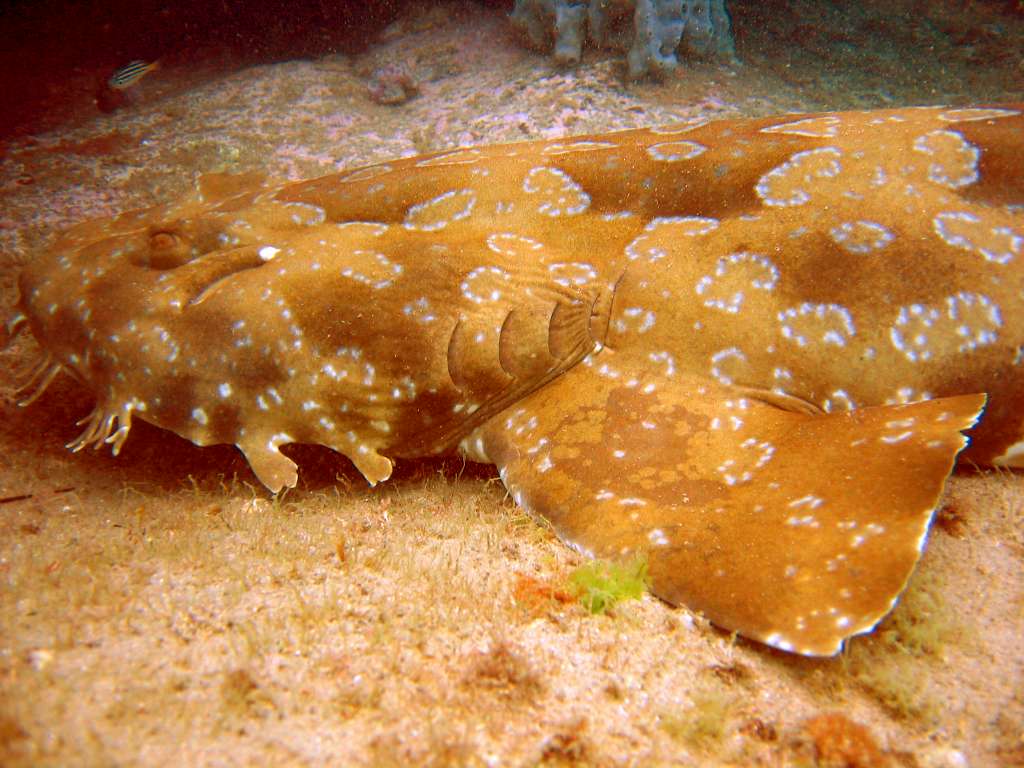 🇦🇺 Australia and 2 moreWobbegong
Camouflaged bottom-dwelling sharks found in the western Pacific and eastern Indian Ocean.Shark · Coasts and shelves
 🇮🇩 Indonesia and 4 moreWhitespotted bamboo shark
A small, bottom-dwelling carpet shark with purple and pink spots, common in Asian coral reefs.Shark · Coasts and shelves
 🇦🇺 Australia and 2 moreTasselled wobbegong
A camouflaged carpet shark with a fringed head.Shark · Coasts and shelves · 1867
Photo credits on this page
The small pictures above come from Wikimedia Commons under free licences. Some are cropped to fit.
- Estuarine stonefish: Sir Francis Day, Public domain, source
- Wobbegong: Unknown author, CC BY-SA 3.0, source
- Whitespotted bamboo shark: yvonne n, CC BY 2.0, source
- Tasselled wobbegong: Lakshmi Sawitri, CC BY 2.0, source