
Tasselled wobbegong
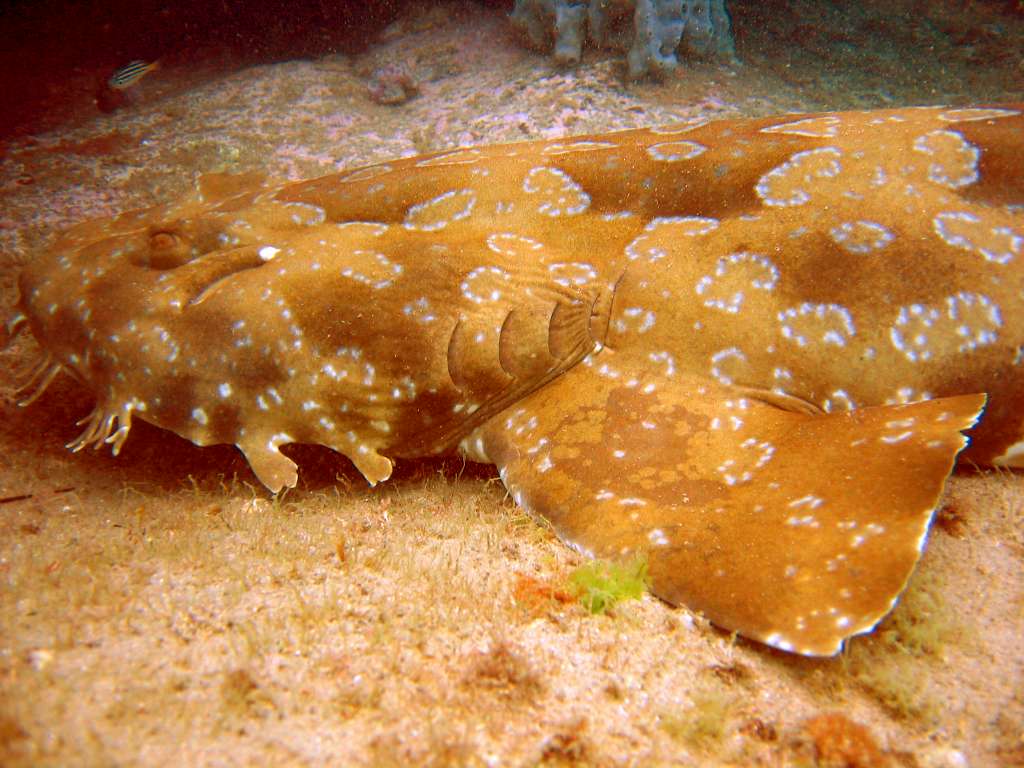
A camouflaged carpet shark with a fringed head.
The tasselled wobbegong is a solitary carpet shark found on coral reefs in northern Australia and New Guinea. It uses intricate skin flaps and tail movements to ambush prey. Listed as Least Concern by the IUCN, it faces threats from habitat loss outside Australian waters.
- Uses tail waving to lure prey like a small fish.
- Has branching skin flaps forming a beard-like fringe.
- Rests in caves during the day and hunts at night.
- Reaches a maximum confirmed length of 1.8 metres.
- Listed as Least Concern by the IUCN since 2015.
What it is
This carpet shark has a broad, flattened body and a wide head. Its most striking feature is a fringe of branching skin flaps around the snout and chin, resembling a beard. The dorsal surface displays a mosaic of dark blotches and lines on a grey or yellow-brown background. This pattern helps it blend into the reef. The mouth sits forward of the eyes, and the teeth are slender and pointed. Large pectoral fins aid in resting on the seabed.
Where it lives
It lives on continental shelves from Ningaloo Reef in western Australia to Bundaberg in the east. The range extends to New Guinea, Waigeo, and the Aru Islands. Reports from Malaysia remain unconfirmed. This bottom-dweller inhabits coral reefs exclusively, from shallow tidal zones to depths of about 50 metres. It prefers reef channels, faces, and coral heads.
How it lives
Solitary and slow-moving, it rests in caves or under ledges during the day with its tail curled. At night, it becomes active and hunts on the reef. It eats bony and cartilaginous fish, crustaceans, and squid. It ambushes prey using camouflage and may lure victims by waving its tail, which mimics a small fish. Cleaner shrimp and wrasse often remove parasites from its skin.
Breeding and life cycle
Reproduction is aplacental viviparous, meaning embryos develop inside the mother and rely on yolk for nourishment rather than a placental connection. Mating has been observed in caves at night. Newborns measure approximately 20 centimetres in length. The size at which males reach sexual maturity is uncertain, though one adult male measured 1.2 metres.
Fish and people
Divers sometimes encounter this shark without incident, but it has a reputation for unprovoked bites. One historical account from 1940 claimed it killed people in Papua New Guinea. Caution is advised as its poor vision may lead it to mistake limbs for prey. It adapts well to captivity and appears in the aquarium trade. Its skin is occasionally used for leather, but it has little other economic value.
Status and threats
The IUCN lists this species as Least Concern. In Australian waters, it faces minimal threats and is not targeted by fisheries. However, populations outside Australia may suffer from habitat degradation due to pollution, blast fishing, and coral removal. Extensive fishery activity in these regions also poses a risk to its survival.


Questions people ask about Tasselled wobbegong
Is the tasselled wobbegong dangerous to humans?
It has a reputation for aggression and one unverified report of killing humans exists. While many divers approach it safely, its poor vision means it might bite if provoked or if it mistakes a hand for food.
What does the tasselled wobbegong eat?
It feeds on bony fish, cartilaginous fish like smaller sharks, crustaceans, and cephalopods. It is an ambush predator that can swallow large prey whole, including other sharks up to one metre long.
Where can I find this shark?
It inhabits coral reefs in northern Australia, from Ningaloo Reef to Bundaberg. It is also found in New Guinea, Waigeo, and the Aru Islands, typically in shallow waters up to 50 metres deep.
How does it catch its food?
It relies on camouflage to hide during the day. At night, it actively forages. It also uses active luring, waving its tail to mimic a small fish, attracting curious prey within striking distance of its mouth.
Good reading and sources
- Tasselled wobbegong on WikipediaEncyclopedia
- More photos on Wikimedia CommonsPhotos
- Wikidata recordOpen data
The facts on this page come from the Wikipedia article "Tasselled wobbegong", written by its contributors and used under the CC BY-SA 4.0 licence, and from its Wikidata record (CC0). EveryFish rewrote the text in its own words, with AI assistance, and compares every page with the article to make sure no passage is copied. It may be reused under the same CC BY-SA 4.0 licence with a link back.
It may contain mistakes, and figures change over time. Nothing here is investment or buying advice. If something is wrong, tell us. Last refreshed 2026-11-15.
Like Tasselled wobbegong
All sharks WorldGalapagos shark
Large requiem shark of tropical oceanic islandsShark · Coasts and shelves · 1905
 🇦🇺 AustraliaEpaulette shark
A small carpet shark that walks on coral reefs and survives low oxygen.Shark · Coasts and shelves · 1788
 🇦🇺 AustraliaSpotted wobbegong
A camouflaged carpet shark native to Australian coastal waters.Shark · Coasts and shelves · 1778
 🇮🇩 Indonesia and 4 moreEstuarine stonefish
A venomous marine ray-finned fish found in the Indo-Pacific region.Shark · Coasts and shelves · 1766