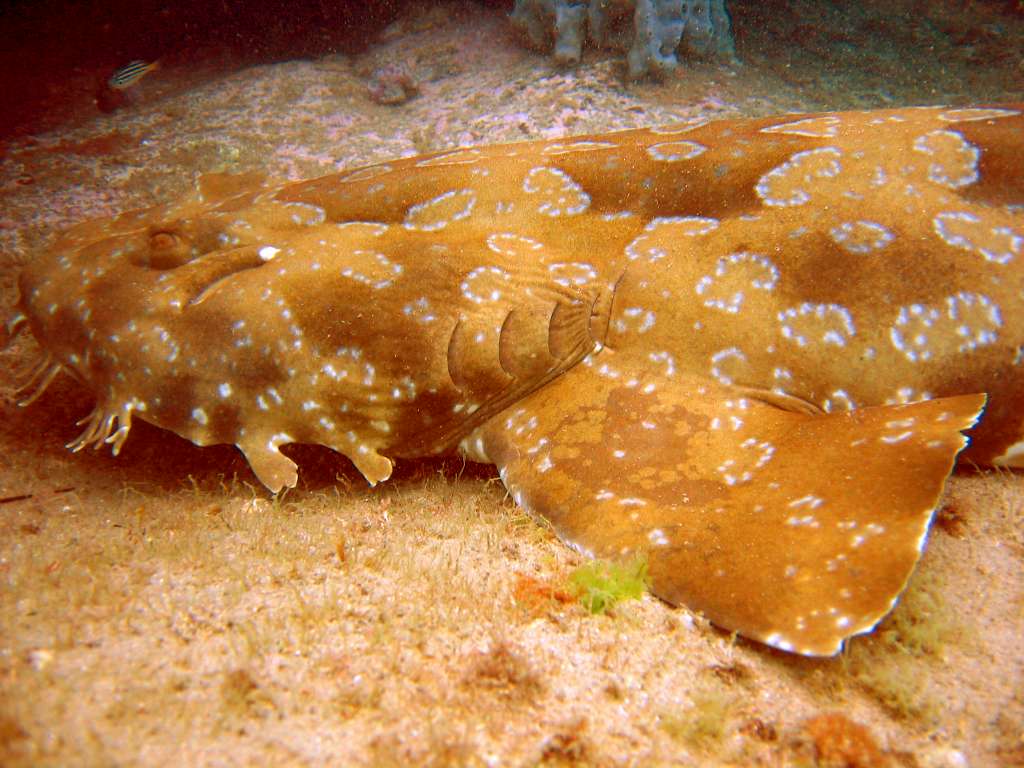
Spotted wobbegong
A camouflaged carpet shark native to Australian coastal waters.
The spotted wobbegong is a large carpet shark found in Australian waters. It rests on the seabed by day and hunts at night using electroreception. Listed as least concern globally, it faces local fishing pressure but remains stable.
- Grows up to 320 cm in length
- Uses electroreceptors to hunt at night
- Gives birth to litters of 20–37 pups
- Endemic to Australian coastal waters
- Camouflages with O-shaped body spots
What it is
This robust shark belongs to the carpet shark family. It features a broad body that tapers behind the pelvic fins. Its skin displays green, yellow, or brown hues with dark saddles and distinctive O-shaped spots. Dermal lobes frame its eyes and mouth, aiding in camouflage against rocky or sandy seabeds. Large barbels extend from its nostrils, and it lacks dorsal ridges.
Where it lives
Found exclusively around Australia, this species inhabits tropical and temperate coastal zones. It lives in the western Pacific and eastern Indian Ocean, ranging from Queensland to Western Australia. Adults prefer algae-covered rocky reefs and seagrass meadows, while juveniles frequent estuaries. They dwell at depths up to 218 metres, often resting on the bottom during daylight hours.
How it lives
Nocturnal by nature, it hunts at night for fish, rays, and invertebrates like crabs and octopuses. It uses complex electroreceptors in its snout to detect prey electric fields. During the day, it rests motionless, relying on camouflage. Recent studies suggest they form social groups with preferred partners rather than associating randomly. Large marine mammals or fish may prey upon them.
Breeding and life cycle
Reproduction is ovoviviparous, meaning embryos develop inside the mother until hatching. Gestation lasts nearly a year, with births occurring in spring. Litters typically contain 20 to 37 pups, each about 21 centimetres long. Males reach sexual maturity at roughly 60 centimetres. Aggressive behaviour, including biting, occurs among males and towards females during courtship.
Fish and people
Commercial fisheries target this shark for its edible flesh, particularly in eastern Australia. Historically, its skin was used for decoration. While generally docile, it can bite if provoked, stepped on, or handled by divers. Unprovoked attacks are rare and non-fatal. Early colonial records describe its ferocity when defending itself or attacking dogs near boats.
Status and threats
The International Union for Conservation of Nature lists it as least concern globally. However, it was considered near threatened in Australian waters in 2009. Fishing via trawls, nets, and lines poses a threat, especially in New South Wales. Conservation nominations for vulnerable status under Australian law were rejected in 2013, though population trends remain uncertain.


Questions people ask about Spotted wobbegong
Is the spotted wobbegong dangerous to humans?
It can bite if provoked, stepped on, or handled, causing severe wounds due to its strong grip. However, attacks are rarely fatal, and most incidents involve divers disturbing the shark during its daytime rest.
What does the spotted wobbegong eat?
It feeds on various fish, including luderick and sea bass, as well as rays, crabs, lobsters, and octopuses. It uses suction to pull prey into its broad pharynx, often ambushing animals that wander close to its mouth.
Where can I find spotted wobbegongs?
They are endemic to Australia, found in coastal bays, rocky reefs, and estuaries from Queensland to Western Australia. They typically inhabit waters no deeper than 218 metres and rest on the seabed during the day.
Good reading and sources
- Spotted wobbegong on WikipediaEncyclopedia
- More photos on Wikimedia CommonsPhotos
- Wikidata recordOpen data
The facts on this page come from the Wikipedia article "Spotted wobbegong", written by its contributors and used under the CC BY-SA 4.0 licence, and from its Wikidata record (CC0). EveryFish rewrote the text in its own words, with AI assistance, and compares every page with the article to make sure no passage is copied. It may be reused under the same CC BY-SA 4.0 licence with a link back.
It may contain mistakes, and figures change over time. Nothing here is investment or buying advice. If something is wrong, tell us. Last refreshed 2026-11-15.
Like Spotted wobbegong
All sharks WorldGalapagos shark
Large requiem shark of tropical oceanic islandsShark · Coasts and shelves · 1905
 🇮🇩 Indonesia and 4 moreEstuarine stonefish
A venomous marine ray-finned fish found in the Indo-Pacific region.Shark · Coasts and shelves · 1766
 WorldBlacktip reef shark
Small coral reef shark with distinct black fin tipsShark · Coasts and shelves · 1824
 WorldWhitetip reef shark
Small Indo-Pacific reef shark with white-tipped finsShark · Coasts and shelves · 1837
