
Galapagos shark
Large requiem shark of tropical oceanic islands
The Galapagos shark is a large requiem shark found near tropical islands worldwide. It reaches lengths over three metres and favours clear reef waters with strong currents. This active predator forms large groups and feeds on fish, cephalopods and marine mammals.
- Commonly reaches 3.0 m in length
- Found mainly off tropical oceanic islands
- Litters of 4-16 pups every 2-3 years
- Feeds on sea lions and marine iguanas
- Protected in Galapagos marine reserves
What it is
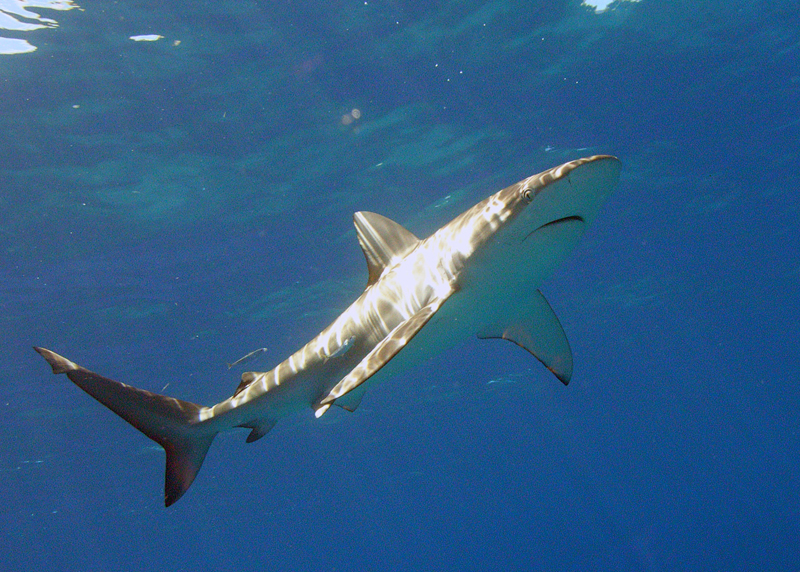
This species is a large requiem shark with a streamlined body typical of its family. It has a wide rounded snout and round eyes. The first dorsal fin is tall and sickle-shaped, originating above the rear tips of the pectoral fins. A low ridge runs along the midline to the second dorsal fin. Colouration is brownish grey above and white below, with a faint white stripe on the sides. Fin edges are darker but not prominently marked. Adults commonly reach three metres in length.
Where it lives
Found mainly off tropical oceanic islands, this shark inhabits the Atlantic, Indian and Pacific Oceans. Locations include Bermuda, the Hawaiian Islands, the Galapagos Islands and Lord Howe Island. It prefers rugged reef habitats with clear water and strong converging currents. Groups form around rocky islets and seamounts. Juveniles stay in shallow water under twenty-five metres deep, while adults venture to depths of one hundred and eighty metres.
How it lives
An active predator, it often appears in large aggregations rather than true schools. It dominates blacktip sharks but defers to silvertip sharks of similar size. Diet consists mainly of bottom-dwelling bony fishes and octopuses. Larger individuals eat rays, smaller sharks, sea lions and marine iguanas. They may perform threat displays involving arched backs and gaping jaws when confronted. Parasitic flatworms attach to their skin, and some fish rub against them to remove parasites.
Breeding and life cycle
Reproduction is viviparous, with embryos sustained by a placental connection. Mating occurs from January to March, leaving bite scars on females. Gestation lasts about one year. Females give birth to four to sixteen pups in shallow nursery areas. Birth size varies geographically, ranging from fifty-seven to eighty centimetres. Juveniles remain in shallow water to avoid predation by adults. Males mature at six to eight years, females at seven to nine years.
Fish and people
Fisheries catch this species across its range for meat considered of excellent quality. Divers encounter them frequently at sites like Wolf and Darwin islands. They are inquisitive and persistent, often approaching swimmers or boats. Attacks on humans are rare but documented, including one fatal incident. Excited sharks are difficult to deter and may incite feeding frenzies if threatened. Populations in the Kermadec and Galapagos Islands are protected within marine reserves.
Status and threats
The IUCN assesses this species as Least Concern, though populations face heavy fishing pressure. Its slow reproductive rate limits recovery from depletion. It may have disappeared from some Central American sites. The New Zealand Department of Conservation classifies it as Not Threatened but Conservation Dependent. Fragmented distribution puts regional populations at risk despite overall common status in places like Hawaii.


Questions people ask about Galapagos shark
How big do Galapagos sharks get?
They commonly reach three metres in length. Maximum recorded length is up to 3.7 metres. The heaviest weighed specimen was a female measuring three metres and weighing 195 kilograms.
Are Galapagos sharks dangerous to humans?
They are inquisitive and persistent around divers and swimmers. Two confirmed attacks have occurred, one fatal. They are drawn to fishing activity and can be difficult to deter when excited.
What do Galapagos sharks eat?
Primary prey includes bottom-dwelling bony fishes and octopuses. Larger individuals consume rays, smaller sharks, sea lions and marine iguanas. They occasionally eat indigestible items like garbage.
Good reading and sources
- Galapagos shark on WikipediaEncyclopedia
- More photos on Wikimedia CommonsPhotos
- Wikidata recordOpen data
The facts on this page come from the Wikipedia article "Galapagos shark", written by its contributors and used under the CC BY-SA 4.0 licence, and from its Wikidata record (CC0). EveryFish rewrote the text in its own words, with AI assistance, and compares every page with the article to make sure no passage is copied. It may be reused under the same CC BY-SA 4.0 licence with a link back.
It may contain mistakes, and figures change over time. Nothing here is investment or buying advice. If something is wrong, tell us. Last refreshed 2026-11-15.
Like Galapagos shark
All sharks WorldBigeye thresher
Deep-diving shark with huge eyes and a long tail.Shark · Open ocean · 1840
 WorldSpinner shark
A fast requiem shark known for spinning leaps out of water.Shark · Coasts and shelves · 1839
 WorldTiger shark
A large predatory shark known for its striped pattern and diverse diet.Shark · Coasts and shelves · 1822
 WorldPorbeagle
A fast, cold-water mackerel shark found in the Atlantic and Southern Hemisphere.Shark · Coasts and shelves · 1788
More from Carcharhinidae
All of them
WorldRequiem shark
A family of migratory, live-bearing sharks found in warm seas worldwide.Shark · Coasts and shelves · 1896
 🇺🇸 United States and 4 moreCaribbean reef shark
Large requiem shark of western Atlantic coral reefsShark · Coasts and shelves · 1876
 WorldLemon shark
A social, yellow-skinned requiem shark of shallow tropical waters.Shark · Coasts and shelves · 1868
 WorldGrey reef shark
Common Indo-Pacific reef predator known for threat displaysShark · Coasts and shelves · 1856