
Porbeagle
A fast, cold-water mackerel shark found in the Atlantic and Southern Hemisphere.
The porbeagle is a stout mackerel shark inhabiting cold and temperate seas. It maintains a high body temperature and hunts bony fish and cephalopods. Intense fishing has reduced stocks, leading to vulnerable conservation status globally.
- Maintains body temperature higher than surrounding water
- Distinctive white blotch on rear of first dorsal fin
- Embryos subsist on non-viable eggs inside the uterus
- Stocks collapsed in North Atlantic during mid-20th century
- Migrates up to 2,300 km seasonally
What it is
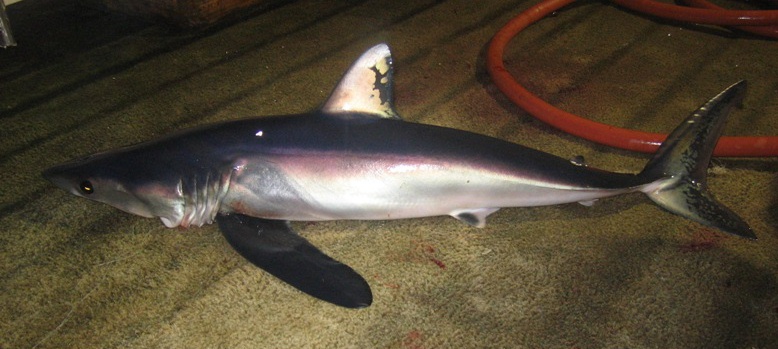
The porbeagle is a robust shark with a spindle-shaped body. It features a long, pointed snout and large pectoral fins. The first dorsal fin is tall with a distinctive white blotch at its rear base. Its skin feels velvety due to tiny flattened scales. The tail is crescent-shaped with lateral keels on the peduncle. Adults are grey above and white below. Southern Hemisphere individuals may have dark belly markings. This species grows up to 3.7 metres, though 2.5 metres is more common. Females in the North Atlantic grow larger than males.
Where it lives
This shark lives in cold and temperate waters, avoiding the tropics. In the North Atlantic, it ranges from Canada to Scandinavia and south to Morocco. It enters the Mediterranean but not the Black Sea. Southern populations inhabit waters around South America, South Africa, Australia, and New Zealand. It prefers offshore banks but visits shallow coastal areas and deep ocean basins. Recorded depths reach 1,360 metres. Water temperatures usually range between 8 and 20 degrees Celsius. Populations in the northern and southern hemispheres remain separate.
How it lives
Porbeagles are active hunters that maintain body heat above ambient water levels. They prey on bony fish and cephalopods throughout the water column. Their stiff swimming style offers energy efficiency for sustained speed. They may hunt alone or in groups. Observations suggest playful behaviour, such as rolling in kelp fronds. Seasonal migrations shift them between shallow feeding grounds and deeper waters. In the western North Atlantic, they move north in summer and south in winter. Mature females travel far into the Sargasso Sea to give birth.
Breeding and life cycle
Females reproduce via aplacental viviparity with oophagy. Developing embryos stay in the uterus and eat non-viable eggs. This method provides nutrition without a placental connection. Females typically bear four pups annually. In the western North Atlantic, pregnant females migrate to the Sargasso Sea. They remain in cooler, deep waters beneath the Gulf Stream during this period. This specific breeding ground helps regulate temperature for the developing young. Stock separation limits mixing between eastern and western Atlantic groups.
Fish and people
Fishermen value porbeagle meat and fins highly. Recreational anglers regard it as a strong game fish. Norwegian longliners drove stock collapses in the mid-twentieth century. Overfishing occurred in both the eastern and western North Atlantic. The species cannot withstand heavy pressure due to slow reproduction. It remains caught intentionally and as bycatch across its range. Few attacks on humans are attributed to this shark. Its name may derive from Cornish words for harbour and shepherd. Other names include blue dog and bottle-nosed shark.
Status and threats
The IUCN lists the porbeagle as vulnerable globally. Northern populations face higher risk, rated endangered or critically endangered. Commercial fishing caused significant declines in the 1950s and 1960s. Management efforts vary by region, with some monitoring in place. The low reproductive rate makes recovery from overfishing slow. Continued catch, both targeted and accidental, threatens remaining stocks. Conservation status differs between the discrete northern and southern stocks. Protection measures aim to prevent further collapse of these fisheries.


Questions people ask about Porbeagle
Is the porbeagle dangerous to humans?
Only a few shark attacks of uncertain origin have been linked to this species. It is not considered a major threat to people. Most interactions occur during recreational fishing activities where it is valued as a game fish.
Why is the porbeagle population declining?
Intense commercial fishing for its meat and fins caused stock collapses in the 1950s and 1960s. Its low reproductive capacity means it cannot sustain heavy fishing pressure. It continues to be caught as bycatch despite management efforts.
Where does the porbeagle live?
It inhabits cold and temperate marine waters in the North Atlantic and Southern Hemisphere. It avoids tropical zones. Preferred habitats include offshore fishing banks, though it ranges from shallow coastal waters to deep ocean basins.
How does the porbeagle reproduce?
Females are aplacental viviparous with oophagy. Embryos develop in the uterus and feed on non-viable eggs produced by the mother. Females typically give birth to four pups every year after migrating to specific breeding grounds.
Good reading and sources
The facts on this page come from the Wikipedia article "Porbeagle", written by its contributors and used under the CC BY-SA 4.0 licence, and from its Wikidata record (CC0). EveryFish rewrote the text in its own words, with AI assistance, and compares every page with the article to make sure no passage is copied. It may be reused under the same CC BY-SA 4.0 licence with a link back.
It may contain mistakes, and figures change over time. Nothing here is investment or buying advice. If something is wrong, tell us. Last refreshed 2026-11-15.
Like Porbeagle
All sharks WorldSpinner shark
A fast requiem shark known for spinning leaps out of water.Shark · Coasts and shelves · 1839
 WorldBigeye thresher
Deep-diving shark with huge eyes and a long tail.Shark · Open ocean · 1840
 WorldSmooth hammerhead
Temperate hammerhead shark with a curved head marginShark · Coasts and shelves · 1758
 WorldSilky shark
A fast, migratory requiem shark found in tropical oceans worldwide.Shark · Open ocean · 1839
More from Lamnidae
All of them WorldGreat white shark
A large, globally distributed predator known for its size and apex status in marine ecosystems.Shark · Coasts and shelves · 1758
 WorldLongfin mako shark
A rare, deep-water mackerel shark with long pectoral finsShark · Open ocean · 1966
 WorldSalmon shark
A warm-blooded mackerel shark of the northern PacificShark · Coasts and shelves
WorldMako shark
Fast predatory sharks of the genus Isurus, known for their speed and blue-grey colour.Shark · Open ocean