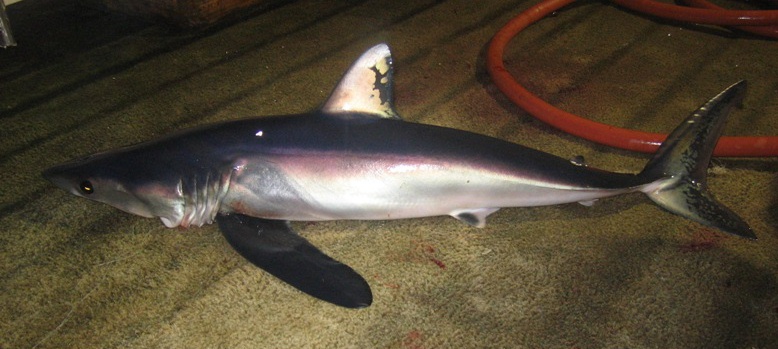
Longfin mako shark
A rare, deep-water mackerel shark with long pectoral fins
The longfin mako shark is a large, pelagic predator found in tropical and warm-temperate oceans worldwide. It is distinguished by its slender body and exceptionally long pectoral fins. Listed as endangered due to low reproductive rates and bycatch in commercial fisheries.
- Grows up to 4.3 metres in length
- Listed as endangered by the IUCN
- Embryos feed on unfertilised eggs
- Has pectoral fins longer than its head
- Found in tropical oceans worldwide
What it is
This species is a large mackerel shark with a slim, fusiform body. It features a long, pointed snout and large eyes that lack protective third eyelids. Its most distinct trait is the pair of long, broad pectoral fins, which are as long as or longer than its head. The colouration is dark blue or grayish black on the upper side and white below. Adults often show dusky mottling around the jaw and pectoral fin origins. It can grow up to 4.3 metres in length.
Where it lives
Records suggest a global distribution across tropical and warm-temperate waters. In the Atlantic, it inhabits areas from the Gulf Stream to southern Brazil and from the Iberian Peninsula to Ghana. It is also found in the Indian Ocean near Mozambique and in the Pacific off Japan, Australia, and California. The shark typically stays in deeper water during the day, descending to the mesopelagic zone, and rises closer to the surface at night.
How it lives
The longfin mako is a visual hunter, attracted to light sources in dark water. Its diet primarily consists of small schooling fish and squids. There is evidence it may attack swordfish, as one specimen was found with a broken bill lodged in its abdomen. Its slender build and long fins suggest it is a slower swimmer compared to the energetic shortfin mako. Adult individuals have no known natural predators, though juveniles may be eaten by larger sharks.
Breeding and life cycle
Reproduction is aplacental viviparous, meaning embryos develop inside the uterus without a placental connection. The unborn young practice oophagy, feeding on nonviable eggs produced by the mother after exhausting their yolk supply. Litter sizes are usually two but can reach eight. Pups are born relatively large, measuring nearly a metre in length. Females likely move to shallow coastal waters in winter to give birth.
Fish and people
This shark is caught unintentionally in longline and gillnet fisheries targeting tuna and swordfish. Its meat is considered poor quality due to a mushy texture, and its fins are less valued than those of other species. Despite this, captured individuals are often finned at sea. Retention is prohibited in United States Atlantic waters. No attacks on humans have been recorded, but its size and teeth make it potentially dangerous.
Status and threats
The International Union for Conservation of Nature lists this species as endangered. This assessment reflects its rarity, slow reproductive rate, and ongoing mortality from bycatch. Populations appear to be declining, mirroring trends seen in the shortfin mako. It is included in international agreements aimed at protecting migratory sharks from overexploitation.


Questions people ask about Longfin mako shark
How big does the longfin mako shark get?
The largest recorded specimen was a female measuring 4.3 metres. Most adults exceed 2.5 metres in length, with females generally growing larger than males. Large individuals can weigh over 200 kilograms.
Is the longfin mako shark dangerous to humans?
No attacks on humans have been attributed to this species. However, its large size and sharp, knife-shaped teeth mean it should be treated with caution. It is a powerful predator capable of inflicting serious injury.
What does the longfin mako shark eat?
It primarily feeds on small schooling bony fishes and cephalopods such as squid. There is also evidence suggesting it may prey on swordfish, as indicated by a specimen found with a broken swordfish bill in its abdomen.
Why is the longfin mako shark endangered?
It faces threats from low reproductive rates and incidental capture in commercial fisheries. Its rarity and slow population growth make it vulnerable to decline. Bycatch in tuna and swordfish fisheries is a major cause of mortality.
Good reading and sources
- Longfin mako shark on WikipediaEncyclopedia
- More photos on Wikimedia CommonsPhotos
- Wikidata recordOpen data
The facts on this page come from the Wikipedia article "Longfin mako shark", written by its contributors and used under the CC BY-SA 4.0 licence, and from its Wikidata record (CC0). EveryFish rewrote the text in its own words, with AI assistance, and compares every page with the article to make sure no passage is copied. It may be reused under the same CC BY-SA 4.0 licence with a link back.
It may contain mistakes, and figures change over time. Nothing here is investment or buying advice. If something is wrong, tell us. Last refreshed 2026-11-15.
Like Longfin mako shark
All sharks WorldPelagic thresher
The smallest thresher shark, found in tropical oceans and known for its whip-like tail.Shark · Open ocean · 1935
 WorldGalapagos shark
Large requiem shark of tropical oceanic islandsShark · Coasts and shelves · 1905
 WorldGrey reef shark
Common Indo-Pacific reef predator known for threat displaysShark · Coasts and shelves · 1856
 WorldBigeye thresher
Deep-diving shark with huge eyes and a long tail.Shark · Open ocean · 1840
More from Lamnidae
All of them WorldPorbeagle
A fast, cold-water mackerel shark found in the Atlantic and Southern Hemisphere.Shark · Coasts and shelves · 1788
 WorldGreat white shark
A large, globally distributed predator known for its size and apex status in marine ecosystems.Shark · Coasts and shelves · 1758
 WorldSalmon shark
A warm-blooded mackerel shark of the northern PacificShark · Coasts and shelves
WorldMako shark
Fast predatory sharks of the genus Isurus, known for their speed and blue-grey colour.Shark · Open ocean