
Pelagic thresher
The smallest thresher shark, found in tropical oceans and known for its whip-like tail.
This mid-sized shark lives in open waters across the Indo-Pacific. It hunts small fish using its long tail and is heavily targeted by commercial fisheries, leading to an endangered status.
- Smallest thresher shark, typically measuring 3 metres long.
- Hunts by stunning prey with its whip-like tail lobe.
- Embryos eat unfertilized eggs produced by the mother.
- Classified as endangered by the IUCN in 2019.
- Liver oil makes up 10 percent of body weight.
What it is
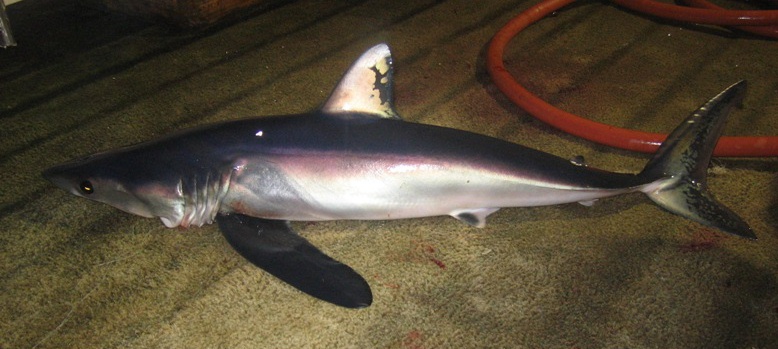
The pelagic thresher is a member of the thresher shark family, distinguished by its relatively small size compared to other species in the group. Adults typically reach three metres in length, though females can grow slightly larger. The body is streamlined with a narrow head and very large eyes in younger individuals. Its most striking feature is the upper lobe of the tail, which is extremely long and slender, resembling a whip. The skin displays a dark blue back that fades to white on the belly, with a distinctive dark patch above the pectoral fins that separates it from the common thresher.
Where it lives
This species inhabits tropical and subtropical waters throughout the Indo-Pacific. Records span from the Red Sea and South Africa eastward to Hawaii, California, and the Galapagos Islands. While primarily an open-ocean dweller, it occasionally enters coastal areas, particularly where continental shelves are narrow. Sightings have been recorded near coral reefs, seamounts, and even within large lagoons in the Tuamotu Islands. Population genetics indicate limited mixing between eastern and western Pacific groups, suggesting distinct regional stocks.
How it lives
These sharks are active swimmers capable of leaping from the water. They hunt small mesopelagic fish such as barracudinas and escolars by stunning them with sharp strikes from their elongated tails. This hunting method often results in the sharks becoming hooked on their tails during longline fishing. Predators include larger sharks and toothed whales. Parasites such as tapeworms and copepods affect their health. In places like Malapascua Island, they visit cleaning stations run by wrasses to remove parasites, explaining some shallow-water encounters.
Breeding and life cycle
Reproduction follows an ovoviviparous pattern common to mackerel sharks. Females carry pregnancies year-round, giving birth to one or two pups per uterus. Embryos initially rely on yolk sacs but later consume unfertilized eggs produced by the mother, a process called oophagy. Young are born unusually large, reaching up to forty-three percent of the mother's length, which helps reduce predation risk. Growth slows significantly with age, and females reach maturity at approximately eight to nine years old.
Fish and people
Commercial fisheries in the central Pacific and western Indian Ocean target this species for its meat, skin, liver oil, and fins. Taiwanese landings alone account for significant numbers annually. The fins are used in soup, while liver oil serves industrial and cosmetic purposes. Sport fishers also value the species for its fighting ability. Despite never attacking humans, the intense fishing pressure has led the IUCN to classify it as endangered in 2019, citing overexploitation as the primary threat.
Status and threats
The International Union for Conservation of Nature listed the pelagic thresher as endangered in 2019. Commercial fishing for meat, fins, and oil drives population declines. Bycatch in nets targeting tuna and other species further impacts numbers. Slow growth rates and late maturity make recovery difficult. Conservation efforts are critical due to the species' vulnerability to overfishing across its wide range.


Questions people ask about Pelagic thresher
How does the pelagic thresher catch its food?
It uses its extremely long upper tail lobe like a whip to strike and stun small midwater fish. This allows the shark to consume multiple prey items at once without chasing each individual fish separately.
What distinguishes it from the common thresher?
The key difference is coloration. The pelagic thresher has dark pigment above its pectoral fins, whereas the common thresher has white. It also lacks labial furrows and has rounded fin tips.
Is the pelagic thresher dangerous to humans?
No. It has never been implicated in attacks on humans. It tends to flee from divers and possesses small jaws and teeth relative to its size, making it harmless to people.
Why is the species considered endangered?
Heavy commercial fishing for meat, fins, and liver oil has depleted populations. Their slow growth rate and late sexual maturity make it difficult for them to recover from high fishing pressure.
Good reading and sources
- Pelagic thresher on WikipediaEncyclopedia
- More photos on Wikimedia CommonsPhotos
- Wikidata recordOpen data
The facts on this page come from the Wikipedia article "Pelagic thresher", written by its contributors and used under the CC BY-SA 4.0 licence, and from its Wikidata record (CC0). EveryFish rewrote the text in its own words, with AI assistance, and compares every page with the article to make sure no passage is copied. It may be reused under the same CC BY-SA 4.0 licence with a link back.
It may contain mistakes, and figures change over time. Nothing here is investment or buying advice. If something is wrong, tell us. Last refreshed 2026-11-15.
Like Pelagic thresher
All sharks WorldGalapagos shark
Large requiem shark of tropical oceanic islandsShark · Coasts and shelves · 1905
 WorldLongfin mako shark
A rare, deep-water mackerel shark with long pectoral finsShark · Open ocean · 1966
 🇺🇸 United States and 4 moreCaribbean reef shark
Large requiem shark of western Atlantic coral reefsShark · Coasts and shelves · 1876
 WorldBigeye thresher
Deep-diving shark with huge eyes and a long tail.Shark · Open ocean · 1840
