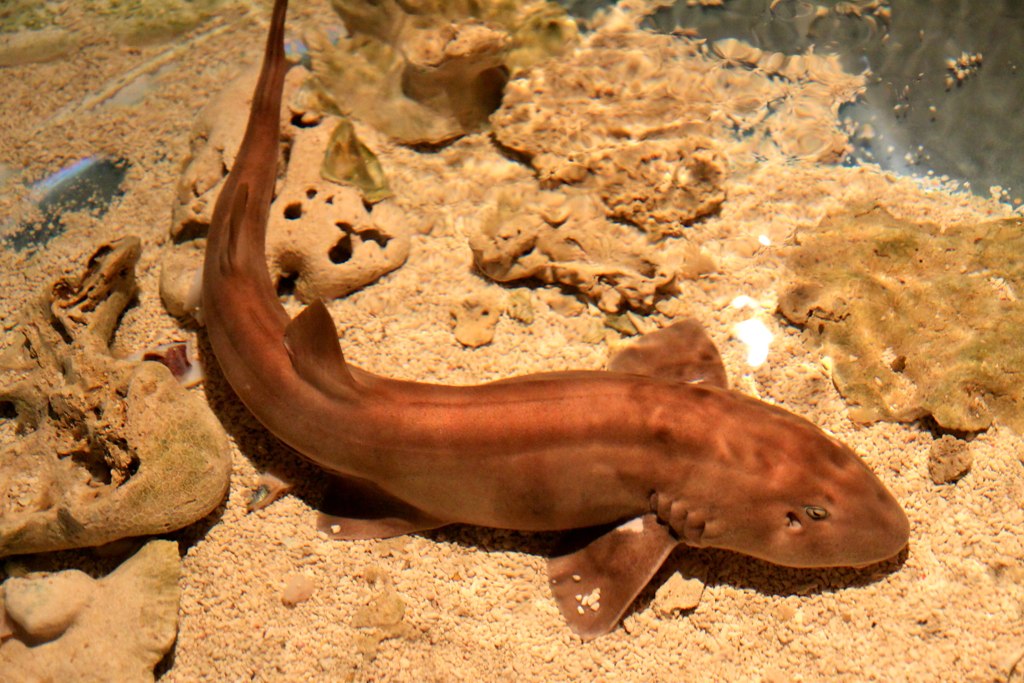
Epaulette shark
A small carpet shark that walks on coral reefs and survives low oxygen.
The epaulette shark is a small species of carpet shark found in shallow tropical waters around Australia and New Guinea. It is known for its ability to walk along the sea floor and tolerate extreme lack of oxygen in tidal pools.
- Can survive complete anoxia for two hours at high temperatures.
- Walks on coral reefs using modified pectoral and pelvic fins.
- Lays egg capsules every two weeks during the breeding season.
- Commonly kept in home aquariums due to small size and docility.
- Named for black spots behind pectoral fins resembling military epaulettes.
What it is
This small carpet shark has a slender body with a short head and broad, paddle-like fins. Adults are light brown with scattered spots and distinctive black rings behind each pectoral fin that resemble military epaulettes. The tail section makes up more than half of its total length. Juveniles display alternating light and dark bands that fade as they mature. They typically measure between 70 and 90 centimetres, with a recorded maximum of 107 centimetres.
Where it lives
These sharks inhabit shallow tropical waters from the northern coast of Australia south to Sydney, extending to southern New Guinea. Large populations exist on the Great Barrier Reef, particularly around Heron Island. Unverified reports suggest presence in Malaysia, Sumatra, and the Solomon Islands. They prefer tidal pools, coral flats, and staghorn coral stands at depths up to 50 metres.
How it lives
They are nocturnal hunters that often walk along the substrate using their muscular fins rather than swimming. This locomotion allows them to navigate complex reef structures and even crawl out of water into isolated pools. Their diet includes crabs, worms, and small bony fish. They use electroreception and smell to find prey, sometimes chewing hard-shelled items for several minutes. Predators include larger sharks, while parasites like gnathiid isopods attach to their skin.
Breeding and life cycle
Mating occurs from July to December, with females laying egg capsules every two weeks. Each female produces 20 to 50 eggs annually. The young hatch after four months at about 14 centimetres long. Sexual maturity is reached at five to six decades of age, corresponding to a length of 54 to 64 centimetres. They breed readily in captivity given adequate tank space.
Fish and people
Harmless to humans, these sharks are popular in public and home aquariums due to their hardiness and unique appearance. They are not targeted by commercial fisheries in Australia but face threats from artisanal fishing and habitat degradation in New Guinea. Conservation status varies by region, being Least Concern globally but Near Threatened locally where exploitation occurs.
Status and threats
The global population is assessed as Least Concern because Australian waters offer significant protection through marine parks. However, New Guinean populations face Near Threatened status due to destructive fishing practices and habitat loss. Climate change poses a risk by affecting development rates and fitness through rising temperatures.


Questions people ask about Epaulette shark
Why is it called the epaulette shark?
The name comes from large black spots ringed in white located behind each pectoral fin. These markings look like the decorative shoulder pieces worn by military officers, known as epaulettes.
How does this shark survive in tidal pools?
It tolerates severe oxygen depletion by slowing its heart rate and redirecting blood to the brain. It can also shut down non-essential neural functions to conserve energy during hypoxic conditions.
Do epaulette sharks swim or walk?
They often walk along the sea floor by wriggling their bodies and pushing with their broad fins. This adaptation helps them navigate complex reef environments and access isolated tidal pools.
Are they dangerous to humans?
No, they are harmless to people. They may nip if handled roughly, but they show little fear of humans and are easily observed by beachgoers in shallow waters.
Good reading and sources
- Baby sharks emerge from egg cases earlier and weaker in oceans warmed by climate crisisThe Guardian, Article
- BBC OneBBC, Article
- Epaulette shark on WikipediaEncyclopedia
- More photos on Wikimedia CommonsPhotos
- Wikidata recordOpen data
The facts on this page come from the Wikipedia article "Epaulette shark", written by its contributors and used under the CC BY-SA 4.0 licence, and from its Wikidata record (CC0). EveryFish rewrote the text in its own words, with AI assistance, and compares every page with the article to make sure no passage is copied. It may be reused under the same CC BY-SA 4.0 licence with a link back.
It may contain mistakes, and figures change over time. Nothing here is investment or buying advice. If something is wrong, tell us. Last refreshed 2026-11-15.
Like Epaulette shark
All sharks 🇦🇺 Australia and 2 moreTasselled wobbegong
A camouflaged carpet shark with a fringed head.Shark · Coasts and shelves · 1867
 WorldGalapagos shark
Large requiem shark of tropical oceanic islandsShark · Coasts and shelves · 1905
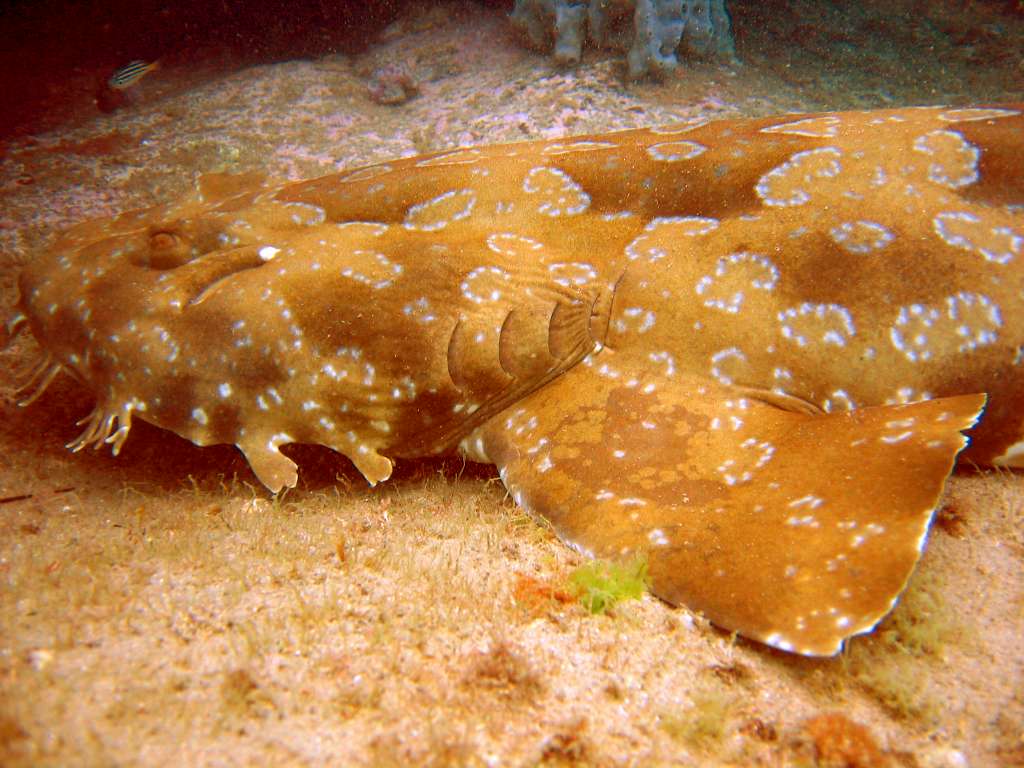 🇦🇺 AustraliaSpotted wobbegong
A camouflaged carpet shark native to Australian coastal waters.Shark · Coasts and shelves · 1778
 🇮🇩 Indonesia and 4 moreEstuarine stonefish
A venomous marine ray-finned fish found in the Indo-Pacific region.Shark · Coasts and shelves · 1766