
White sturgeon
Large North American sturgeon found in Pacific rivers and estuaries.
The white sturgeon is a massive migratory fish native to the eastern Pacific coast of North America. It lives in rivers and estuaries from Alaska to Mexico, growing up to six metres long. Historically overfished for caviar, it is now managed through strict regulations and aquaculture programmes.
- Can grow up to 6.1 metres and weigh over 600 kg
- Octoploid genetics with 240 chromosomes
- Spawns on gravel in fast river currents
- Listed as Endangered by American Fisheries Society
- Legal caviar produced via aquaculture in California
What it is
The white sturgeon is a large, ancient fish with a distinctive row of bony plates between its anus and anal fin. Its body colour ranges from grey to brown on top, fading to pale underneath, with grey fins. Barbels sit near the snout rather than the mouth. Adults commonly reach two metres in length, though records show individuals exceeding six metres and weighing over half a tonne. This species belongs to the family Acipenseridae and was recently reclassified into the genus Sinosturio.
Where it lives
Native to the eastern Pacific, this fish ranges from the Gulf of Alaska down to northern Mexico. It inhabits deep, soft-bottomed areas of large river estuaries. While primarily anadromous, migrating between sea and river, some populations are landlocked in systems like the Fraser, Columbia, and Snake Rivers. Dams have significantly altered their historical distribution, blocking upstream movement in many basins.
How it lives
Larvae feed on small crustaceans called Corophium, relying on currents to reach food-rich zones. Juveniles eat tube-dwelling amphipods and insect larvae. Adults shift to a piscivorous diet, consuming herring, salmon, smelt, and invasive clams. They appear to forage more actively at night, influenced by tidal cycles. Genetic studies show they are octoploid, possessing eight sets of chromosomes, which distinguishes them from many other vertebrates.
Breeding and life cycle
Spawning occurs in spring, typically between February and May, depending on the river system. Females release adhesive eggs onto gravel or rocky substrates in fast-moving water. The eggs stick to the bottom and hatch within days, depending on water temperature. Maturity is reached late, often after a decade, with females spawning every few years. This slow reproductive cycle makes population recovery difficult after declines.
Fish and people
Indigenous peoples relied on this fish for food before commercial fleets nearly wiped it out for caviar in the early twentieth century. Today, wild harvest is heavily restricted, but aquaculture farms in California produce legal caviar and meat. Sport fishing is popular in the Pacific Northwest, usually under catch-and-release rules. Poaching remains a threat due to high black-market prices for roe.
Status and threats
The American Fisheries Society lists the species as Endangered. Populations face threats from dams, pollution, and habitat loss. Recruitment varies widely, with some years showing almost no new young fish. Conservation efforts include habitat restoration and improved fish passage at dams. International trade is controlled under CITES Appendix II to prevent unsustainable exploitation.


Questions people ask about White sturgeon
How big do white sturgeon get?
They commonly reach lengths of around two metres. The maximum recorded length is 6.1 metres, with an authenticated weight record of 630 kilograms. Some unverified reports suggest even larger sizes.
Is it legal to keep white sturgeon?
Regulations vary by location. In the Columbia River Basin, retention is prohibited, but catch-and-release sport fishing is allowed. Selling wild sturgeon or eggs is illegal in California, though farmed products are permitted.
What do white sturgeon eat?
Larvae and juveniles feed on small invertebrates like amphipods and Corophium. Adults become piscivorous, eating fish such as herring, salmon, and smelt, as well as benthic items like invasive clams.
Why are they called white sturgeon?
The name refers to their pale ventral side and greyish dorsal colouring. The scientific name transmontanus means beyond the mountains, reflecting their range relative to early explorers.
Good reading and sources
- White sturgeon on WikipediaEncyclopedia
- More photos on Wikimedia CommonsPhotos
- Wikidata recordOpen data
The facts on this page come from the Wikipedia article "White sturgeon", written by its contributors and used under the CC BY-SA 4.0 licence, and from its Wikidata record (CC0). EveryFish rewrote the text in its own words, with AI assistance, and compares every page with the article to make sure no passage is copied. It may be reused under the same CC BY-SA 4.0 licence with a link back.
It may contain mistakes, and figures change over time. Nothing here is investment or buying advice. If something is wrong, tell us. Last refreshed 2026-11-15.
Like White sturgeon
All ancient fish 🇺🇸 United States and 1 moreLake sturgeon
A large, long-lived freshwater fish native to North America.Ancient · Rivers and lakes
 🇧🇷 Brazil and 1 moreArapaima
Large freshwater fish from the Amazon basin known for its size and air-breathing ability.Ancient · Rivers and lakes
 🇺🇸 United States and 1 moreBowfin
Ancient North American freshwater fish with air-breathing abilityAncient · Rivers and lakes
 🇨🇳 ChinaDabry's sturgeon
Freshwater sturgeon native to the Yangtze River basin in China.Ancient · Rivers and lakes
More from Acipenseridae
All of them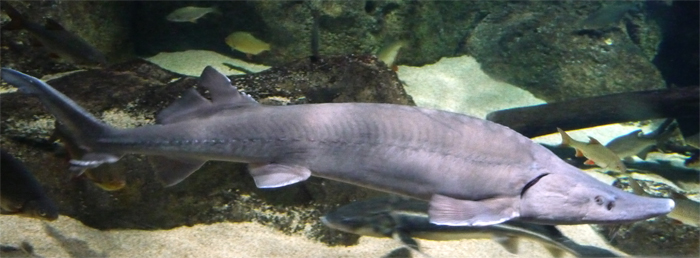 🇷🇺 Russia and 4 moreSiberian sturgeon
Large freshwater sturgeon native to Siberian riversAncient · Rivers and lakes
 🇺🇸 United States and 1 moreGreen sturgeon
A large anadromous fish native to the northern Pacific Ocean.Shark · Coasts and shelves
 🇺🇸 United States and 1 moreAtlantic sturgeon
A large anadromous fish native to the western Atlantic Ocean and its river systems.Ancient · Rivers and lakes
 🇮🇹 Italy and 4 moreAdriatic sturgeon
A critically endangered sturgeon native to the Adriatic basin.Ancient · Rivers and lakes