
Dabry's sturgeon
Freshwater sturgeon native to the Yangtze River basin in China.
Dabry's sturgeon is a freshwater fish endemic to China, historically found in the Yangtze and Yellow River basins. Once commercially important, it was declared extinct in the wild in 2022 due to overfishing and dam construction, though captive breeding and recent wild reproduction offer hope for recovery.
- Declared extinct in the wild by IUCN in 2022
- Can grow up to 2.5 metres in length
- First wild reproduction confirmed in April 2025
- Over 800,000 captive fish released in 2024
- Blocked by Gezhouba and Three Gorges Dams
What it is
Dabry's sturgeon is a large freshwater fish with a blue-gray back and yellowish-white belly. It features five rows of bony plates called scutes along its body. The head is triangular with a long snout, and the mouth sits on the underside. Two pairs of barbels hang near the mouth. Adults can reach 2.5 metres in length, though most are smaller. This species belongs to the sturgeon family and is the type species of the genus Sinosturio.
Where it lives
This fish is endemic to China. Its primary habitat is the Yangtze River basin, including main channels, tributaries, and connected lakes. Historically, it also inhabited the Yellow River basin, with records there until the 1960s. By the late twentieth century, populations disappeared from the lower Yangtze. They became restricted to the upper reaches in Sichuan province. The fish prefers slow-moving waters with sandy or muddy bottoms.
How it lives
The sturgeon feeds on aquatic plants, invertebrates, and small fish. It is potamodromous, meaning it migrates within fresh water but does not enter the sea. Males spawn annually, while most females do not breed every year. The species moves along the river for spawning and feeding. Habitat fragmentation has severely limited its movement. Pollution from runoff and wastewater has further degraded its environment.
Breeding and life cycle
Spawning occurs mainly in the upper Yangtze during March and April, with some activity in November and December. Females produce between 57,000 and 102,000 eggs. Dams like Gezhouba and Three Gorges blocked historical migration routes. Captive breeding began in the 1970s. In 2025, scientists confirmed the first wild reproduction after releasing captive-bred individuals. Hatchlings were spotted in April 2025, proving reintroduction potential.
Fish and people
This sturgeon was once a commercially important food fish. Overharvesting, especially of juveniles, contributed to its decline. Commercial harvest was banned in 1988 when it was listed as endangered in China. Thousands of captive-bred fish have been released into the Yangtze. In June 2024, over 800,000 individuals were released near Yibin. These efforts aim to prevent total extinction and restore wild populations.
Status and threats
The International Union for Conservation of Nature declared the species extinct in the wild in July 2022. Major threats included overfishing, dam construction, and pollution. The Gezhouba and Three Gorges Dams caused habitat fragmentation. Despite the extinction status, captive breeding programmes continue. Recent confirmation of wild spawning in 2025 suggests that restocking efforts may be succeeding in re-establishing a breeding population.

Questions people ask about Dabry's sturgeon
Is Dabry's sturgeon extinct?
It was declared extinct in the wild in 2022. However, captive breeding continues, and scientists confirmed the first wild reproduction in April 2025, offering hope for recovery.
Where does Dabry's sturgeon live?
It is endemic to China, primarily in the Yangtze River basin. It was historically found in the Yellow River basin but has not been recorded there since the 1960s.
Why did the population decline?
Overfishing, especially of juveniles, was a major cause. Dam construction blocked migration routes, and pollution from development further degraded its habitat in the Yangtze basin.
Good reading and sources
- Dabry's sturgeon on WikipediaEncyclopedia
- More photos on Wikimedia CommonsPhotos
- Wikidata recordOpen data
The facts on this page come from the Wikipedia article "Dabry's sturgeon", written by its contributors and used under the CC BY-SA 4.0 licence, and from its Wikidata record (CC0). EveryFish rewrote the text in its own words, with AI assistance, and compares every page with the article to make sure no passage is copied. It may be reused under the same CC BY-SA 4.0 licence with a link back.
It may contain mistakes, and figures change over time. Nothing here is investment or buying advice. If something is wrong, tell us. Last refreshed 2026-11-15.
Like Dabry's sturgeon
All ancient fish WorldStarry sturgeon
Long-snouted sturgeon from the Caspian and Black Seas.Ancient · Rivers and lakes
 🇧🇷 Brazil and 1 moreArapaima
Large freshwater fish from the Amazon basin known for its size and air-breathing ability.Ancient · Rivers and lakes
 🇺🇸 United States and 1 moreWhite sturgeon
Large North American sturgeon found in Pacific rivers and estuaries.Ancient · Rivers and lakes
 🇷🇺 RussiaSterlet
A small Eurasian sturgeon found in rivers flowing to the Black, Azov, and Caspian seas.Ancient · Rivers and lakes · 1758
More from Acipenseridae
All of them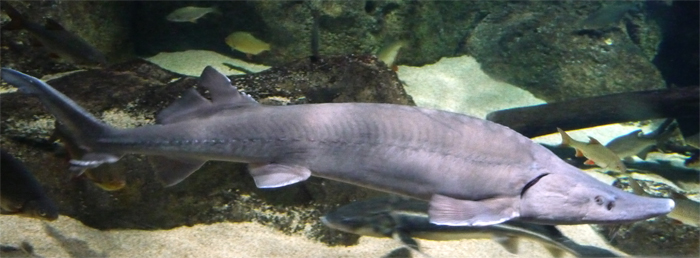 🇷🇺 Russia and 4 moreSiberian sturgeon
Large freshwater sturgeon native to Siberian riversAncient · Rivers and lakes
 🇺🇸 United States and 1 moreLake sturgeon
A large, long-lived freshwater fish native to North America.Ancient · Rivers and lakes
 🇺🇸 United States and 1 moreAtlantic sturgeon
A large anadromous fish native to the western Atlantic Ocean and its river systems.Ancient · Rivers and lakes
 🇺🇸 United States and 1 moreGreen sturgeon
A large anadromous fish native to the northern Pacific Ocean.Shark · Coasts and shelves