
Viperfish
Deep-sea fish with fang-like teeth and bioluminescent lures in the genus Chauliodus.
Viperfish are marine fish in the genus Chauliodus that inhabit the twilight zone of tropical and temperate oceans. They use bioluminescence to hunt prey and hide from predators while migrating vertically through the water column at night.
- Teeth can pierce the brain if misaligned.
- Bioluminescent lure attracts prey.
- Counter-illumination hides them from predators.
- Migrate vertically between depths daily.
- Nine recognized living species exist.
What it is
Viperfish belong to the genus Chauliodus within the family Stomiidae. These marine creatures typically reach a maximum length of thirty centimetres. Their bodies feature silvery scales arranged in five rows, though these scales shed easily or dissolve during preservation. The skin beneath displays hexagonal pigment patterns and an opalescent slime. A defining trait is their prominent fang-like teeth, which are long enough to pierce the brain if misaligned. They possess a specialized loosejaw structure that enables wide mouth opening and rapid closing. Light organs called photophores line the ventral side of their body. One species also has a light-emitting lure on the tip of its first dorsal ray.
Where it lives
These fish inhabit mesopelagic and bathypelagic environments across tropical and temperate oceans globally. They dwell below two hundred metres but migrate vertically. Specimens have been recorded in the western Mediterranean Basin, the Adriatic Sea, the Aegean Sea, and the Levant Sea. Rare sightings occur off the Algerian coast and northern Tunisia. Some submarine calderas like the Kurose Hole host high densities of these fish. In tropical waters, they often remain below four hundred metres year-round. Temperate populations may interact with surface predators during nightly migrations.
How it lives
Viperfish feed on pelagic fishes and crustaceans such as lanternfishes, bristlemouths, copepods, and krill. They consume large prey infrequently to maximize energy intake. Their elastic stomachs and flexible skin accommodate substantial meals. Bioluminescence serves dual purposes: attracting prey and avoiding predators. The dorsal lure swings forward to draw food into their mouths. Ventral photophores provide counter-illumination camouflage against dim sunlight. Many species undergo diel vertical migration to surface waters at night. This movement exposes them to temperature shifts up to seven degrees Celsius. Their slow metabolism means they do not need to feed every night.
Breeding and life cycle
Reproductive ecology remains largely unknown due to difficulties in capturing mature adults. They are gonochoristic, meaning individuals have distinct sexes. Males likely produce sperm continuously. Females exhibit asynchronous oocyte development and batch spawning. Research on related dragonfishes suggests similar patterns. A study in the Gulf of Mexico found a skewed sex ratio favoring females. Eggs have been recovered far from typical habitats, suggesting long incubation periods and displacement by strong currents.


Questions people ask about Viperfish
What makes viperfish teeth unique?
Their fang-like teeth are exceptionally long. If they close their jaws incorrectly, the teeth can pierce their own brain. They have a loosejaw mechanism that allows wide opening and rapid closing to capture prey effectively.
How do viperfish use light?
They use bioluminescence for hunting and defense. A lure on their dorsal fin attracts prey close to their mouth. Photophores along their belly match ambient sunlight to hide their silhouette from predators below, a technique called counter-illumination.
Where do viperfish live?
They inhabit the mesopelagic and bathypelagic zones of tropical and temperate oceans worldwide. They typically stay below two hundred metres but migrate upward at night to feed in shallower waters.
What do viperfish eat?
Their diet includes pelagic fishes like lanternfishes and bristlemouths, as well as crustaceans such as copepods and krill. They eat large prey infrequently to conserve energy.
Good reading and sources
The facts on this page come from the Wikipedia article "Viperfish", written by its contributors and used under the CC BY-SA 4.0 licence, and from its Wikidata record (CC0). EveryFish rewrote the text in its own words, with AI assistance, and compares every page with the article to make sure no passage is copied. It may be reused under the same CC BY-SA 4.0 licence with a link back.
It may contain mistakes, and figures change over time. Nothing here is investment or buying advice. If something is wrong, tell us. Last refreshed 2026-11-15.
Like Viperfish
All other fish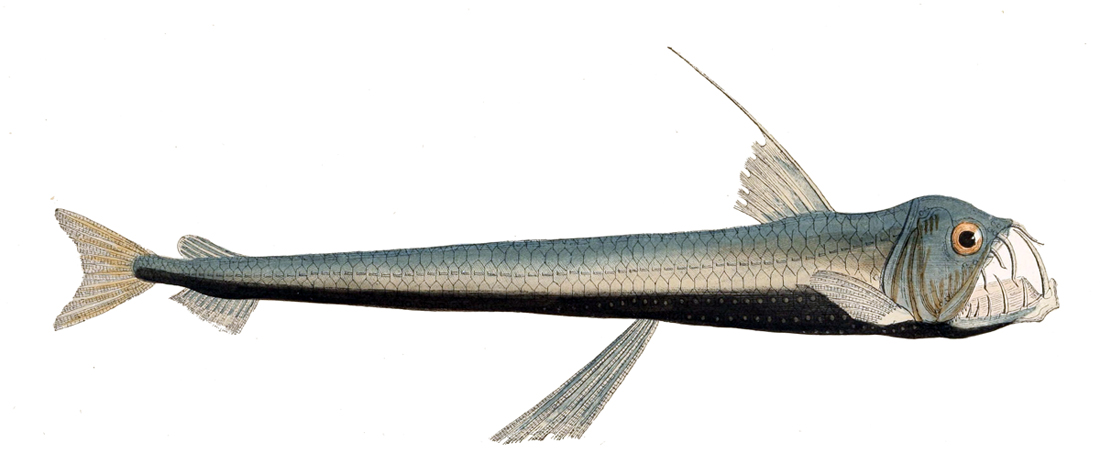 WorldSloane's viperfish
Deep-sea dragonfish with huge teeth and light organsOther · Open ocean · 1801
 WorldAnglerfish
Ray-finned fish using a modified dorsal fin ray as a lure to catch prey.Other · Coasts and shelves · 1829
 WorldOarfish
Extremely long pelagic fish known for their ribbon-like bodies and association with sea serpent myths.Other · Open ocean · 1772
 WorldCommon fangtooth
A small, black deep-sea fish with large fangs found worldwide.Other · Open ocean · 1833
More from Stomiidae
All of them WorldStoplight loosejaw
Deep-sea dragonfish that hunts with invisible red light.Shark · Deep sea · 1848
 WorldStareater
Small deep-sea fish with a red glowing lureOther · Deep sea
 WorldBlack dragonfish
Deep-sea fish with infrared light and stalked larval eyesOther · Open ocean
 WorldPacific blackdragon
Deep-sea fish with light-absorbing skin and a glowing chin lure.Other · Open ocean