
Pacific blackdragon
Deep-sea fish with light-absorbing skin and a glowing chin lure.
The Pacific blackdragon is a deep-dwelling barbeled dragonfish found in the Pacific Ocean and Gulf of Mexico. It uses ultrablack skin to hide and a glowing barbel to catch prey in dark waters.
- Skin absorbs 99.95% of visible light
- Lives at depths of 500 to 2,000 metres
- Uses a glowing chin barbel to attract prey
- Males are small and larval-like compared to females
What it is
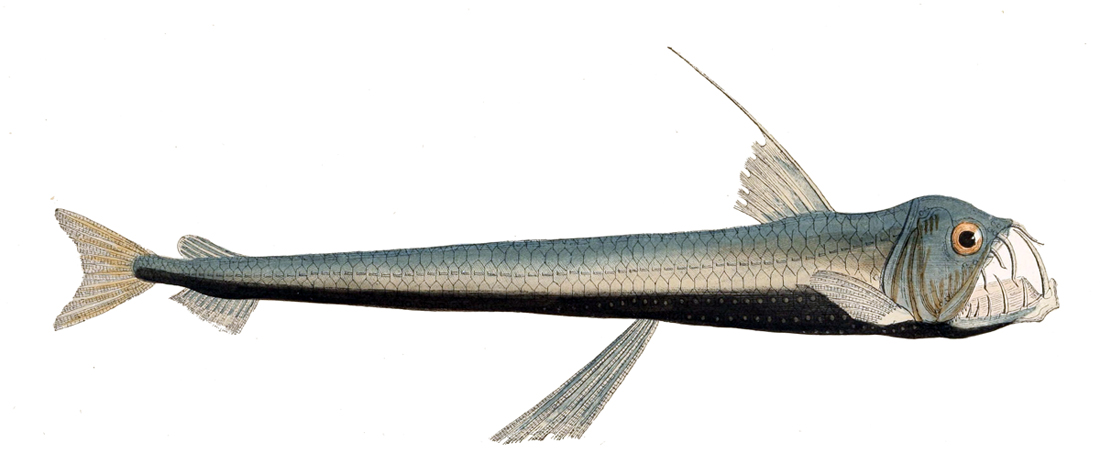
This species belongs to the barbeled dragonfish family. It lives in the deep ocean and is famous for its skin, which absorbs almost all visible light. This effect comes from densely packed pigment structures. The fish has four sets of light-producing organs on its belly and tail. A glowing appendage hangs from its chin to help it hunt. Its head connects to the spine via a rigid tube rather than a flexible joint.
Where it lives
You can find this creature in the Pacific Ocean. It also inhabits the Gulf of Mexico and waters off the western United States. It stays in the deep zone, typically between 500 and 2,000 metres down. The fish moves vertically each day to feed, a behaviour known as diel vertical migration.
How it lives
It hunts small crustaceans and other fish. To sense movement in the dark, it relies on a complex lateral line system. This network of sensors includes over 2000 units along its body and more than 200 on its head. These detectors pick up vibrations in the water, helping the fish locate prey or avoid threats.
Breeding and life cycle
Scientists have not observed its reproduction directly. Based on related species, it likely lays eggs in batches. Males and females look very different. Females are larger, while males remain small and larval-like throughout their lives. This extreme difference in appearance between sexes is common in deep-sea dragonfishes.
Fish and people
This fish is not a target for commercial fishing or aquarium trade due to its deep habitat. Researchers study it to understand how its skin absorbs light so effectively. Its unique biological features provide insights into deep-sea adaptation and sensory systems in extreme environments.
Status and threats
There is no specific conservation status listed for this species. It lives in remote deep waters, which may offer some protection from direct human activity. However, data on its population size and trends are limited.


Questions people ask about Pacific blackdragon
Why is the Pacific blackdragon so dark?
Its skin contains tightly packed melanosomes that absorb 99.95% of light. This ultrablack quality helps it remain invisible in the deep ocean where faint bioluminescence might otherwise reveal its shape.
How does it catch food in the dark?
It uses a glowing barbel on its chin to lure prey close. It also has an extensive lateral line system with thousands of sensors to detect vibrations from moving fish and crustaceans.
Where does this fish live?
It inhabits the deep Pacific Ocean, including areas off the US West Coast and in the Gulf of Mexico. It stays between 500 and 2,000 metres deep and migrates vertically to feed.
Good reading and sources
The facts on this page come from the Wikipedia article "Idiacanthus antrostomus", written by its contributors and used under the CC BY-SA 4.0 licence, and from its Wikidata record (CC0). EveryFish rewrote the text in its own words, with AI assistance, and compares every page with the article to make sure no passage is copied. It may be reused under the same CC BY-SA 4.0 licence with a link back.
It may contain mistakes, and figures change over time. Nothing here is investment or buying advice. If something is wrong, tell us. Last refreshed 2026-11-15.
Like Pacific blackdragon
All other fish WorldBlack swallower
Deep-sea fish that eats prey larger than itselfOther · Open ocean
 WorldGlasshead barreleye
Deep-sea fish with mirror-based eyesOther · Open ocean
 WorldBarreleye
Deep-sea fish with tubular eyes and a light-producing anusOther · Open ocean
 WorldTripod fish
Deep-sea fish that stands on elongated finsOther · Open ocean
More from Stomiidae
All of them WorldStareater
Small deep-sea fish with a red glowing lureOther · Deep sea
 WorldBlack dragonfish
Deep-sea fish with infrared light and stalked larval eyesOther · Open ocean
 WorldViperfish
Deep-sea fish with fang-like teeth and bioluminescent lures in the genus Chauliodus.Other · Open ocean · 1801
 WorldSloane's viperfish
Deep-sea dragonfish with huge teeth and light organsOther · Open ocean · 1801