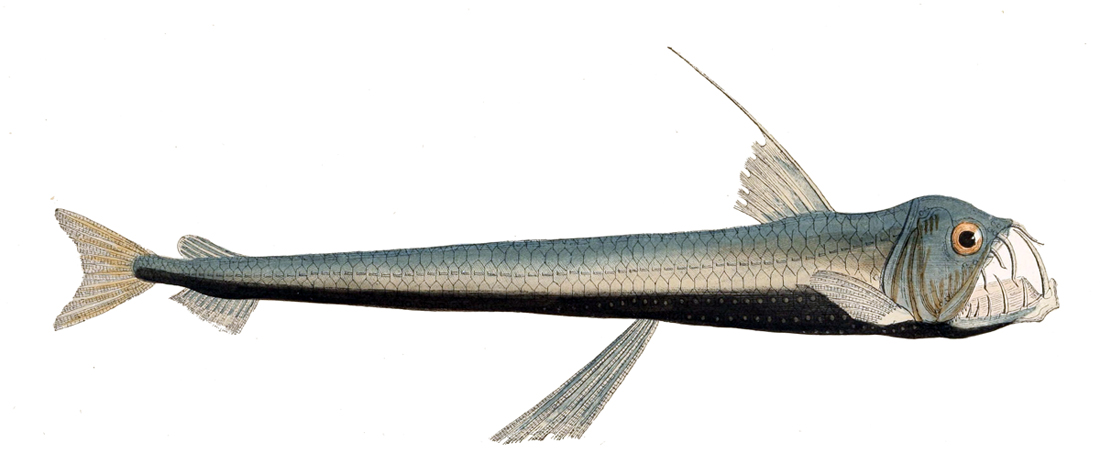
Sloane's viperfish
Deep-sea dragonfish with huge teeth and light organs
Sloane's viperfish is a predatory mesopelagic fish found in tropical and temperate oceans worldwide. It uses bioluminescence for camouflage and possesses hinged jaws with large teeth to trap prey.
- Jaw opens 90 degrees to catch large prey
- Uses light organs for counter-illumination camouflage
- Found in Atlantic, Indian, and Pacific Oceans
- Teeth form a cage to trap smaller organisms
What it is
Sloane's viperfish is a deep-sea dragonfish belonging to the genus Chauliodus. It features a forked caudal fin, an adipose fin, and a dorsal fin positioned just behind the head. The body is covered in a thick, transparent gelatinous casing, and its scales are poorly ossified. Unlike many surface fish, it lacks a gas-filled swim bladder. Its most striking feature is a set of enormous, fixed teeth that form a cage when the jaw closes.
Where it lives
This species inhabits tropical and temperate waters across the globe. It is widespread in the Atlantic Ocean, particularly between 35°N and 55°N, with peak abundance near 45°N. Populations also exist in the western Mediterranean Sea, the Indian Ocean, and the Pacific Ocean. In the Arabian Sea, it is found primarily south of 10°N. Temperature limits its vertical distribution in the water column.
How it lives
As a specialist predator, it consumes lanternfishes, other bony fishes, and crustaceans. It likely lures prey using its photophores or by dangling a long dorsal ray. The fish can open its mouth up to 90 degrees to capture prey up to 63 percent of its own size. Smaller individuals eat proportionally larger prey than adults. Feeding occurs opportunistically without a specific diurnal pattern, allowing the fish to maximize energy efficiency.
Breeding and life cycle
Female Sloane's viperfish reach sexual maturity when they grow between 133 and 191 millimetres in length. Males are believed to mature at slightly smaller sizes. Specific details regarding spawning seasons, egg laying, or larval development are not provided in the available records.
Fish and people
The species serves as prey for larger marine animals. In the central Mediterranean, it forms a primary part of the diet for Atlantic bluefin tuna. Remnants have also been found in the stomachs of pygmy sperm whales and Gervais's beaked whales. Scientists study its unique jaw mechanics and bioluminescent properties for research purposes.
Status and threats
No conservation status is assigned in the provided data. Its wide circumglobal range suggests it is established in multiple ocean basins.

Questions people ask about Sloane's viperfish
How does Sloane's viperfish catch its food?
It unhinges its jaw to open its mouth up to 90 degrees. This allows it to trap prey up to 63 percent of its own body size. It may lure victims using bioluminescent photophores or a long dorsal ray.
Where does this fish live?
It lives in tropical and temperate mesopelagic waters worldwide. You can find it in the Atlantic, Indian, and Pacific Oceans, as well as the western Mediterranean Sea. Temperature restricts its depth range.
What does Sloane's viperfish eat?
It primarily consumes lanternfishes, other bony fishes, and crustaceans. It is an opportunistic feeder that eats large prey rarely to save energy. Smaller individuals often eat proportionally larger meals than adults.
Good reading and sources
- Sloane's viperfish on WikipediaEncyclopedia
- More photos on Wikimedia CommonsPhotos
- Wikidata recordOpen data
The facts on this page come from the Wikipedia article "Sloane's viperfish", written by its contributors and used under the CC BY-SA 4.0 licence, and from its Wikidata record (CC0). EveryFish rewrote the text in its own words, with AI assistance, and compares every page with the article to make sure no passage is copied. It may be reused under the same CC BY-SA 4.0 licence with a link back.
It may contain mistakes, and figures change over time. Nothing here is investment or buying advice. If something is wrong, tell us. Last refreshed 2026-11-15.
Like Sloane's viperfish
All other fish WorldCommon fangtooth
A small, black deep-sea fish with large fangs found worldwide.Other · Open ocean · 1833
 WorldHumpback anglerfish
Deep-sea black seadevil with a glowing lureOther · Open ocean · 1863
 WorldDeepsea lizardfish
A deep-ocean predator with a flattened head and large eyes found in tropical seas worldwide.Other · Deep sea · 1878
 WorldGlasshead barreleye
Deep-sea fish with mirror-based eyesOther · Open ocean
More from Stomiidae
All of them WorldViperfish
Deep-sea fish with fang-like teeth and bioluminescent lures in the genus Chauliodus.Other · Open ocean · 1801
 WorldStoplight loosejaw
Deep-sea dragonfish that hunts with invisible red light.Shark · Deep sea · 1848
 WorldStareater
Small deep-sea fish with a red glowing lureOther · Deep sea
 WorldBlack dragonfish
Deep-sea fish with infrared light and stalked larval eyesOther · Open ocean