
Stoplight loosejaw
Deep-sea dragonfish that hunts with invisible red light.
The stoplight loosejaw is a deep-sea dragonfish found in the mesopelagic and bathypelagic zones of most oceans. It uses unique red bioluminescence to hunt prey without being seen by other creatures.
- Only fish producing red bioluminescence to hunt unseen.
- Uses chlorophyll derivative to see red light.
- Jaw is one-quarter of total body length.
- Eats copepods despite large fang-like teeth.
- Does not perform daily vertical migrations.
What it is
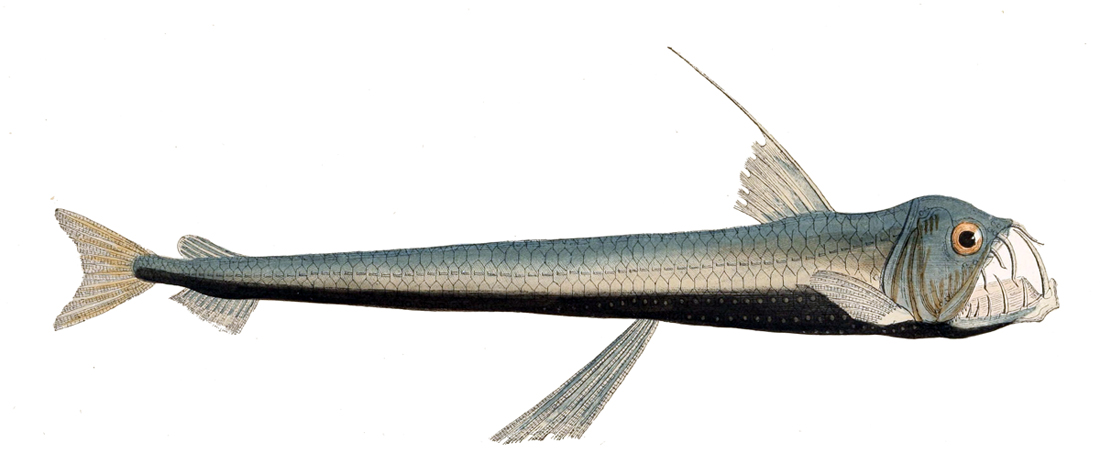
These small dragonfishes belong to the genus Malacosteus. They have elongated bodies with short snouts and large forward-facing eyes for binocular vision. Their skin is black, thin, and scaleless. A key feature is their wide gape, with a lower jaw measuring a quarter of the total length. The jaws lack skin between the rami, allowing them to snap shut quickly. Three photophores sit near the eyes: one emits red light, another green, and a third is tiny and round. Rows of blue lights cover the belly and sides. The name comes from Greek words for soft bone.
Where it lives
They live worldwide in all oceans, avoiding the Arctic and Subantarctic areas. One species ranges from 66° N to 33° S, excluding the Mediterranean. The other lives in the southern transition zone between 25° and 45° S. Both stay below 500 meters, reaching depths of 2500 meters. Unlike other stomiids, they do not migrate vertically each day. Red light fades quickly in water, limiting their visual range compared to blue-light users.
How it lives
They hunt using an invisible beam of red light because most deep-sea prey cannot see it. This allows them to spot food without detection. Despite having large fangs and powerful jaws, they mostly eat zooplankton like copepods. They may snack on these abundant small creatures between larger meals. Their open jaw structure reduces water resistance, helping them grab prey from afar. Unossified vertebrae allow the head to tilt back for a wider bite. Gills remain exposed so they can breathe while swallowing slowly.


Questions people ask about Stoplight loosejaw
How does the stoplight loosejaw hunt?
It produces red light using special photophores near its eyes. Most deep-sea prey cannot see red wavelengths, making the beam invisible. This allows the fish to illuminate and catch prey without being detected by potential competitors or victims.
What makes its vision unique among animals?
It is the only known animal using a chlorophyll derivative to perceive red light. This chemical absorbs long-wave light around 700 nm. It indirectly stimulates visual pigments that normally absorb blue-green light. The fish likely gets this derivative from eating copepods.
Why does it have such a large mouth?
The open jaw structure reduces water resistance when snapping shut. It also allows the fish to swing its entire head forward to grab prey from a distance. Large recurved teeth and strong muscles ensure a secure hold on whatever it catches.
Good reading and sources
- Stoplight loosejaw on WikipediaEncyclopedia
- More photos on Wikimedia CommonsPhotos
- Wikidata recordOpen data
The facts on this page come from the Wikipedia article "Stoplight loosejaw", written by its contributors and used under the CC BY-SA 4.0 licence, and from its Wikidata record (CC0). EveryFish rewrote the text in its own words, with AI assistance, and compares every page with the article to make sure no passage is copied. It may be reused under the same CC BY-SA 4.0 licence with a link back.
It may contain mistakes, and figures change over time. Nothing here is investment or buying advice. If something is wrong, tell us. Last refreshed 2026-11-15.
Like Stoplight loosejaw
All sharks WorldChaunax
A genus of deep-sea anglerfishes known for their large mouths and luring habits.Shark · Deep sea · 1846
 WorldMegalodon
Extinct giant mackerel shark from the Miocene to Pliocene epochs.Shark · Coasts and shelves · 1843
 🇿🇦 South Africa and 4 moreWhale shark
The largest living fish species, a gentle giant of tropical oceans.Shark · Open ocean · 1829
 🇺🇸 United States and 3 moreStethacanthus
Extinct Devonian-Carboniferous shark with a distinctive anvil-shaped dorsal fin.Shark · Coasts and shelves · 1874
More from Stomiidae
All of them WorldViperfish
Deep-sea fish with fang-like teeth and bioluminescent lures in the genus Chauliodus.Other · Open ocean · 1801
 WorldSloane's viperfish
Deep-sea dragonfish with huge teeth and light organsOther · Open ocean · 1801
 WorldStareater
Small deep-sea fish with a red glowing lureOther · Deep sea
 WorldBlack dragonfish
Deep-sea fish with infrared light and stalked larval eyesOther · Open ocean