
Common fangtooth
A small, black deep-sea fish with large fangs found worldwide.
The common fangtooth is a deep-sea species found in tropical and temperate oceans globally. It lives at depths up to 5,000 metres and is known for its large head, sharp teeth, and ability to absorb light efficiently.
- Absorbs 99.5% of light to remain invisible in deep water
- Juveniles look so different they were once named as a separate species
- Found globally in tropical and temperate oceans down to 5,000 m
- Adults grow to about 18 cm with large heads and sharp fangs
What it is
The common fangtooth is a small deep-sea fish reaching about 18 cm in length. Adults are dark brown or black with a large, bony head and no spines. Their bodies taper quickly behind the head, and their skin feels granular. The mouth contains sharp fangs, while the dorsal and anal fins have only soft rays. Unlike many deep-sea relatives, this species possesses a swim bladder. Juveniles look entirely different, appearing pale and triangular with long head spines and large eyes. They lack the prominent fangs of adults and were once classified as a separate species.
Where it lives
This species has a global presence in tropical and temperate oceans. It inhabits the Atlantic, Indian and Pacific basins. Off the western coast of America, its range stretches from British Columbia to south of the equator. These pelagic fish occupy depths between 2 and 5,000 metres. Adults typically reside deeper, between 500 and 5,000 metres, often caught near 2,000 metres. Younger fish stay closer to the surface in shallower waters.
How it lives
The common fangtooth acts as a predator, feeding on other fish, crustaceans and cephalopods. Larger pelagic carnivores such as tuna, marlin and albacore hunt them. They may form small schools or live solitarily. To survive in the dark deep sea, they have evolved extreme light absorption. Melanin granules in their skin capture 99.5 per cent of incoming light, making them nearly invisible to predators that use bioluminescence. This adaptation makes photographing them in their natural environment very difficult.
Breeding and life cycle
These fish reproduce by laying eggs, and their larvae drift as plankton. Off the west coast of North America, breeding activity peaks during the summer months. Studies of otoliths, which are bony structures behind the eyes, indicate a lifespan of at least three years. The transition from juvenile to adult involves significant physical changes, including the development of dark pigmentation and the loss of head spines.
Fish and people
This species holds no value for human fisheries and is not targeted by commercial fishing. However, it serves as a subject for scientific research. Studies have examined how pressure affects its respiration, showing that respiratory rate correlates with body size. Researchers also investigate its unique optical properties, specifically how its skin absorbs light so efficiently compared to other marine life.


Questions people ask about Common fangtooth
How big does the common fangtooth get?
The common fangtooth grows to a total length of about 18 cm (7 in). Despite its fearsome name and large head, it remains a relatively small fish.
Why do juvenile fangtooths look different from adults?
Juveniles are pale, triangular, and have long head spines and large eyes, unlike the dark, fanged adults. They were once thought to be a different species until 1955.
Is the common fangtooth dangerous to humans?
No, it is not dangerous to humans. It lives in deep ocean waters far beyond typical diving ranges and is of no interest to human fisheries.
How does the fangtooth hide in the deep sea?
It uses melanin granules in its skin to absorb 99.5% of incoming light. This makes it practically invisible to predators that hunt using bioluminescence.
Good reading and sources
- Anoplogaster cornuta on WikipediaEncyclopedia
- More photos on Wikimedia CommonsPhotos
- Wikidata recordOpen data
The facts on this page come from the Wikipedia article "Anoplogaster cornuta", written by its contributors and used under the CC BY-SA 4.0 licence, and from its Wikidata record (CC0). EveryFish rewrote the text in its own words, with AI assistance, and compares every page with the article to make sure no passage is copied. It may be reused under the same CC BY-SA 4.0 licence with a link back.
It may contain mistakes, and figures change over time. Nothing here is investment or buying advice. If something is wrong, tell us. Last refreshed 2026-11-15.
Like Common fangtooth
All other fish WorldHumpback anglerfish
Deep-sea black seadevil with a glowing lureOther · Open ocean · 1863
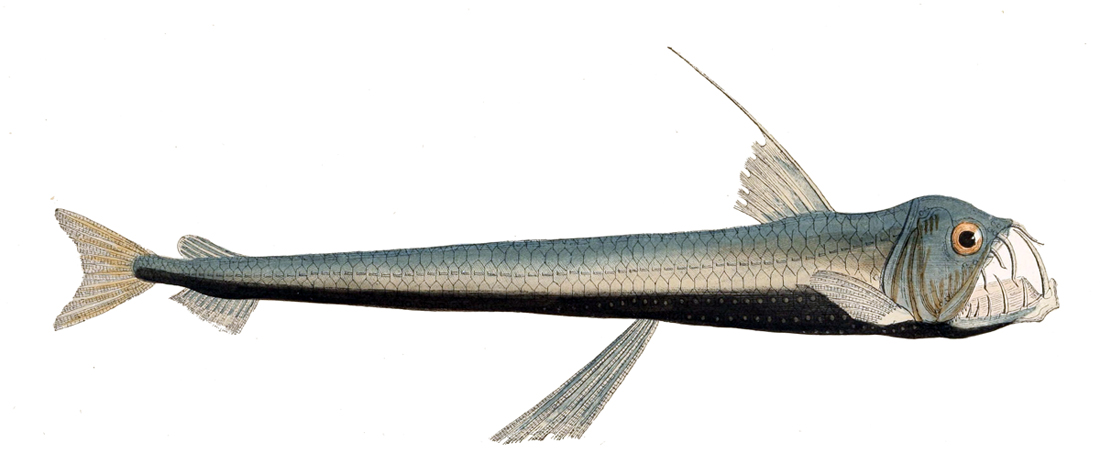 WorldSloane's viperfish
Deep-sea dragonfish with huge teeth and light organsOther · Open ocean · 1801
 WorldDeepsea lizardfish
A deep-ocean predator with a flattened head and large eyes found in tropical seas worldwide.Other · Deep sea · 1878
 WorldBarreleye
Deep-sea fish with tubular eyes and a light-producing anusOther · Open ocean