
Deepsea lizardfish
A deep-ocean predator with a flattened head and large eyes found in tropical seas worldwide.
The deepsea lizardfish (Bathysaurus ferox) is a member of the family Bathysauridae. It was first described by Albert Günther in 1878. This species inhabits the dark depths of tropical and subtropical oceans globally.
- Adults reach over 70 cm with a flattened, lizard-like head.
- Found globally in tropical seas at depths of 600 to 3,500 metres.
- Hermaphroditic with synchronous reproduction to cope with low density.
- Possess an expansive liver constituting up to 20% of total weight.
- First described by Albert Günther in 1878.
What it is
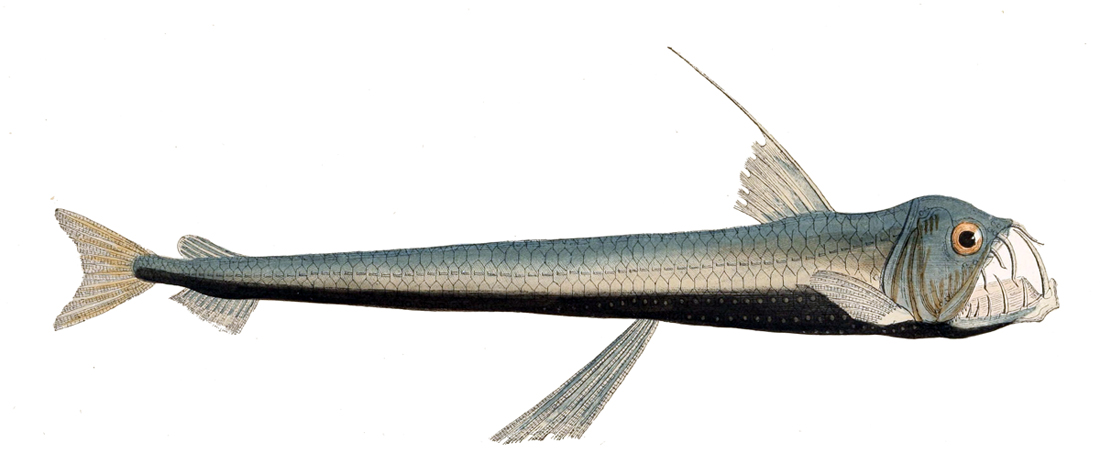
The deepsea lizardfish is an aulopiform fish belonging to the family Bathysauridae. Adults possess a slender, cylindrical body that can exceed 70 centimetres in length. Their head is flattened and bony, resembling a lizard, which distinguishes them from typical shallow-water lizardfishes in the family Synodontidae. The mouth is enormous and lined with multiple rows of long, sharp teeth designed for piercing prey. These fish display whitish, grey, or brown colouring and are covered in tough scales. Enlarged scales run along the lateral line, a sensory organ that detects water movement. Large eyes with wide pupils help detect faint residual sunlight or bioluminescence in the dark depths where they live.
Where it lives
This species occurs circumglobally across tropical and subtropical seas. Its range extends from 65 degrees north latitude to 40 degrees south latitude. They inhabit the aphotic zone, living on the deep ocean floor at depths ranging from 600 to 3,500 metres. Water temperatures in these habitats remain cold, typically between 3 and 4 degrees Celsius. The ecosystem is energy-poor, resulting in very low population densities. Surveys along the Mid-Atlantic Bight recorded only zero to eight individuals per 25,000 square metres. Despite their widespread distribution, they are sparse in any given area due to the harsh conditions of the deep sea.
How it lives
Deepsea lizardfish act as apex predators in their environment. They are predominantly piscivores, hunting demersal and bathypelagic fishes that dwell in the deep. Occasionally, they consume crustaceans, molluscs, and dead fish drifting down from above. Most of the time, they remain motionless on the substrate with their heads raised, waiting for prey. When an opportunity arises, they lunge forward rapidly to snap their trap-like jaws around the victim. They have an expansive liver making up to 20 percent of their body weight, which serves as an energy reserve during sporadic feeding periods. Cannibalism is also observed within this species.
Breeding and life cycle
These fish are hermaphrodites, possessing both male and female reproductive organs. This trait is likely an adaptation to their low population densities. Samples collected off the coast of Virginia between November and January indicate synchronous reproduction. This method maximizes breeding success without requiring larger populations. Mean fecundity rates average around 32,000 ova per fish based on small sample sizes. Larval deepsea lizardfish have been recorded at the ocean surface, suggesting spawning may occur higher in the water column than adult habitats.
Fish and people
Information regarding human interaction with deepsea lizardfish is limited. They are not commonly targeted by commercial fisheries due to their extreme depth habitat. Consequently, there is little data on their use as food or in aquarium trades. Their primary significance lies in scientific research, particularly studies concerning deep-sea biology, adaptation to high pressure, and reproductive strategies in sparse populations. Conservation concerns exist due to their status as common inhabitants of vulnerable deep-ocean ecosystems.
Status and threats
Although widely distributed, deepsea lizardfish are considered a conservation concern. Their existence in the aphotic zone makes them susceptible to unknown threats from deep-sea mining or bottom trawling, though specific impacts are not detailed. The low population density and slow growth potential implied by their energy reserves suggest vulnerability to disturbance. Current knowledge gaps prevent a definitive assessment of their global population trends. Research continues to monitor their ecological role as deep-sea apex predators.


Questions people ask about Deepsea lizardfish
What is the scientific name of the deepsea lizardfish?
The scientific name is Bathysaurus ferox. It belongs to the family Bathysauridae and the order Aulopiformes. The generic name derives from Greek words meaning lizard of the depths.
How deep does the deepsea lizardfish live?
They inhabit the deep ocean floor between 600 and 3,500 metres. They live in the aphotic zone where water temperatures range from 3 to 4 degrees Celsius.
What do deepsea lizardfish eat?
They are primarily piscivores, hunting other deep-dwelling fish. They also eat crustaceans, molluscs, and dead fish drifting down. They sometimes eat members of their own species.
Are deepsea lizardfish related to typical lizardfish?
No. They were formerly classified in Synodontidae but were moved to their own family, Bathysauridae, in 1996 based on genetic and morphological evidence.
Good reading and sources
- Deepsea lizardfish on WikipediaEncyclopedia
- More photos on Wikimedia CommonsPhotos
- Wikidata recordOpen data
The facts on this page come from the Wikipedia article "Deepsea lizardfish", written by its contributors and used under the CC BY-SA 4.0 licence, and from its Wikidata record (CC0). EveryFish rewrote the text in its own words, with AI assistance, and compares every page with the article to make sure no passage is copied. It may be reused under the same CC BY-SA 4.0 licence with a link back.
It may contain mistakes, and figures change over time. Nothing here is investment or buying advice. If something is wrong, tell us. Last refreshed 2026-11-15.
Like Deepsea lizardfish
All other fish WorldHumpback anglerfish
Deep-sea black seadevil with a glowing lureOther · Open ocean · 1863
 WorldCommon fangtooth
A small, black deep-sea fish with large fangs found worldwide.Other · Open ocean · 1833
 WorldSloane's viperfish
Deep-sea dragonfish with huge teeth and light organsOther · Open ocean · 1801
 WorldOarfish
Extremely long pelagic fish known for their ribbon-like bodies and association with sea serpent myths.Other · Open ocean · 1772