
Oarfish
Extremely long pelagic fish known for their ribbon-like bodies and association with sea serpent myths.
Oarfish are large, slender marine fish belonging to the family Regalecidae. They inhabit deep ocean waters worldwide but rarely appear near the surface. Their unusual appearance has inspired folklore linking them to earthquakes and sea monsters.
- Longest bony fish reaches 8 metres
- No swim bladder for depth control
- Shed tails to escape predators
- Linked to earthquake folklore in Japan
- Feeds on zooplankton and small crustaceans
What it is
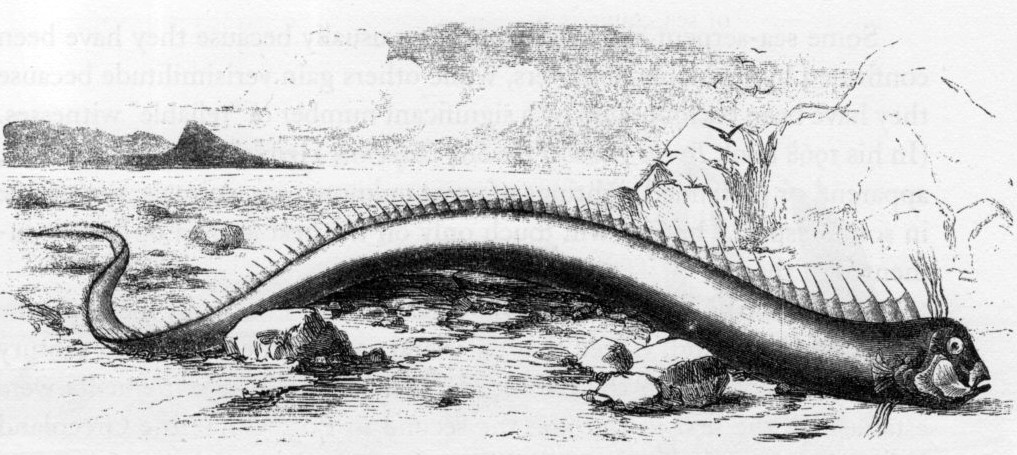
The oarfish comprises three species within the family Regalecidae. These animals possess extremely elongated, ribbon-shaped bodies that lack scales. The giant oarfish holds the record for the longest bony fish, reaching eight metres. Their dorsal fin stretches from above the eyes along the entire back, featuring a crest with reddish spots. Pelvic fins are reduced to thin rays, while pectoral fins sit low on the body. The tail tapers to a fine point, often lacking a distinct caudal fin. Skin may bear hard tubercles in some species. They appear silver with dark spots. Despite their size, they have little muscle mass due to living in calm deep waters without strong currents.
Where it lives
These fish live in tropical, subtropical, and warm temperate oceans across the globe. They typically dwell between two hundred fifty and one thousand metres below the surface. Humans rarely encounter them alive because pressure changes kill them when they rise too quickly. Records come mostly from accidental catches or beachings. Sightings occur in the Gulf of Mexico, off Japan, and in New Zealand. Deep-sea vehicles have filmed them swimming vertically or horizontally. Their distribution spans wide oceanic areas, though specific locations remain poorly documented due to their elusive nature.
How it lives
Oarfish move by undulating their long dorsal fin while keeping their bodies straight. This amiiform swimming allows efficient movement in still deep water. They feed on zooplankton, shrimp, small fish, and jellyfish. Predators likely include shortfin mako sharks and sperm whales. Oarfish exhibit slow flight responses to threats, suggesting few natural enemies. They practice autotomy, shedding their tails to escape predators. The wound heals, but the tail does not grow back. Some specimens show hyperossified bones supporting their spines during movement. They lack swim bladders, relying on constant tail motion to regulate depth.
Breeding and life cycle
Spawning occurs in batches over one or two months. Females release bright, buoyant eggs up to six millimetres wide into the water column. Larvae hatch after three weeks and drift near the surface feeding on zooplankton. Young fish resemble adults less than typical fish, possessing long fins and extensible mouths. Artificial insemination experiments produced larvae that died after four days. Adults spawn off Mexico between July and December. Males have disconnected testes, while females have bifurcated ovaries. Each female produces hundreds of thousands of eggs.
Fish and people
Oarfish are occasionally caught as game fish or commercially on a small scale. Their flesh is gelatinous and generally considered poor for eating. Beachings before storms led to beliefs they predict disasters. In Japan, they are called the Messenger from the Sea God's Palace. Folklore links their appearance to earthquakes and tsunamis. A 2019 study described this link as an illusory correlation. Historical sea serpent tales likely originated from sightings of these large, strange creatures. Researchers value them for studying deep-sea adaptation and evolution.
Status and threats
Data on oarfish populations remains scarce. Conservation status is listed as data deficient. Threats include commercial fishing and habitat disturbance. Their rarity makes population assessment difficult. Beachings often result in death due to decompression. Research efforts focus on understanding their biology through rare captures and remote footage. No specific protection programmes are mentioned. Their role in deep-sea ecosystems is not fully understood. Future studies may clarify their vulnerability to environmental changes.


Questions people ask about Oarfish
Why are oarfish associated with earthquakes?
Folklore in Japan calls them harbingers of doom. Many beachings occurred before the 2011 Tōhoku tsunami. A 2019 study labeled this link an illusory correlation. No scientific evidence supports predictive ability.
How do oarfish swim so slowly?
They undulate their long dorsal fin while keeping bodies straight. This method works well in calm deep waters. They lack swim bladders, requiring constant motion. Muscle mass is minimal due to low current environments.
Can oarfish regrow their tails?
No, they cannot regenerate lost tails. They practice autotomy to escape predators. The wound heals, but the tail remains missing. This adaptation helps survival despite permanent loss.
What do oarfish eat?
They strain zooplankton, shrimp, and small fish. Jellyfish and squid are also consumed. Suction feeding helps capture plankton blooms. Larvae feed similarly on tiny organisms near the surface.
Good reading and sources
- BBC - Earth News - Giant bizarre deep sea fish filmed in Gulf of MexicoBBC, Article
- Oarfish Offer Chance to Study an Elusive Animal Long Thought a Monster (Published 2013)The New York Times, Article
- Third oarfish, mythical harbinger of doom, found washed up in CaliforniaThe Guardian, Article
The facts on this page come from the Wikipedia article "Oarfish", written by its contributors and used under the CC BY-SA 4.0 licence, and from its Wikidata record (CC0). EveryFish rewrote the text in its own words, with AI assistance, and compares every page with the article to make sure no passage is copied. It may be reused under the same CC BY-SA 4.0 licence with a link back.
It may contain mistakes, and figures change over time. Nothing here is investment or buying advice. If something is wrong, tell us. Last refreshed 2026-11-15.
Like Oarfish
All other fish WorldAnglerfish
Ray-finned fish using a modified dorsal fin ray as a lure to catch prey.Other · Coasts and shelves · 1829
 WorldDeepsea lizardfish
A deep-ocean predator with a flattened head and large eyes found in tropical seas worldwide.Other · Deep sea · 1878
 🇯🇵 Japan and 1 moreGiant grenadier
A large deep-sea rattail from the North Pacific.Other · Open ocean
 🇺🇸 United States and 2 moreGar
Ancient armored fish with lung-like swim bladders found in North American waters.Ancient · Rivers and lakes · 1758
