Schizothorax plagiostomus
A high-altitude cyprinid from the Himalayan rivers.
This ray-finned fish lives in fast-flowing Himalayan streams across South and Central Asia. It supports local food supplies and commercial fishing in mountain regions like Kashmir and Nepal.
- Grows up to 60 cm long and weighs 2.5 kg
- Spawns twice yearly in fast-flowing clear water
- Key food fish in the Himalayan region
- Features a unique horny lower jaw called sector mouth
- Found in rivers across China, India, Pakistan and Nepal
What it is
This species belongs to the carp family and features an elongated, sub-cylindrical body. Its head is somewhat flattened with a short, blunt snout that may have warts in males. The mouth sits below the head and has fleshy lips with a hard, horny lower edge known as a sector mouth. Two pairs of barbels are present near the mouth. The dorsal fin aligns with the pelvic fins and has a strong, serrated rear ray. Small elliptical scales cover the body, and the tail fin is deeply notched. Adults grow up to 60 cm long and weigh around 2.5 kg.
Where it lives
Its habitat spans the Himalayan river systems and their tributaries. Populations exist in China, Afghanistan, Pakistan, Turkistan, Nepal, Ladakh, Tibet, Bhutan and north-eastern India. Within India, it is prominent in Kashmir, Himachal Pradesh, Uttarakhand, the Uttar Pradesh foothills and Assam. These fish thrive in fast-moving, high-elevation streams where they show strong adaptation to the cold, oxygen-rich environment.
How it lives
These fish are well-suited to rapid currents in mountain waters. They form part of a group of twelve species in Pakistan that help scientists study evolutionary changes in high-altitude environments. Their body shape and mouth structure allow them to feed and maintain position in strong flows. Specific details on their daily diet or predator interactions are not provided in the available records.
Breeding and life cycle
Sexual maturity occurs when the fish reaches 18 to 24 cm in length. Spawning takes place twice a year, during September to October and March to April. They lay eggs in natural and artificial settings. Ideal conditions include clear water with a current speed of 2.8 to 4 m/s, a pH of 7.5, and dissolved oxygen levels between 10 and 15 mg/L. The substrate consists of gravel or fine pebbles at a shallow depth of 10 to 30 cm.
Fish and people
It serves as a key food source in the Himalayan region and contributes to commercial fish production. Local communities in areas like Kashmir and Himachal Pradesh rely on this species for sustenance and trade. The fish is also known by various regional names such as khont and swati fish, reflecting its cultural presence in these mountainous areas.
Questions people ask about Schizothorax plagiostomus
Where does this fish live?
It inhabits fast-running rivers and tributaries throughout the Himalayas. Its range includes parts of China, Afghanistan, Pakistan, Nepal, Bhutan, Tibet, Ladakh and north-eastern India.
What does it eat?
The provided text does not specify the diet of this species. It focuses on physical description, distribution, breeding habits and its role as a food fish for humans.
When does it spawn?
Spawning occurs in two seasons: September to October and March to April. It requires clear water with specific flow rates, oxygen levels and gravel beds at shallow depths.
Good reading and sources
- Schizothorax plagiostomus on WikipediaEncyclopedia
- More photos on Wikimedia CommonsPhotos
- Wikidata recordOpen data
The facts on this page come from the Wikipedia article "Schizothorax plagiostomus", written by its contributors and used under the CC BY-SA 4.0 licence, and from its Wikidata record (CC0). EveryFish rewrote the text in its own words, with AI assistance, and compares every page with the article to make sure no passage is copied. It may be reused under the same CC BY-SA 4.0 licence with a link back.
It may contain mistakes, and figures change over time. Nothing here is investment or buying advice. If something is wrong, tell us. Last refreshed 2026-11-15.
Like Schizothorax plagiostomus
All carps and minnows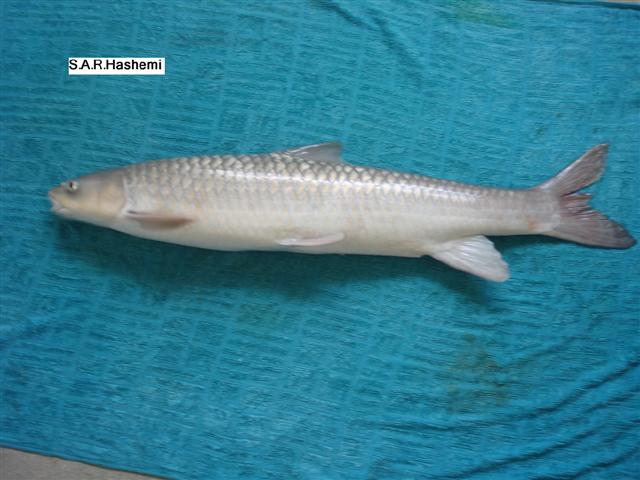 🇮🇷 Iran and 1 moreShabout
A large freshwater carp native to the Tigris-Euphrates basin in Western Asia.Carp · Rivers and lakes
 🇯🇵 JapanNigorobuna
Wild carp from Lake Biwa used for fermented sushi.Carp · Rivers and lakes
 🇮🇳 India and 4 moreRohu
A large silver carp from South Asian rivers, farmed for food and prized as a game fish.Carp · Rivers and lakes
 🇺🇸 United States and 1 moreGolden shiner
A North American minnow used widely as bait and in pond culture.Carp · Rivers and lakes
More from Cyprinidae
All of them 🇮🇳 India and 4 moreCommon snowtrout
A cold-water cyprinid from Himalayan rivers.Carp · Rivers and lakes
 🇲🇾 Malaysia and 1 moreHarlequin rasbora
A small, colourful freshwater fish popular in home aquariums for its distinctive black body marking.Carp · Rivers and lakes
🇵🇰 Pakistan and 3 moreGolden barb
Small Asian cyprinid found in rivers and aquariumsCarp · Rivers and lakes
 🇹🇭 Thailand and 2 moreSiamese mud carp
Freshwater cyprinid native to Mekong and Chao Phraya riversCarp · Rivers and lakes