
Port Jackson shark
A blunt-headed, egg-laying shark from southern Australia.
The Port Jackson shark is a nocturnal, bottom-dwelling species found in temperate waters off southern Australia. It grows up to 1.65 metres and is known for its harness-like markings and unique teeth adapted for crushing shells. This oviparous shark migrates annually to breed and poses little danger to humans.
- Grows up to 1.65 metres long
- Lays eggs with a spiral casing
- Crushes shells with flat back teeth
- Migrates south in summer, north in winter
- Can breathe while resting on the seabed
What it is
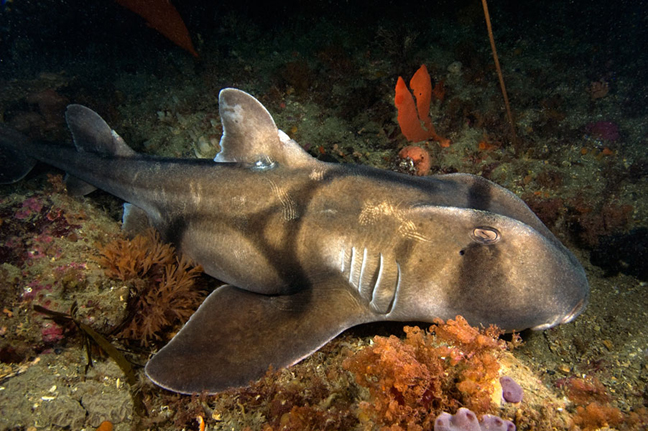
This bullhead shark has a broad, blunt head with ridges above the eyes. Its body is grey-brown with dark, harness-like bands that cross the eyes and run along the back. Two dorsal fins of similar size sit near the rear, each preceded by a sharp spine. These spines are rumoured to be venomous. The mouth is small, and nostrils connect directly to it. Adults reach lengths of 1.65 metres, making them the largest in their genus.
Where it lives
The species lives in temperate coastal waters around southern Australia. Its range extends from southern Queensland down to Tasmania and west to central Western Australia. Rare sightings have occurred off New Zealand. It prefers rocky environments but also inhabits sandy bottoms, muddy areas, and seagrass beds. Sharks usually stay below 100 metres but can dive as deep as 275 metres.
How it lives
Active at night, this shark rests in caves or rocky outcrops during the day. It feeds on sea urchins, molluscs, and crustaceans, using specialised teeth to crush hard shells. Juveniles eat more soft-bodied prey. The shark can pump water over its gills while stationary, allowing it to breathe without swimming. Adults often rest in groups, showing preference for partners of similar sex and size.
Breeding and life cycle
Males mature at eight to ten years, females at eleven to fourteen. Breeding occurs annually from late August to November. Females lay pairs of eggs every eight to seventeen days, producing up to eight pairs per season. Eggs take ten to eleven months to hatch. Mortality rates for eggs are high, estimated at nearly ninety per cent, largely due to predation by other sharks.
Fish and people
This shark has no major commercial value and is not a common food source. It is generally harmless to humans, though one minor bite incident was recorded in Melbourne. Scientists use the species to study bottom-dwelling shark behaviour. It is sometimes caught as bycatch in fishing nets. Research has shown juveniles can learn to associate lights or sounds with food rewards.
Status and threats
The International Union for Conservation of Nature lists the species as Least Concern. However, egg mortality is very high. In New Zealand, it is classified as Vagrant with a Secure Overseas qualifier. Threats include predation on embryos by other sharks and incidental capture in fishing gear. Population trends remain largely unknown outside of these specific threats.


Questions people ask about Port Jackson shark
Is the Port Jackson shark dangerous to humans?
No, it is not considered dangerous. It has small teeth adapted for crushing shells, not tearing flesh. One recorded incident involved a minor bite that did not pierce the skin, and the person swam away safely.
What does the Port Jackson shark eat?
It primarily feeds on hard-shelled prey such as sea urchins, molluscs, and crustaceans. Its unique teeth allow it to hold and crush these shells. Juveniles also consume soft-bodied fish and other prey.
How does the Port Jackson shark reproduce?
It is oviparous, meaning it lays eggs. Females deposit pairs of screw-shaped egg capsules on the seabed between August and November. The eggs take about ten months to hatch, and many are eaten by predators before hatching.
Good reading and sources
- Port Jackson shark on WikipediaEncyclopedia
- More photos on Wikimedia CommonsPhotos
- Wikidata recordOpen data
The facts on this page come from the Wikipedia article "Port Jackson shark", written by its contributors and used under the CC BY-SA 4.0 licence, and from its Wikidata record (CC0). EveryFish rewrote the text in its own words, with AI assistance, and compares every page with the article to make sure no passage is copied. It may be reused under the same CC BY-SA 4.0 licence with a link back.
It may contain mistakes, and figures change over time. Nothing here is investment or buying advice. If something is wrong, tell us. Last refreshed 2026-11-15.
Like Port Jackson shark
All sharks WorldSmall-spotted catshark
A common shallow-water shark found across the northeast Atlantic and Mediterranean.Shark · Coasts and shelves
 WorldBasking shark
The second-largest living fish, a slow-moving filter feeder found in temperate oceans worldwide.Shark · Coasts and shelves · 1765
 🇺🇸 United States and 1 moreLeopard shark
A coastal Pacific houndshark with black saddle markings and spots.Shark · Coasts and shelves · 1854
 🇺🇸 United States and 2 moreSwell shark
A catshark that inflates its body for defenceShark · Coasts and shelves · 1880
