
Leopard shark
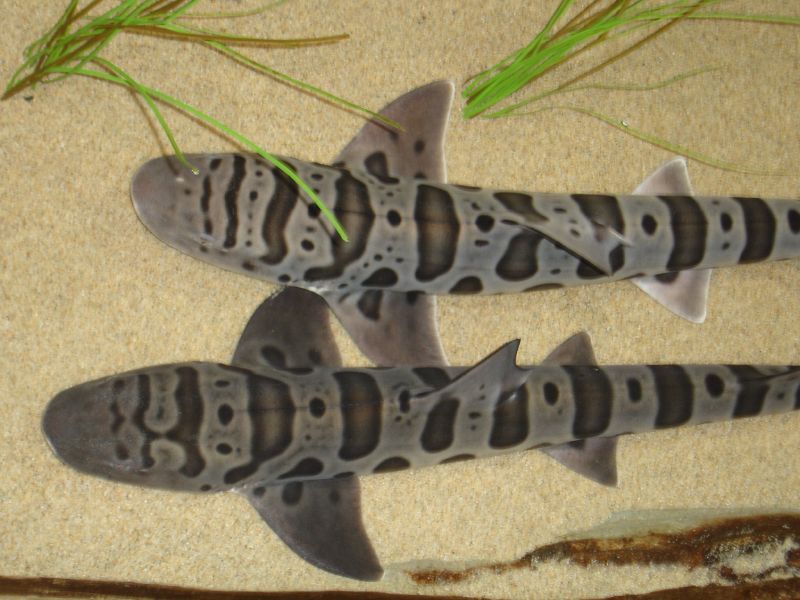
A coastal Pacific houndshark with black saddle markings and spots.
The leopard shark is a slender houndshark found along the eastern Pacific coast from Oregon to Mexico. It is known for its distinctive dark patterns and shallow-water habitat, where it feeds on crustaceans and small fish.
- Distinctive black saddle markings and spots identify this houndshark.
- Found in shallow Pacific bays from Oregon to Mexico.
- Gives birth to live young after a ten-to-twelve-month gestation.
- Feeds on crabs, clams, worms, and small fish using suction.
- Assessed as Least Concern, though local stocks face overfishing risks.
What it is
This slender-bodied shark belongs to the houndshark family and displays a striking pattern of black saddle-like markings and large spots over its back. Adults typically measure between 1.2 and 1.5 metres, though females can reach up to 2.1 metres. The species has a short, rounded snout and large eyes protected by a nictitating membrane. Its colouration ranges from silvery to bronzy gray on the upper body, fading to white underneath. Juveniles often have lighter centres to their markings compared to adults.
Where it lives
Leopard sharks inhabit the northeastern Pacific Ocean, ranging from Coos Bay in Oregon to Mazatlán in Mexico, including the Gulf of California. They prefer shallow waters less than four metres deep, frequenting muddy or sandy flats within enclosed bays and estuaries. They are also found near kelp beds, rocky reefs, and occasionally near warm power plant discharges. While most stay in localized areas, some individuals migrate south in winter when water temperatures drop below ten degrees Celsius.
How it lives
These active predators swim with a strong undulating motion and are more active at night. They often follow tides onto intertidal mudflats to forage, retreating before the water recedes completely. Their diet includes crabs, shrimp, clams, fat innkeeper worms, and small bony fish. They capture prey using suction created by expanding their buccal cavity. Young sharks fall prey to larger species like great white sharks and sevengill sharks. Parasites such as tapeworms and copepods are common inhabitants of this species.
Breeding and life cycle
The leopard shark is aplacental viviparous, meaning embryos develop inside the uterus nourished by a yolk sac. Gestation lasts ten to twelve months, with births occurring from March to June. Females give birth to one to thirty-seven young, depending on their size. Nursery grounds include bays and sloughs in northern areas, while southern populations may give birth in more open waters. Newborns measure around twenty centimetres and grow slowly, reaching maturity after seven to thirteen years.
Fish and people
Although harmless to humans, this species is caught by commercial and recreational fisheries primarily off the coast of California. It is harvested for food and enters the aquarium trade. After population declines in the 1980s, new regulations in the early 1990s helped restore sustainable harvest levels. The International Union for Conservation of Nature lists the species as Least Concern, though local stocks remain vulnerable due to slow growth rates and limited migration habits.
Status and threats
The global population is assessed as Least Concern by the IUCN. However, genetic studies reveal distinct subpopulations along the Californian coast with limited mixing. This isolation makes specific groups susceptible to local overfishing. Conservation efforts focus on maintaining sustainable catch limits, particularly in California waters. The species' slow maturation and site fidelity increase the risk of depletion if fishing pressure intensifies without adequate management controls.


Questions people ask about Leopard shark
What does a leopard shark look like?
It has a slender body with black saddle-like markings and large spots on a silvery to bronzy gray background. The underside is plain white. Adults typically measure 1.2 to 1.5 metres, with females growing larger than males.
Where do leopard sharks live?
They inhabit the northeastern Pacific Ocean from Oregon to Mexico. They prefer shallow coastal waters less than four metres deep, frequenting sandy or muddy flats in bays and estuaries, as well as areas near kelp beds and reefs.
What do leopard sharks eat?
Their diet consists of crabs, shrimp, clams, fat innkeeper worms, and small bony fish. They use suction to extract prey from the sediment and may tear entire bodies out of shells using a levering motion.
Are leopard sharks dangerous to humans?
No, they are considered harmless to humans. They are caught by fisheries for food and the aquarium trade but do not pose a threat to swimmers or divers.
How fast do leopard sharks grow?
They are relatively slow-growing. Males grow about two centimetres per year and mature in seven to thirteen years. Females grow slightly faster at 2.3 centimetres per year and also take many years to reach sexual maturity.
Good reading and sources
- Leopard shark on WikipediaEncyclopedia
- More photos on Wikimedia CommonsPhotos
- Wikidata recordOpen data
The facts on this page come from the Wikipedia article "Leopard shark", written by its contributors and used under the CC BY-SA 4.0 licence, and from its Wikidata record (CC0). EveryFish rewrote the text in its own words, with AI assistance, and compares every page with the article to make sure no passage is copied. It may be reused under the same CC BY-SA 4.0 licence with a link back.
It may contain mistakes, and figures change over time. Nothing here is investment or buying advice. If something is wrong, tell us. Last refreshed 2026-11-15.
Like Leopard shark
All sharks 🇮🇩 Indonesia and 4 moreEstuarine stonefish
A venomous marine ray-finned fish found in the Indo-Pacific region.Shark · Coasts and shelves · 1766
 🇺🇸 United States and 1 moreHorn shark
Small spotted bullhead shark from the eastern Pacific coast.Shark · Coasts and shelves · 1855
 🇦🇺 Australia and 2 moreTasselled wobbegong
A camouflaged carpet shark with a fringed head.Shark · Coasts and shelves · 1867
 WorldBigeye thresher
Deep-diving shark with huge eyes and a long tail.Shark · Open ocean · 1840
More from Triakidae
All of them EuropeCommon smooth-hound
A grey-brown houndshark of the eastern Atlantic and Mediterranean.Shark · Coasts and shelves
 WorldSchool shark
A temperate houndshark valued for liver oil and meat.Shark · Coasts and shelves
 🇦🇺 AustraliaGummy shark
A bottom-dwelling shark from southern Australia known for its crushing teeth and commercial fillets.Shark · Coasts and shelves