
Pengba
A ray-finned fish native to Manipur and Myanmar.
Pengba is a ray-finned fish species once common in Manipur, India. Dam construction and invasive species wiped out wild populations there. It now survives in the wild only in Myanmar, though farmers in Manipur still raise it for food.
- Extirpated from wild in Manipur, India
- Wild populations remain only in Myanmar
- Farmed in Manipur for local food supply
- Named after explorer Charles Paulus Bélanger
What it is
Pengba is a ray-finned fish belonging to the genus Osteobrama. It is known locally in Meitei as Pengba. The species was named after Charles Paulus Bélanger, a botanist and explorer who collected the original specimen. This fish has a streamlined body typical of cyprinids. It was historically found in the waterways of Manipur but no longer exists there in the wild.
Where it lives
This species was originally native to the Indian state of Manipur. However, it has been completely extirpated from that region. As of 2022, wild populations are found only in Myanmar. The loss of its habitat in India was driven by environmental changes and human activity. It inhabits freshwater systems in these South and Southeast Asian regions.
How it lives
Specific details on daily behaviour, diet, and predators are not provided in the available records. The species likely shares traits with other members of its genus, such as schooling in freshwater environments. Its survival in Myanmar suggests it can adapt to remaining natural habitats despite regional pressures. Fragmentation of populations has affected its genetic diversity and distribution.
Breeding and life cycle
Information regarding spawning seasons, egg development, and juvenile growth is not included in the current data. Like many cyprinids, it likely reproduces in freshwater during specific seasonal cycles. Conservation efforts may depend on understanding these reproductive habits to support farmed and wild stocks effectively.
Fish and people
Local communities in Manipur continue to consume Pengba, sourced entirely from aquaculture farms. Wild-caught specimens from Myanmar also serve as a food source. The fish holds cultural significance in Manipur, where it is known by the traditional name Pengba. Farming helps maintain its presence in local diets despite its disappearance from natural waters in India.
Status and threats
The species is extirpated from its historic range in Manipur, India. Key threats included dam construction, which altered water flow, and habitat degradation. The introduction of alien species further fragmented wild populations. While it persists in Myanmar, the loss of its Indian stronghold highlights vulnerability to infrastructure projects and invasive competitors.

Questions people ask about Pengba
Where can I find wild Pengba today?
Wild populations are currently found only in Myanmar. The species was extirpated from its native range in Manipur, India, due to habitat loss and other factors.
Why did Pengba disappear from Manipur?
Dam building, habitat degradation, and the introduction of alien species caused population fragmentation and eventual extirpation from the wild in Manipur.
Is Pengba still eaten in Manipur?
Yes, it is still used as food in Manipur, but the supply comes from farmed populations rather than wild catches from local rivers.
Good reading and sources
- Osteobrama belangeri on WikipediaEncyclopedia
- More photos on Wikimedia CommonsPhotos
- Wikidata recordOpen data
The facts on this page come from the Wikipedia article "Osteobrama belangeri", written by its contributors and used under the CC BY-SA 4.0 licence, and from its Wikidata record (CC0). EveryFish rewrote the text in its own words, with AI assistance, and compares every page with the article to make sure no passage is copied. It may be reused under the same CC BY-SA 4.0 licence with a link back.
It may contain mistakes, and figures change over time. Nothing here is investment or buying advice. If something is wrong, tell us. Last refreshed 2026-11-15.
Like Pengba
All carps and minnows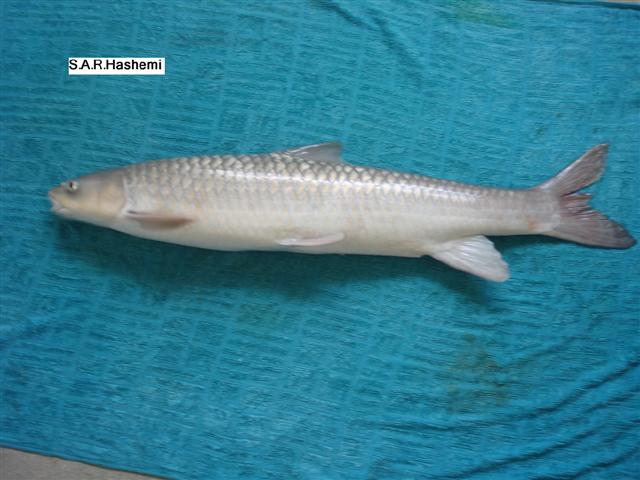 🇮🇷 Iran and 1 moreShabout
A large freshwater carp native to the Tigris-Euphrates basin in Western Asia.Carp · Rivers and lakes
 🇯🇵 JapanNigorobuna
Wild carp from Lake Biwa used for fermented sushi.Carp · Rivers and lakes
 🇮🇳 India and 4 moreRohu
A large silver carp from South Asian rivers, farmed for food and prized as a game fish.Carp · Rivers and lakes
 🇺🇸 United States and 1 moreGolden shiner
A North American minnow used widely as bait and in pond culture.Carp · Rivers and lakes
More from Cyprinidae
All of them 🇮🇳 India and 4 moreCommon snowtrout
A cold-water cyprinid from Himalayan rivers.Carp · Rivers and lakes
 🇲🇾 Malaysia and 1 moreHarlequin rasbora
A small, colourful freshwater fish popular in home aquariums for its distinctive black body marking.Carp · Rivers and lakes
🇵🇰 Pakistan and 3 moreGolden barb
Small Asian cyprinid found in rivers and aquariumsCarp · Rivers and lakes
 🇹🇭 Thailand and 2 moreSiamese mud carp
Freshwater cyprinid native to Mekong and Chao Phraya riversCarp · Rivers and lakes