
Orange chromide
Small spotted cichlid from India and Sri Lanka
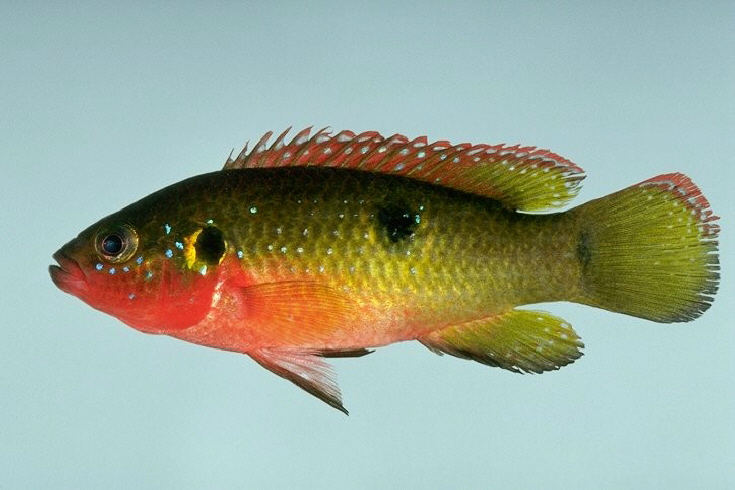
The orange chromide is a small cichlid fish native to southern India and Sri Lanka. It lives in fresh and brackish waters and is popular in home aquariums due to its unique parental care behaviour.
- Grows to a maximum length of 8 cm
- Young fish feed on parental mucous secretions
- Endemic to southern India and Sri Lanka
- Acts as a cleaner for the green chromide
What it is
The orange chromide is a small member of the cichlid family. It grows to a maximum length of eight centimetres. Its scientific name includes the word for spotted, referring to a large black mark on its upper sides. This fish is found in both fresh and slightly salty water environments. It is well known among hobbyists who keep tropical fish in tanks.
Where it lives
This species is endemic to the southern parts of India and Sri Lanka. It inhabits streams, lagoons and estuaries where river water meets the sea. These habitats provide the mix of freshwater and brackish conditions the fish requires. It shares these waters with other local species, including the larger green chromide.
How it lives
The orange chromide has a varied diet that includes algae and tiny aquatic animals called zooplankton. It also exhibits a special relationship with the green chromide. While it eats the eggs and young of this larger neighbour, it also cleans parasites from their bodies. This mutual interaction is a form of cleaning symbiosis seen in some reef and freshwater fish.
Breeding and life cycle
Parental care is vital for the survival of young orange chromides. After hatching, the fry do not just hunt for food immediately. Instead, they feed on a mucous coating secreted by their parents. During this nursing period, the glands of the adult fish increase their output significantly to support the growing offspring.
Fish and people
Fishkeepers value this species for its interesting behaviour and manageable size. It is a common choice for community tanks that mimic brackish or freshwater conditions. In Kerala, India, locals know it as pallathi. Its role in cleaning other fish makes it an intriguing subject for observation in captivity.

Questions people ask about Orange chromide
What does the orange chromide eat?
It feeds on algae, zooplankton, and the eggs or larvae of the green chromide. It also removes parasites from the larger green chromide in a cleaning symbiosis relationship.
How do baby orange chromides survive?
Survival depends on parental care. The young feed on a mucous coating secreted by their parents. This secretion increases by thirty four percent during the feeding period.
Where is the orange chromide found?
It is endemic to southern India and Sri Lanka. It lives in freshwater and brackish habitats such as streams, lagoons and estuaries.
Good reading and sources
- Orange chromide on WikipediaEncyclopedia
- More photos on Wikimedia CommonsPhotos
- Wikidata recordOpen data
The facts on this page come from the Wikipedia article "Orange chromide", written by its contributors and used under the CC BY-SA 4.0 licence, and from its Wikidata record (CC0). EveryFish rewrote the text in its own words, with AI assistance, and compares every page with the article to make sure no passage is copied. It may be reused under the same CC BY-SA 4.0 licence with a link back.
It may contain mistakes, and figures change over time. Nothing here is investment or buying advice. If something is wrong, tell us. Last refreshed 2026-11-15.
Like Orange chromide
All cichlids 🇲🇽 Mexico and 4 moreJack Dempsey
Aggressive cichlid native to Central AmericaCichlid · Rivers and lakes
 Sub-Saharan AfricaJewel cichlid
Brightly colored African cichlids kept in aquariums for their vivid breeding colours and parental care.Cichlid · Rivers and lakes
 🇺🇸 United States and 1 moreTexas cichlid
The only cichlid native to the United StatesCichlid · Rivers and lakes
 🇿🇦 South Africa and 4 moreMozambique tilapia
A hardy cichlid from southeastern Africa, now farmed globally and listed as a major invasive species.Cichlid · Rivers and lakes
More from Cichlidae
All of them 🇹🇿 Tanzania and 2 moreSingida tilapia
A cichlid fish native to the Lake Victoria basin in East Africa.Cichlid · Rivers and lakes
 WorldAuratus cichlid
Small, colourful cichlid from Lake MalawiCichlid · Rivers and lakes
 🇭🇳 Honduras and 3 moreJaguar cichlid
Large predatory cichlid from Central American lakesCichlid · Rivers and lakes
 Sub-Saharan AfricaPrincess cichlid
A cooperative schooling cichlid from Lake Tanganyika.Cichlid · Rivers and lakes