
Kuhl's maskray
A venomous, blue-spotted stingray found in Indo-Pacific waters.
Kuhl's maskray is a tropical stingray with a green body and bright blue spots. It lives in shallow coastal waters from Africa to the Pacific. Fishermen catch it for meat and skin, while aquarists value its striking appearance despite its venomous nature.
- Disk width reaches up to 47 cm with a total length of 70 cm.
- Venomous tail spines contain serotonin and phosphodiesterase.
- Skin is traditionally used for making Arab and Turkish drums.
- Mating season occurs in October and November in Australian waters.
What it is
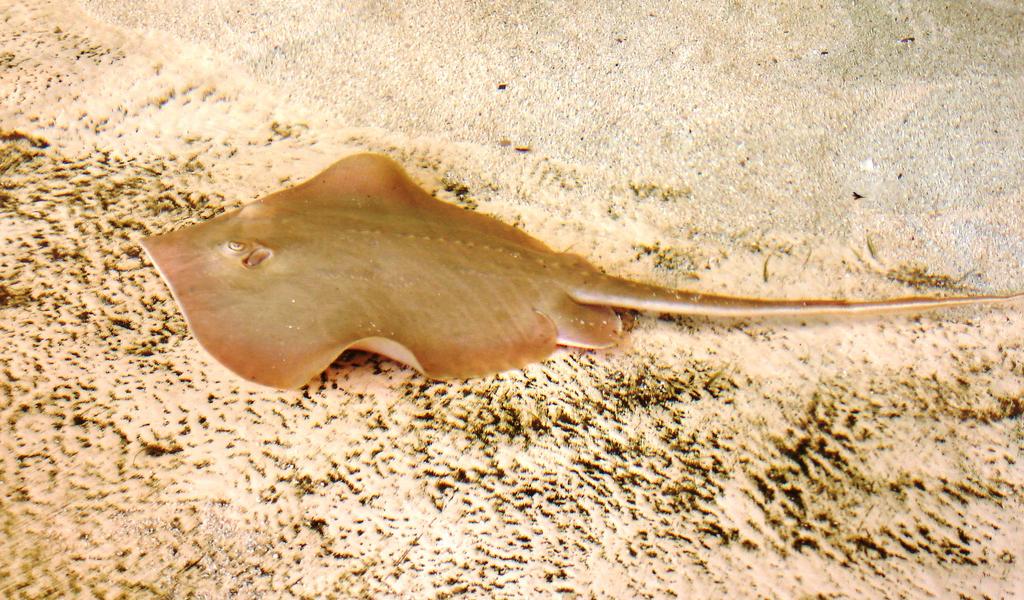
Kuhl's maskray has a flat, rhomboid body that can reach 47 cm in width. Its upper surface is dark green with vivid blue spots, while the belly is white. This countershading helps it blend into the seabed. The ray possesses a long tail, roughly twice its body length, equipped with two venomous spines. Bright yellow eyes sit high on the head, providing a wide field of view. Spiracles behind the eyes allow breathing while resting on the bottom.
Where it lives
This species inhabits tropical waters between 29°N and 31°S. Its range extends from Kenya and Madagascar in the west to Japan and the Pacific islands in the east. It is common in northern Australia, India, and throughout Southeast Asian seas like the Java and Celebes Seas. The ray prefers depths under 90 metres, frequenting sand flats, mud bottoms, seagrass beds, and coral reefs. It often moves into shallow lagoons during high tide.
How it lives
Kuhl's maskray feeds on shrimp, crabs, worms, and small bony fish. It uses its pectoral fins to pin prey against the seafloor before crushing it with plate-like teeth. Unlike many relatives, it buries itself in sand primarily to hide from predators rather than to ambush food. Larger sharks, such as hammerheads, hunt these rays by pinning them down. The ray’s bright colours warn potential threats of its venomous barbs.
Breeding and life cycle
Females reproduce annually through ovoviviparity, retaining eggs inside the body until they hatch. Embryos feed on uterine fluid during development. Mating occurs in October and November, with ovulation following in the Australian summer. A mother gives birth to up to seven pups, each measuring between 15 and 33 cm. These young rays are independent from birth and carry 32 sets of chromosomes.
Fish and people
Fishermen in the Java Sea catch this ray in large numbers using trawls and seines. The meat is often dried, salted, or smoked for local markets. Its tough skin is used to make traditional drums like the darbuka. The aquarium trade values the species for its beauty, though adults outgrow many home tanks. Researchers have identified peptides in its proteins that may protect against oxidation.
Status and threats
Coral reef destruction poses a significant threat, particularly in the north-western Pacific. Pollution from agricultural runoff further degrades its habitat. In Queensland, Australia, protected areas like the Great Barrier Reef Marine Park offer some refuge. However, heavy fishing pressure remains a concern, with the species being a major component of ray catches in some regions.


Questions people ask about Kuhl's maskray
Is Kuhl's maskray dangerous to humans?
Yes, it possesses two venomous spines on its tail base. The venom contains serotonin and enzymes that cause pain. While not aggressive, accidental contact can result in injury. Its bright colouring serves as a warning to potential predators and humans alike.
What does Kuhl's maskray eat?
It feeds on shallow-bottom marine life including shrimp, crabs, worms, mollusks, and small bony fish. The ray uses its fins to pin prey to the seafloor and crushes it with specialized plate-like teeth located in its lower jaw.
Where can I find this stingray?
It lives in tropical coastal waters across the Indo-Pacific. Common locations include northern Australia, Indonesia, Japan, India, and the east coast of Africa. It prefers sandy or muddy bottoms near reefs and seagrass beds at depths under 90 metres.
How big do they get?
The disk width can reach up to 47 cm, while the total length including the tail is about 70 cm. Females tend to live longer than males, reaching an estimated age of 13 years compared to 10 years for males.
Good reading and sources
- Kuhl's maskray on WikipediaEncyclopedia
- More photos on Wikimedia CommonsPhotos
- Wikidata recordOpen data
The facts on this page come from the Wikipedia article "Kuhl's maskray", written by its contributors and used under the CC BY-SA 4.0 licence, and from its Wikidata record (CC0). EveryFish rewrote the text in its own words, with AI assistance, and compares every page with the article to make sure no passage is copied. It may be reused under the same CC BY-SA 4.0 licence with a link back.
It may contain mistakes, and figures change over time. Nothing here is investment or buying advice. If something is wrong, tell us. Last refreshed 2026-11-15.
Like Kuhl's maskray
All rays and skates WorldSpotted eagle ray
Tropical ray with white spots and a long tail.Ray · Coasts and shelves · 1790
 WorldSouthern stingray
A large, flat whiptail ray of the Western Atlantic.Ray · Coasts and shelves
 🇦🇺 Australia and 4 moreLargetooth sawfish
A critically endangered ray with a toothed rostrum that enters rivers.Ray · Rivers and lakes
 WorldBluespotted ribbontail ray
A small, colourful reef stingray with electric blue spots.Ray · Coasts and shelves · 1775
More from Dasyatidae
All of them WorldCowtail stingray
Large Indo-Pacific stingray with a distinctive tail fold.Ray · Rivers and lakes
 EuropeCommon stingray
A venomous ray of Atlantic and Mediterranean coastal waters.Ray · Coasts and shelves · 1758
 🇿🇦 South Africa and 4 moreReticulate whipray
A large spotted stingray from the western Indian Ocean and eastern Mediterranean.Ray · Coasts and shelves · 1789
 🇺🇸 United States and 1 moreAtlantic stingray
Small stingray found in Atlantic coastal waters and fresh rivers.Ray · Rivers and lakes · 1824