
Indian oil sardine
Small commercial fish of the northern Indian Ocean
The Indian oil sardine is a ray-finned fish found in the northern Indian Ocean. It is a key commercial species in India, valued for its high oil content and role in local fisheries alongside mackerel.
- One of India's top two commercial fish species
- Spawns once per season between June and December
- Eggs contain a large oil globule
- Lifespan is approximately 2.5 years
- Feeds on diatoms and copepods
What it is
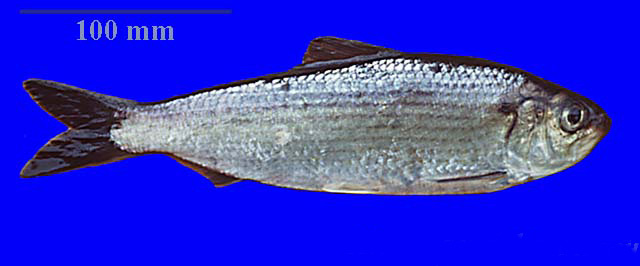
This ray-finned fish belongs to the genus Sardinella. Its body is elongated and nearly cylindrical with a slightly rounded belly. A faint golden line runs along its side, and a black spot marks the rear edge of the gill cover. Behind the gill opening, a subtle golden spot is visible. The pelvic fins have eight rays, and the fish possesses many gill rakers. Adults typically reach lengths between 14 and 18 centimetres depending on their age.
Where it lives
The species inhabits the northern parts of the Indian Ocean. Its presence and movement are closely tied to water conditions surrounding the monsoon season rather than strict seasonal cycles. This environmental dependency defines its regional distribution. The fish remains within these coastal zones where plankton availability supports its feeding habits throughout its short life cycle.
How it lives
These fish feed on microscopic plants called phytoplankton, specifically diatoms, and small animals known as zooplankton, such as copepods. Their growth is marked by rings on their scales, though these can form due to summer heat and reduced feeding rather than just annual changes. Reliable age determination is only possible after the first year. They live for approximately two and a half years.
Breeding and life cycle
Spawning occurs once per season, anytime from June to December, driven by monsoon-related water conditions. Older adults spawn early in this window, while younger fish arrive later. Each female produces roughly 75,000 spherical eggs containing a large oil globule, which gives the species its name. The eggs hatch within 24 hours. Larvae swim in a serpentine motion and use up their yolk reserves by the third day.
Fish and people
It is one of the two most important commercial fishes in India, sharing this status with mackerel. The peak catch period is June and July, coinciding with juveniles fattening before their first spawn. The high oil content in the eggs and flesh makes it a valuable food source. Fishers target these schools heavily during the pre-spawning phase when the fish are most abundant and nutritious.


Questions people ask about Indian oil sardine
Why is it called an oil sardine?
The name comes from the large oil globule that makes up a major part of the egg yolk. This high oil content is a distinctive feature of the species and contributes to its value as a food fish.
When is the best time to catch them?
The peak period for commercial catch is June and July. During these months, juvenile fish have fattened themselves in preparation for their first spawning season, making them abundant and easy to target.
How long do they live?
The lifespan is about 2.5 years. Determining exact age is difficult because scale rings can form due to summer heat and reduced feeding, not just annual changes. Rings become reliable indicators only after the first year.
Good reading and sources
- Indian oil sardine on WikipediaEncyclopedia
- More photos on Wikimedia CommonsPhotos
- Wikidata recordOpen data
The facts on this page come from the Wikipedia article "Indian oil sardine", written by its contributors and used under the CC BY-SA 4.0 licence, and from its Wikidata record (CC0). EveryFish rewrote the text in its own words, with AI assistance, and compares every page with the article to make sure no passage is copied. It may be reused under the same CC BY-SA 4.0 licence with a link back.
It may contain mistakes, and figures change over time. Nothing here is investment or buying advice. If something is wrong, tell us. Last refreshed 2026-11-15.
Like Indian oil sardine
All herrings and sardines 🇺🇸 United StatesAtlantic menhaden
A silvery herring species found along the North American Atlantic coast.Herring · Coasts and shelves
 🇺🇸 United States and 1 moreAlewife
A small North American herring that migrates between sea and rivers.Herring · Coasts and shelves
 🇹🇷 Turkey and 4 moreAnchovy
Small, oily forage fish found in oceans and some rivers worldwide.Herring · Coasts and shelves
 🇺🇸 United States and 1 moreGulf menhaden
Small filter-feeding fish of the Gulf of MexicoHerring · Coasts and shelves
More from Clupeidae
All of them 🇺🇸 United States and 2 moreAmerican gizzard shad
A silvery freshwater forage fish with a muscular gizzard.Herring · Rivers and lakes
 WorldSpotted sardinella
A small herring with golden spots found in the Indo-Pacific.Herring · Coasts and shelves
 🇺🇸 United States and 3 moreMenhaden
Small silver forage fish that filter plankton and support marine food webs.Herring · Coasts and shelves
 🇲🇦 Morocco and 2 moreEuropean pilchard
Small schooling fish of the Atlantic and Mediterranean.Herring · Coasts and shelves