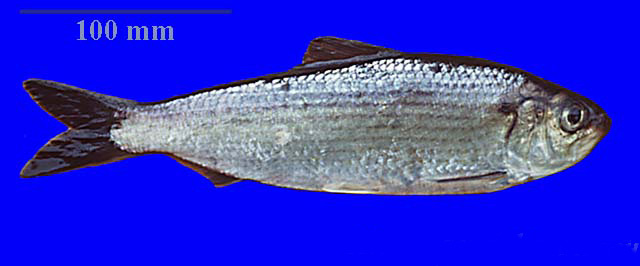
American gizzard shad
A silvery freshwater forage fish with a muscular gizzard.
The American gizzard shad is a herring-family fish native to North America. It lives in lakes and rivers, feeding on plankton and sediment. Its high numbers support ecosystems but can disrupt water management.
- Has a muscular gizzard filled with sand for grinding food.
- Can produce up to 380,000 eggs per female.
- High thiaminase levels may harm predator health.
- Blocked a nuclear plant cooling intake in Canada.
What it is
This fish belongs to the herring family. Adults have deep bodies that are green-silver on top and plain silver underneath. A faint spot with purple shine may appear behind the gill cover. The skin often feels slimy. Its mouth sits low on the head and lacks teeth in adults. A key feature is its muscular gizzard, a stomach chamber filled with sand or rocks that helps grind food. The dorsal fin begins behind the pelvic fins, and the last ray is notably long. The anal fin has many soft rays. A branched lateral line system runs along the head and front body.
Where it lives
Native to large areas of North America, this species ranges from North Dakota south to New Mexico and east to Florida. It rarely goes north of New York Harbor. While absent from many Great Lakes historically, it likely entered Lake Erie after the last ice age. It thrives in freshwater lakes, reservoirs, rivers, and streams. It also tolerates brackish water along the Atlantic coast. The fish prefers shallow lakes with muddy bottoms and cloudy water. Survival rates drop in clear water or areas with heavy plant growth.
How it lives
Young larvae eat phytoplankton and tiny animals like rotifers. As they grow, diets shift. In many reservoirs, adults consume sediment detritus, while those in natural lakes may keep eating zooplankton if available. They ingest sand to help digestion in their gizzard. Feeding happens mostly during the day. High numbers can deplete zooplankton communities, affecting other fish. They redistribute nutrients by eating deep sediment and excreting it in forms other organisms can use. This activity can increase algal production. Predators include birds like herons and mammals like raccoons.
Breeding and life cycle
Spawning starts in mid-May or early June when water warms. Fish gather in shallow water during evening or night hours. They do not pair off. Females lay clumps of eggs that stick to underwater plants. No parents guard the young. A two-year-old female carries about 12,500 eggs, rising to 380,000 for a four-year-old. Fry hatch at 3.3 mm long and start feeding within days. Growth is rapid, allowing populations to expand quickly. They can hybridize with the threadfin shad.
Fish and people
Fisheries managers introduced this shad into many waters as food for game fish like bass and walleye. However, they grow fast and often become too large for predators to eat. High densities can outcompete other fish, leading some to label them nuisances. They are used in toxicology testing as indicators of water quality. In culture, they pose risks to infrastructure. A large bloom once blocked cooling intakes at a Canadian nuclear plant, forcing a shutdown. Their high thiaminase levels can cause vitamin B1 deficiency in predators like alligators.


Questions people ask about American gizzard shad
Why is it called a gizzard shad?
It has a specialized stomach chamber called a gizzard. This muscular sack fills with sand or rocks to help grind up hard food items like sediment and detritus.
Do people eat American gizzard shad?
They are primarily used as bait or forage food for larger game fish like bass and walleye. They are not typically described as a primary food source for humans in these records.
Are they dangerous to other wildlife?
They contain high levels of thiaminase, an enzyme that breaks down vitamin B1. This can cause deficiency and neurological issues in predators like alligators that eat them in large quantities.
Good reading and sources
- American gizzard shad on WikipediaEncyclopedia
- More photos on Wikimedia CommonsPhotos
- Wikidata recordOpen data
The facts on this page come from the Wikipedia article "American gizzard shad", written by its contributors and used under the CC BY-SA 4.0 licence, and from its Wikidata record (CC0). EveryFish rewrote the text in its own words, with AI assistance, and compares every page with the article to make sure no passage is copied. It may be reused under the same CC BY-SA 4.0 licence with a link back.
It may contain mistakes, and figures change over time. Nothing here is investment or buying advice. If something is wrong, tell us. Last refreshed 2026-11-15.