
Goldstripe sardinella
Small tropical sardine found in Indo-Pacific reefs.
The goldstripe sardinella is a small clupeid fish native to shallow tropical waters of the western Indo-Pacific. It forms large schools near coral reefs and supports commercial fisheries across Asia and Africa, often sold dried or salted.
- Grows up to 17 cm in length
- Spawning peaks in June and July
- Sold as dried herring in Korean markets
- First recorded in Mediterranean in 2008
- Lives at depths down to 70 m
What it is
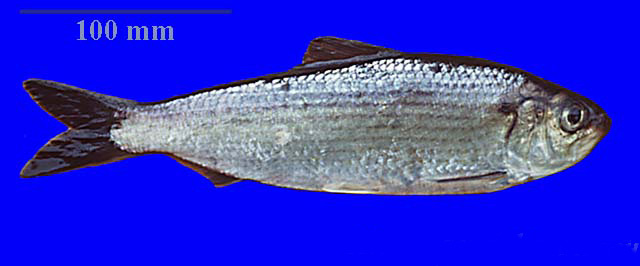
This species belongs to the herring family and features a slender body shape. It displays a dark spot on its dorsal fin and has fewer gill rakers than average. Small perforations mark the rear part of its scales. Adults reach a maximum length of seventeen centimetres. The fish lives in shallow tropical zones and stays close to coral reef structures.
Where it lives
Its native range covers the western Indo-Pacific region. Populations extend from the East African coast and Madagascar to Indonesia. It is abundant off the shores of Taiwan, Korea and Australia. In 2008, records appeared in the Mediterranean Sea near Israel. Scientists suspect it may exist in other areas due to its similarity to Sardinella maderensis. It inhabits depths reaching seventy metres.
How it lives
These fish gather in large schools for protection and feeding. They remain associated with coral reef environments in tropical waters. Determining their exact age is difficult because scale rings are unclear. The markings on their scales, known as annuli, are often interrupted or indented. Unlike salmon, these rings do not form distinct seasonal patterns, making age estimation unreliable.
Breeding and life cycle
Spawning activity occurs between April and October. Smaller individuals tend to reproduce earlier in this window. Peak activity happens during June and July. Larger and older specimens move into spawning grounds later in the season. Their eggs lack the wide perivitelline space typical of most pelagic fish. This unique trait leads some scientists to question its classification within the genus.
Fish and people
It is a key commercial species in India and Southeast Asia. Markets in Korea, England, Sweden and Canada sell it as dried herring. In Vietnam, processors wash, steam and sun-dry the catch before packing. Consumers eat it boiled, salted, dried or formed into fish balls. Fisheries in southern India rely heavily on this abundant resource.

Questions people ask about Goldstripe sardinella
Where does the goldstripe sardinella live?
It is native to shallow tropical waters of the western Indo-Pacific. Its range extends from East Africa and Madagascar to Indonesia, including coasts of Taiwan, Korea and Australia.
How is this fish prepared for eating?
It is consumed dried, salted, boiled or made into fish balls. In Vietnam, it is washed, steamed and sun-dried. Korean markets often advertise it as dried herring.
When does this species spawn?
The spawning season runs from April to October. Peak activity occurs in June and July. Smaller fish spawn earlier, while larger specimens arrive later in the season.
Good reading and sources
- Goldstripe sardinella on WikipediaEncyclopedia
- More photos on Wikimedia CommonsPhotos
- Wikidata recordOpen data
The facts on this page come from the Wikipedia article "Goldstripe sardinella", written by its contributors and used under the CC BY-SA 4.0 licence, and from its Wikidata record (CC0). EveryFish rewrote the text in its own words, with AI assistance, and compares every page with the article to make sure no passage is copied. It may be reused under the same CC BY-SA 4.0 licence with a link back.
It may contain mistakes, and figures change over time. Nothing here is investment or buying advice. If something is wrong, tell us. Last refreshed 2026-11-15.
Like Goldstripe sardinella
All herrings and sardines WorldSpotted sardinella
A small herring with golden spots found in the Indo-Pacific.Herring · Coasts and shelves
 🇺🇸 United States and 1 moreAlewife
A small North American herring that migrates between sea and rivers.Herring · Coasts and shelves
 🇹🇷 Turkey and 4 moreAnchovy
Small, oily forage fish found in oceans and some rivers worldwide.Herring · Coasts and shelves
 🇺🇸 United StatesAtlantic menhaden
A silvery herring species found along the North American Atlantic coast.Herring · Coasts and shelves
More from Clupeidae
All of them 🇺🇸 United States and 3 moreMenhaden
Small silver forage fish that filter plankton and support marine food webs.Herring · Coasts and shelves
 🇺🇸 United States and 2 moreAmerican gizzard shad
A silvery freshwater forage fish with a muscular gizzard.Herring · Rivers and lakes
 🇲🇦 Morocco and 2 moreEuropean pilchard
Small schooling fish of the Atlantic and Mediterranean.Herring · Coasts and shelves
 🇮🇳 India and 3 moreIndian river shad
A shad found in rivers and flooded fields across South Asia.Herring · Rivers and lakes