
Indian river shad
A shad found in rivers and flooded fields across South Asia.
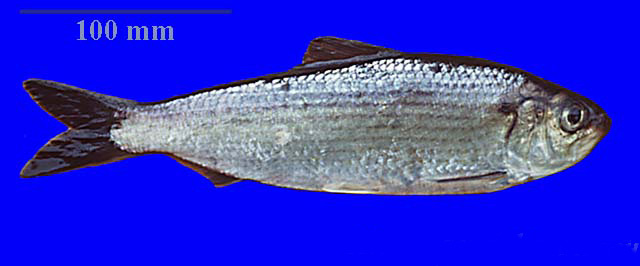
The Indian river shad is a fish belonging to the herring family, known scientifically as Gudusia chapra. It lives in freshwater rivers and flooded agricultural lands across several South Asian nations, adapting to both flowing and still waters.
- Belongs to the herring family, Clupeidae.
- Found in waterways that flow into the Bay of Bengal.
- Inhabits flooded agricultural fields and ponds.
- Recorded in the Ganges, Brahmaputra and Mahanadi.
What it is
The Indian river shad is a type of fish belonging to the herring family. This specific species makes its home in freshwater environments across South Asia. It is found in flowing rivers as well as still or slow-moving waters. These habitats include natural ponds, small ditches and agricultural areas that become flooded. By living in both moving and standing water, the fish adapts to a variety of shallow inland environments throughout its native range. This adaptability allows it to survive in diverse inland ecosystems.
Where it lives
This fish is native to the waterways of South Asia. Its primary range includes the major rivers of India and Bangladesh that flow into the Bay of Bengal. Specific locations include the Ganges, Brahmaputra and Mahanadi. The species has also been recorded in the waters of Pakistan and Nepal. Beyond the main river channels, it adapts well to standing water. It frequently inhabits ponds, natural depressions known as beels, small ditches and fields that become submerged.
Questions people ask about Indian river shad
What family does the Indian river shad belong to?
It belongs to the Clupeidae family, which is the same biological group as herrings and sardines. This species specifically lives in freshwater rivers and flooded areas.
Where can this fish be found in the wild?
It lives in the waterways of India and Bangladesh that flow into the Bay of Bengal. It is also found in Pakistan and Nepal, living in both rivers and still waters.
Does it only live in rivers?
No, it does not only live in rivers. It also inhabits ponds, natural wetlands called beels, small ditches and agricultural fields that become flooded with water during the wet season.
Good reading and sources
- Gudusia chapra on WikipediaEncyclopedia
- More photos on Wikimedia CommonsPhotos
- Wikidata recordOpen data
The facts on this page come from the Wikipedia article "Gudusia chapra", written by its contributors and used under the CC BY-SA 4.0 licence, and from its Wikidata record (CC0). EveryFish rewrote the text in its own words, with AI assistance, and compares every page with the article to make sure no passage is copied. It may be reused under the same CC BY-SA 4.0 licence with a link back.
It may contain mistakes, and figures change over time. Nothing here is investment or buying advice. If something is wrong, tell us. Last refreshed 2026-11-15.
Like Indian river shad
All herrings and sardines 🇺🇸 United States and 2 moreAmerican gizzard shad
A silvery freshwater forage fish with a muscular gizzard.Herring · Rivers and lakes
 🇺🇸 United States and 1 moreAlewife
A small North American herring that migrates between sea and rivers.Herring · Coasts and shelves
 🇹🇷 Turkey and 4 moreAnchovy
Small, oily forage fish found in oceans and some rivers worldwide.Herring · Coasts and shelves
 🇮🇪 IrelandTwait shad
Anadromous herring-like fish with flank spotsHerring · Rivers and lakes
More from Clupeidae
All of them 🇺🇸 United States and 3 moreMenhaden
Small silver forage fish that filter plankton and support marine food webs.Herring · Coasts and shelves
 WorldSpotted sardinella
A small herring with golden spots found in the Indo-Pacific.Herring · Coasts and shelves
 WorldBloch's gizzard shad
Small anadromous fish found across the Indo-West Pacific.Herring · Rivers and lakes · 1795
 Southeast AsiaWhite sardine
Small tropical clupeid fish of the Indo-Pacific.Herring · Coasts and shelves · 1847