Garibaldi
Bright orange damselfish and official marine state fish of California.
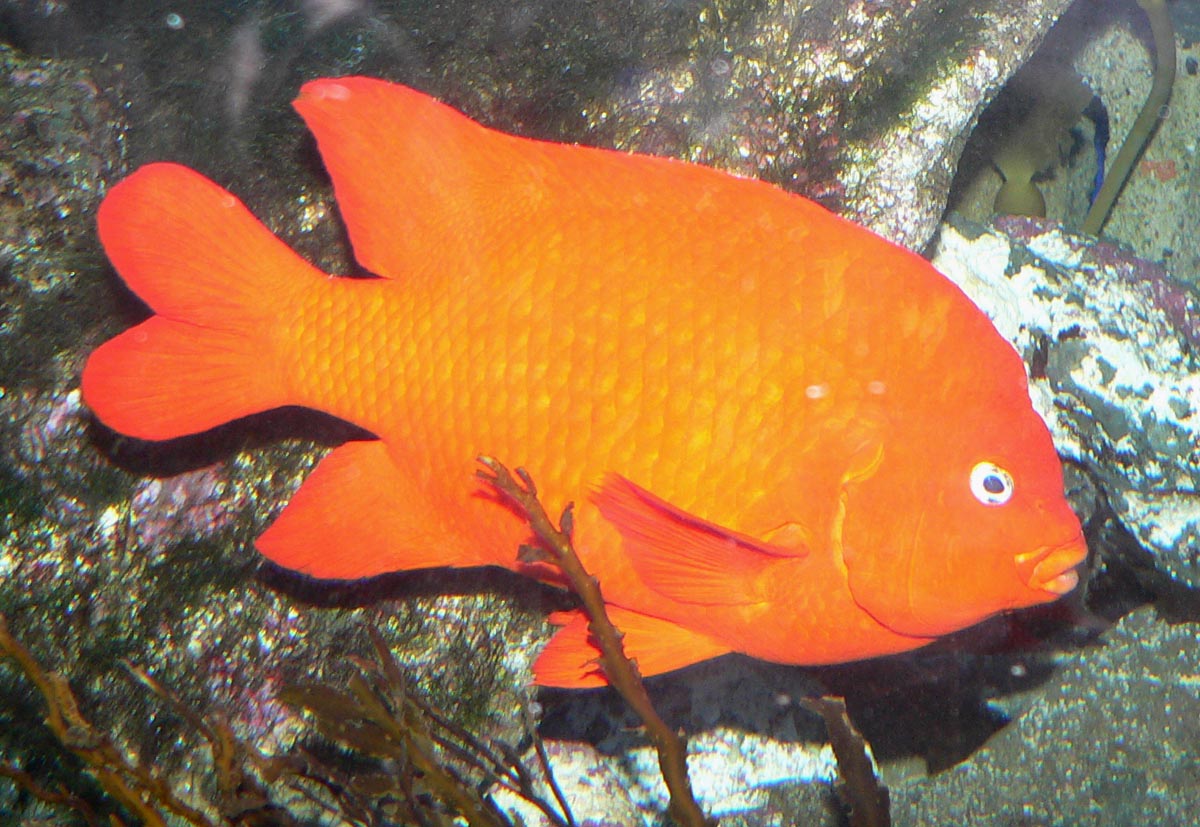
The Garibaldi is a vibrant orange fish native to the northeastern Pacific Ocean. It holds the title of California's official marine state fish and enjoys legal protection from fishing in coastal waters.
- Official marine state fish of California since 1995.
- Protected from fishing in California coastal waters.
- Recorded lifespan of 57 years, longest for any damselfish.
- Males aggressively defend nests, even biting divers.
- Juveniles have blue stripes that disappear upon maturity.
What it is
This species is a member of the damselfish family, known for its striking uniform bright orange colour. Adults are deep-bodied with coarse scales and a single dorsal fin containing spines and rays. They represent the largest species within their family, reaching lengths of roughly thirty-five centimetres. Juveniles differ significantly, displaying reddish-orange hues adorned with iridescent blue stripes and spots. These markings fade as the fish mature, leaving the solid orange appearance characteristic of adults. The fish inhabit rocky environments along exposed or semi-protected coasts, seeking crevices and small caves for shelter.
Where it lives
Garibaldis reside in the subtropical northeastern Pacific Ocean. Their distribution stretches from Monterey Bay in California down to Guadalupe Island in Baja California. They prefer clear waters over rocky bottoms where they can find adequate cover. While adults typically occupy depths up to thirty metres, juveniles may be found in tide pools at shallower depths. The species thrives in habitats that offer abundant rock reefs and sea-bottom structures suitable for nesting and hiding.
How it lives
These fish are generalist omnivores, feeding primarily on invertebrates extracted from rocks. Their diet includes fleshy red algae, polychaete worms, anemones, sponge fragments, bryozoans, hydroids, mollusks, and brown algae. Occasionally, they consume their own eggs. Adult Garibaldis exhibit strong territorial behaviour, defending areas of three to ten square metres year-round. Males are particularly aggressive during breeding seasons, attacking larger creatures including humans to protect their nests. They rely on cleaner fish like Senoritas and Kelp Perch to remove external parasites such as copepods and isopods.
Breeding and life cycle
Breeding occurs between March and July. Males prepare sheltered nest sites often featuring patches of red algae. Females select mates based on nest quality, preferring those with dense turf algae or existing eggs less than three days old. Eggs are bright yellow initially, turning gray after five days. The male guards the nest for nineteen to twenty-one days. Hatching happens shortly after sunset to reduce predation risk. Larvae disperse as plankton before settling into juvenile stages. Sexual maturity is reached around six years, though adult coloration appears by age five.
Fish and people
The Garibaldi was designated the official marine state fish of California in 1995. This status provides legal protection against recreational and commercial fishing in California coastal waters. The name references Giuseppe Garibaldi, an Italian general whose followers wore scarlet shirts. Due to their vivid colour and territorial nature, they are popular in aquariums, although they become aggressive toward other small fish as they grow. They also hold cultural significance as a symbol of California's marine heritage.
Status and threats
The International Union for Conservation of Nature lists the Garibaldi as Least Concern. The species is widespread across the Eastern Pacific and common in many parts of its range. There are no major threats currently causing population declines. Research indicates correlations between sea surface temperature, diet composition, and habitat type, which may inform future reef management. Despite being protected from fishing, natural predators like kelp bass may prey on young-of-the-year individuals.


Questions people ask about Garibaldi
Why do juvenile Garibaldi look different from adults?
Juveniles display reddish-orange bodies with iridescent blue stripes and spots. These markings help them avoid aggression from territorial adults through intraspecific camouflage or adult habituation. As they mature around five years old, the blue patterns fade, revealing the solid bright orange colour typical of adults.
How long does a Garibaldi live?
The average lifespan is believed to be around twelve years. However, a study published in 2022 identified an individual aged fifty-seven years, making it the longest-lived damselfish species recorded. This challenges previous assumptions that the maximum age was seventeen years.
What do Garibaldis eat?
They are generalist omnivores that feed mainly on invertebrates removed from rocks. Their diet includes fleshy red algae, polychaete worms, anemones, sponge fragments, bryozoans, hydroids, mollusks, and brown algae. They may also consume their own eggs under certain conditions.
Are Garibaldis dangerous to humans?
Adults are not inherently dangerous but can be highly territorial. Males aggressively defend their nest sites during breeding seasons. They may attack larger swimming creatures, including humans, and have been known to bite divers attempting to approach their eggs or territory.
Where can I find Garibaldi fish?
They are native to the subtropical northeastern Pacific Ocean. Their range extends from Monterey Bay in California to Guadalupe Island in Baja California. They inhabit rocky reefs and sea-bottoms up to thirty metres deep, preferring clear waters with plenty of crevices for shelter.
Good reading and sources
- Garibaldi (fish) on WikipediaEncyclopedia
- More photos on Wikimedia CommonsPhotos
- Wikidata recordOpen data
The facts on this page come from the Wikipedia article "Garibaldi (fish)", written by its contributors and used under the CC BY-SA 4.0 licence, and from its Wikidata record (CC0). EveryFish rewrote the text in its own words, with AI assistance, and compares every page with the article to make sure no passage is copied. It may be reused under the same CC BY-SA 4.0 licence with a link back.
It may contain mistakes, and figures change over time. Nothing here is investment or buying advice. If something is wrong, tell us. Last refreshed 2026-11-15.
Like Garibaldi
All reef fish WorldButterflyfish
A global family of colourful tropical reef fish known for their bright patterns and coral diets.Reef fish · Coasts and shelves · 1815
 WorldTrumpetfish
Marine fish with a long tubular snout found in tropical reefs worldwide.Reef fish · Coasts and shelves · 1766
 WorldYellow boxfish
A bright yellow, cube-shaped reef fish with toxic mucus.Reef fish · Coasts and shelves · 1758
 🇮🇩 Indonesia and 2 moreRed lionfish
Venomous coral reef fish native to the Indo-Pacific and invasive in the Atlantic.Reef fish · Coral reefs · 1758
More from Pomacentridae
All of them WorldClownfish
Small reef fish living in sea anemones.Reef fish · Coasts and shelves · 1801
 WorldGreen chromis
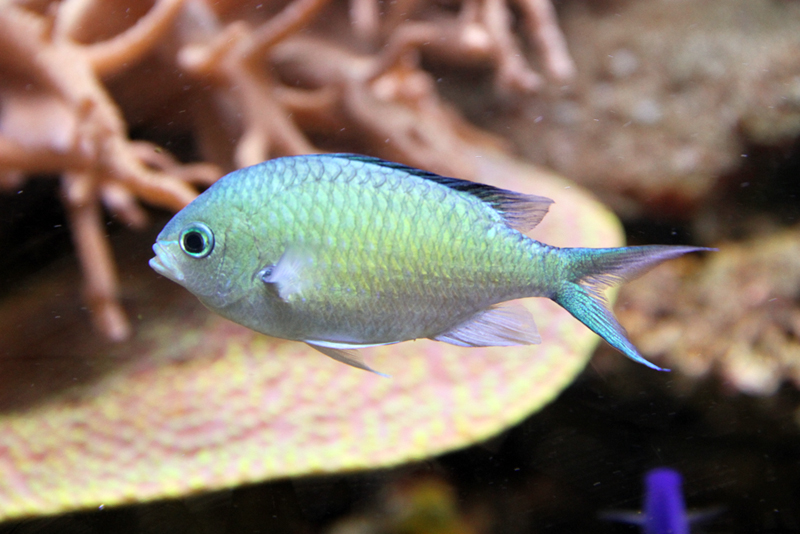
Small iridescent reef damselfish found across the Indo-Pacific.Reef fish · Coral reefs
 WorldDamselfish
Small marine fish known for aggressive territorial behaviour and reef farming.Reef fish · Coasts and shelves
 WorldWhitetail dascyllus
A small Indo-Pacific reef fish with bold black and white stripes.Reef fish · Coasts and shelves