
Butterflyfish
A global family of colourful tropical reef fish known for their bright patterns and coral diets.
Butterflyfish are a group of about 129 species in the family Chaetodontidae found on coral reefs across the Atlantic, Indian, and Pacific Oceans. They are popular in the aquarium trade but require specific care due to their specialized feeding habits.
- Approximately 129 species exist in the family Chaetodontidae.
- Largest species reach 30 cm in length.
- Larvae have a unique armored tholichthys stage.
- Found in Atlantic, Indian, and Pacific tropical oceans.
- Popular in aquariums but difficult to keep due to diet.
What it is
Butterflyfish belong to the family Chaetodontidae, a diverse group of marine percoids inhabiting tropical oceans worldwide. These fish are easily recognised by their deep, laterally compressed bodies and vibrant colouring, which often includes black, white, blue, red, orange, and yellow patterns. Many species display eyespots on their flanks and dark bands across their eyes, resembling butterfly wings. While they resemble angelfish, they lack preopercle spines at the gill covers. Most species measure between 12 and 22 centimetres, with the largest, such as the lined and saddle butterflyfish, reaching 30 centimetres. Their dorsal fins are uninterrupted, and their tail fins are rounded or truncated rather than forked.
Where it lives
This family is distributed across the coral reefs of the Atlantic, Indian, and Pacific Oceans. They are typically found in shallow waters less than 18 metres deep, although some species can descend to depths of 180 metres. Butterflyfish are bound to specific home ranges within reef frameworks. The genus Chaetodon contains numerous species pairs in the Indian and Pacific Oceans, while other genera like Heniochus include bannerfish and coralfish. Their presence is tied closely to the availability of coral structures, which provide both shelter and food sources in these tropical marine environments.
How it lives
Butterflyfish exhibit varied social behaviours depending on their diet. Corallivorous species, which feed on coral polyps and sea anemones, are highly territorial and often form pairs to defend a specific coral head. In contrast, those that feed on zooplankton tend to form large groups. They are diurnal, hiding in reef crevices at night where they may show different colouration. Their bright colours likely aid in interspecies communication. Predators balance prey populations in complex ways. As pelagic spawners, they release buoyant eggs into the water column, where larvae float with currents until hatching.
Breeding and life cycle
Reproduction involves pelagic spawning, where adults release many buoyant eggs into open water. These eggs become part of the planktonic community, drifting with ocean currents until they hatch. The resulting fry enter a unique tholichthys stage, during which their bodies are covered in large bony plates extending from the head. This armour protects them during early development. As the fish mature, they lose these bony plates. Only one other fish family, the scats, shares this distinct armored larval stage, highlighting a rare evolutionary trait within the group.
Fish and people
Due to their striking appearance, butterflyfish are highly sought after in the aquarium trade. However, keeping them requires expertise because most species rely on live coral polyps or sea anemones for food. Hobbyists often focus on generalist species or specialist zooplankton feeders that are easier to maintain in captivity. Their ecological role as coral predators is significant, though balancing predator and prey populations remains complex.
Status and threats
The International Union for Conservation of Nature (IUCN) lists the family status as Least Concern. While individual species face threats from habitat loss and overfishing for the aquarium trade, the group as a whole remains widespread. Conservation efforts focus on sustainable collection practices and protecting coral reef habitats. Pollution, climate change, and physical damage to reefs pose indirect threats to their survival. Molecular studies suggest the family originated in the Late Eocene, indicating a long evolutionary history that has allowed it to persist despite environmental changes.


Questions people ask about Butterflyfish
What do butterflyfish eat?
Most butterflyfish feed on coral polyps and sea anemones. Some species are specialists that consume zooplankton instead. This dietary difference influences their social behaviour, with coral-eaters being territorial and plankton-feeders forming larger groups.
Are butterflyfish dangerous to humans?
No, butterflyfish are not dangerous to humans. They are small, non-aggressive fish that pose no threat. They are primarily known for their bright colours and are kept in aquariums for观赏 purposes rather than for any defensive capabilities.
How do butterflyfish reproduce?
They are pelagic spawners that release buoyant eggs into the water column. The eggs drift with currents until hatching. The larvae undergo a tholichthys stage, featuring bony plates on their heads, before losing them as they mature into adults.
Why are they called butterflyfish?
The name comes from their brightly coloured and patterned bodies, which resemble the wings of butterflies. Many species have eyespots and dark bands across their eyes, enhancing this visual similarity to butterfly wings.
Good reading and sources
- Butterflyfish on WikipediaEncyclopedia
- More photos on Wikimedia CommonsPhotos
- Wikidata recordOpen data
The facts on this page come from the Wikipedia article "Butterflyfish", written by its contributors and used under the CC BY-SA 4.0 licence, and from its Wikidata record (CC0). EveryFish rewrote the text in its own words, with AI assistance, and compares every page with the article to make sure no passage is copied. It may be reused under the same CC BY-SA 4.0 licence with a link back.
It may contain mistakes, and figures change over time. Nothing here is investment or buying advice. If something is wrong, tell us. Last refreshed 2026-11-15.
Like Butterflyfish
All reef fish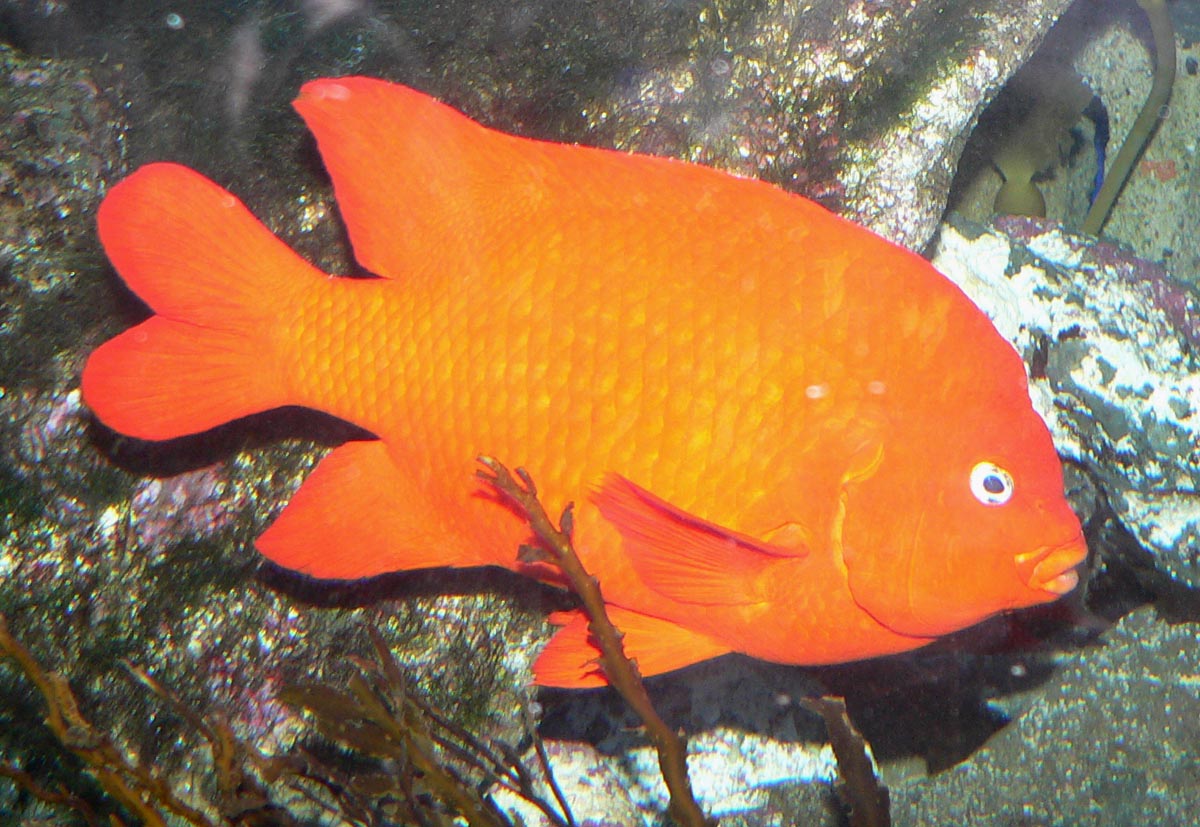 🇺🇸 United StatesGaribaldi
Bright orange damselfish and official marine state fish of California.Reef fish · Coasts and shelves · 1860
 WorldTrumpetfish
Marine fish with a long tubular snout found in tropical reefs worldwide.Reef fish · Coasts and shelves · 1766
 WorldWhitetail dascyllus
A small Indo-Pacific reef fish with bold black and white stripes.Reef fish · Coasts and shelves
 WorldTriggerfish
Armoured reef fish with a locking dorsal spineReef fish · Coasts and shelves · 1810