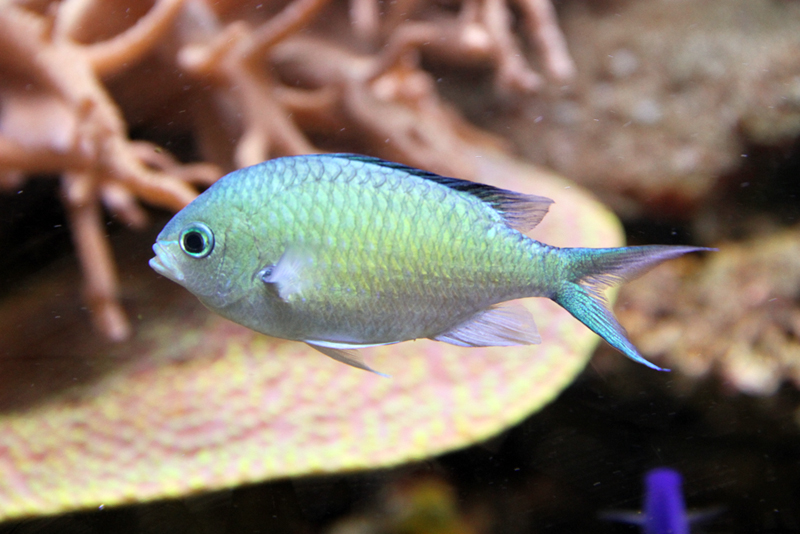
Green chromis
Small iridescent reef damselfish found across the Indo-Pacific.
The green chromis is a small damselfish known for its bright apple-green and blue colours. It lives in coral reefs across the Indo-Pacific and eastern Pacific oceans. This species is popular in marine aquariums due to its schooling behaviour and hardiness.
- Reaches a maximum length of 10 cm
- Schools around Acropora coral heads
- Males turn yellowish when breeding
- Found in reefs from 1 to 12 metres deep
- Eats unhatched eggs to protect the clutch
What it is
The green chromis is a species of damselfish characterised by its iridescent apple-green and light blue colouration. Adults reach a maximum length of ten centimetres. The fish possesses twelve dorsal rays and nine to eleven soft dorsal rays. Its anal fin features two spines and nine to eleven soft rays. This small reef dweller is easily recognised by its vibrant hues and compact size.
Where it lives
This species inhabits tropical and subtropical waters across a vast geographic area. In the Indian Ocean, it is present in the Red Sea, Gulf of Aden, eastern Africa, Madagascar, Seychelles, Persian Gulf, Arabian Sea, Maldives, Sri Lanka, Andaman Sea, Australia, and Indonesia. Pacific populations extend from the Gulf of Thailand and Indonesia to China, Taiwan, Japan, Great Barrier Reef, New Zealand, New Caledonia, Polynesia, Melanesia, and Hawaii. Eastern Pacific records span from the Gulf of California south to Peru and the Galapagos Islands. Occasional reports exist for the Mediterranean Sea. They live in coral reefs and lagoons at depths of one to twelve metres.
How it lives
Green chromis form schools around Acropora coral heads. Their diet consists mainly of phytoplankton, zooplankton, algae, copepods, and amphipods. They feed using a ram jawing technique. Unhatched eggs also serve as a food source. This feeding behaviour helps maintain nest hygiene. Larger predatory fish such as groupers, lionfish, and eels pose a threat to these small damselfish. They are not suitable tankmates for such predators due to the risk of predation.
Breeding and life cycle
Spawning occurs over sand and rubble substrates. The male prepares a nest that is shared with several females. During this period, the male turns more yellowish in colour. He guards the nest and ventilates the eggs with his fins. The large clutch hatches within two to three days. Males consume any eggs that fail to hatch. This prevents the unhatched eggs from becoming breeding grounds for microorganisms that could threaten the remaining healthy clutch.
Fish and people
The green chromis is a common choice for marine aquariums. It is relatively inexpensive and hardy. Aquarists keep them in small groups of odd numbers to encourage natural schooling behaviour. A single specimen requires a tank of at least thirty-eight litres, while a small school needs a minimum of one hundred and ten litres. Some hobbyists have successfully bred this species in home aquariums. Care must be taken to avoid housing them with larger predatory fish.


Questions people ask about Green chromis
How big do green chromis get?
Adults of this species grow up to ten centimetres in maximum length. They are small fish suitable for community tanks with other peaceful species.
What do green chromis eat?
In the wild, they feed on phytoplankton, zooplankton, algae, copepods, and amphipods. They also consume unhatched eggs from their own nests to prevent microbial growth.
Can green chromis be kept in a home aquarium?
Yes, they are popular in marine aquariums. A single fish needs a thirty-eight litre tank, but a small school requires at least one hundred and ten litres. They are relatively inexpensive.
Good reading and sources
- Chromis viridis on WikipediaEncyclopedia
- More photos on Wikimedia CommonsPhotos
- Wikidata recordOpen data
The facts on this page come from the Wikipedia article "Chromis viridis", written by its contributors and used under the CC BY-SA 4.0 licence, and from its Wikidata record (CC0). EveryFish rewrote the text in its own words, with AI assistance, and compares every page with the article to make sure no passage is copied. It may be reused under the same CC BY-SA 4.0 licence with a link back.
It may contain mistakes, and figures change over time. Nothing here is investment or buying advice. If something is wrong, tell us. Last refreshed 2026-11-15.
Like Green chromis
All reef fish WorldThreadfin butterflyfish
A tropical marine fish with a trailing dorsal filament.Reef fish · Coasts and shelves
 WorldBluespotted cornetfish
Long, slender reef fish with a tubular snout and blue spots.Reef fish · Coasts and shelves
 WorldSea goldie
A colourful reef fish that changes sex.Perch-like · Coasts and shelves
 North AmericaFoureye butterflyfish
Atlantic reef fish with false eyespots for defenceReef fish · Coasts and shelves
More from Pomacentridae
All of them WorldDamselfish
Small marine fish known for aggressive territorial behaviour and reef farming.Reef fish · Coasts and shelves
 WorldWhitetail dascyllus
A small Indo-Pacific reef fish with bold black and white stripes.Reef fish · Coasts and shelves
 WorldThreespot dascyllus
A small black and white reef fish with three distinct spots.Reef fish · Coral reefs
 WorldClownfish
Small reef fish living in sea anemones.Reef fish · Coasts and shelves · 1801