
Sea goldie
A colourful reef fish that changes sex.
The sea goldie is a marine ray-finned fish found across the Indo-Pacific. It lives in coral reefs and is popular in aquariums. Males and females look different, and females can turn into males if needed.
- Males reach 15 cm while females stay around 7 cm
- Females change into males when the harem leader dies
- Spawning happens at sunset from December to February
- Lives in schools above coral reefs to 35 m depth
- Found from the Red Sea to southeast Australia
What it is
The sea goldie is a small marine fish belonging to the grouper and sea bass family. It displays strong physical differences between sexes. Females are orange or gold with a violet streak under the eye and grow to seven centimetres. Males are larger, reaching fifteen centimetres, and show fuchsia colours. They have an elongated third dorsal fin ray, a red patch on the pectoral fin, and extended tail margins. This species is often seen in large schools above reefs.
Where it lives
This fish has a broad distribution across the Indo-Pacific region. It inhabits the western Indian Ocean, including the Red Sea. Its range extends through the Pacific Ocean to Japan, the Great Barrier Reef, and southeast Australia. It is notably absent from the Persian Gulf, Hawaii, and Oman. The species prefers clear lagoons, patch reefs, and steep coral slopes. It is typically found at depths of up to thirty-five metres.
How it lives
Sea goldies feed mainly on zooplankton drifting in the water. They are social animals that form very large schools above the reef structure. They are often found alongside Chromis dimidiata. The midas blenny acts as a social mimic, adopting yellow colouration to blend in with them. This behaviour helps the blenny gain protection within the school. The fish rely on group living for safety and feeding efficiency in their reef habitat.
Breeding and life cycle
This species is a protogynous hermaphrodite, meaning it starts life as a female. A single male maintains a harem of five to ten females. If the male dies or leaves, the largest female undergoes hormonal and physical changes to become the new male. This transformation takes several weeks or months. Spawning takes place at sunset. In the Red Sea, this activity occurs between December and February.
Fish and people
The sea goldie is a popular choice in the aquarium trade due to its bright colours. Hobbyists value the distinct appearance of both males and females. Keeping them requires attention to their social needs, as they naturally live in large groups. Their striking fuchsia and orange hues make them a visual highlight in reef tanks. They are not typically used for food but are prized for ornamental purposes.


Questions people ask about Sea goldie
Can sea goldies change their sex?
Yes, they are protogynous hermaphrodites. They start as females, and if the male in a group dies, the largest female changes into a male over several weeks.
What do sea goldies eat in the wild?
They feed primarily on zooplankton. These small drifting organisms are caught by the fish as they hover in schools above the reef structures.
How big do sea goldies get?
There is a size difference between sexes. Females grow up to 7 cm, while males are larger, reaching lengths of up to 15 cm.
Good reading and sources
The facts on this page come from the Wikipedia article "Sea goldie", written by its contributors and used under the CC BY-SA 4.0 licence, and from its Wikidata record (CC0). EveryFish rewrote the text in its own words, with AI assistance, and compares every page with the article to make sure no passage is copied. It may be reused under the same CC BY-SA 4.0 licence with a link back.
It may contain mistakes, and figures change over time. Nothing here is investment or buying advice. If something is wrong, tell us. Last refreshed 2026-11-15.
Like Sea goldie
All perches, basses and snappers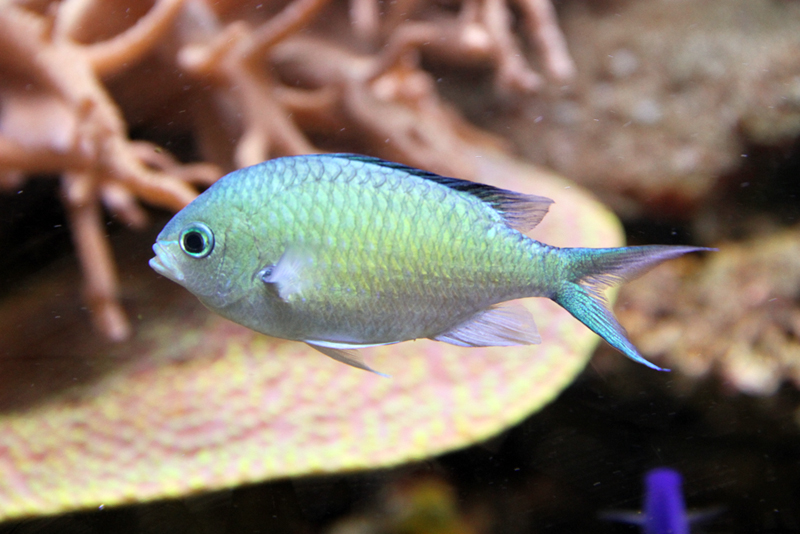 WorldGreen chromis
Small iridescent reef damselfish found across the Indo-Pacific.Reef fish · Coral reefs
 WorldThreadfin butterflyfish
A tropical marine fish with a trailing dorsal filament.Reef fish · Coasts and shelves
 WorldBluespotted cornetfish
Long, slender reef fish with a tubular snout and blue spots.Reef fish · Coasts and shelves
 North AmericaFoureye butterflyfish
Atlantic reef fish with false eyespots for defenceReef fish · Coasts and shelves
More from Serranidae
All of them WorldBlue-spotted grouper
A widely distributed Indo-Pacific grouper known for its blue spots and invasive impact in Hawaii.Other · Coasts and shelves
 North AmericaNassau grouper
A large reef fish critical to Caribbean fisheries now facing extinction risks.Perch-like · Coral reefs
 WorldGiant grouper
A massive Indo-Pacific reef fish and one of the largest bony species on Earth.Reef fish · Coasts and shelves · 1790
 Southeast AsiaHumpback grouper
A spotted marine fish with a distinctive humped head profile.Perch-like · Coral reefs · 1828