
Humpback grouper
A spotted marine fish with a distinctive humped head profile.
The humpback grouper is a medium-sized marine fish found in the Indo-West Pacific. It features a unique body shape and spots, serving as a valued food source in Asia despite conservation concerns and slow growth rates.
- Grows up to 70 cm with a distinctive humped head profile.
- Born female, most transform into males by age nine.
- Highly valued in Asian live fish markets and aquaculture.
- Listed as Data Deficient by the IUCN due to limited data.
- Can accumulate ciguatoxins, posing a risk of poisoning.
What it is
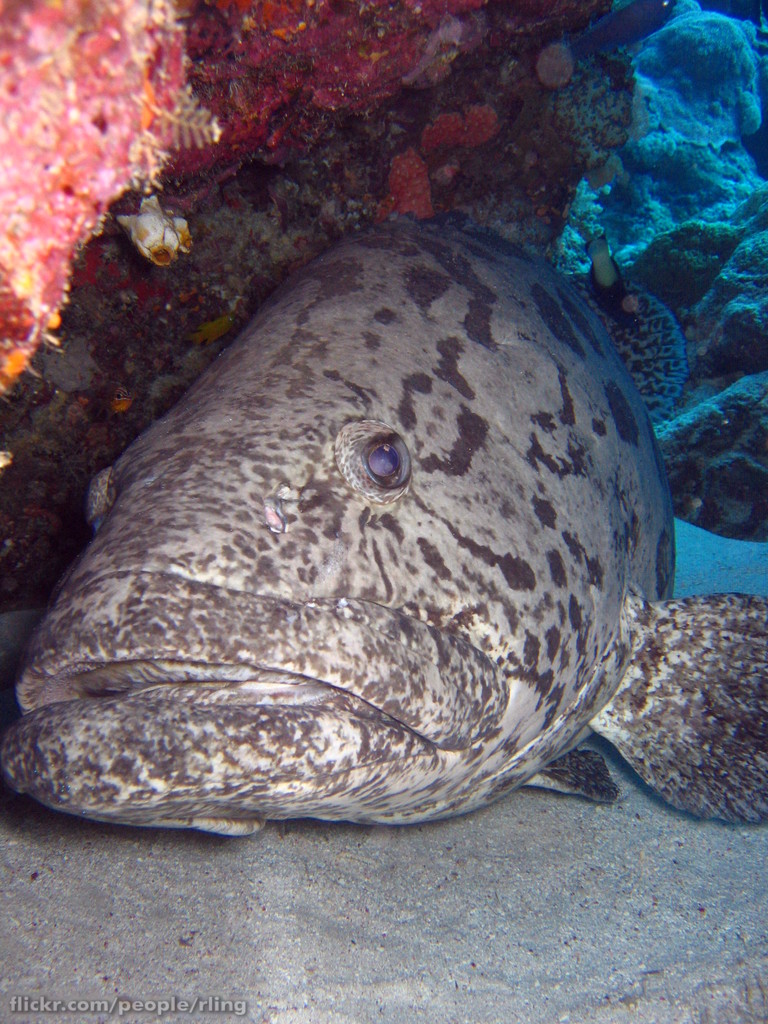
This medium-sized marine ray-finned fish belongs to the grouper subfamily within the sea bass family. It reaches lengths of up to 70 cm. The body is laterally compressed and relatively high, creating a stocky appearance. Its most defining feature is the head profile, which is depressed at the front and rises sharply at the nape. This structure gives the fish its common name. Juveniles are white with large round black spots, while adults display grey and beige tones with variable darker blotches and small black spots covering the body. Rounded pectoral and caudal fins provide stability, and a long dorsal fin runs from the opercle to the tail.
Where it lives
The species inhabits tropical waters across the central Indo-West Pacific region. It prefers clear environments such as lagoons and seaward reefs, often favouring dead or silty areas. Individuals are typically found at depths under 10 metres, though they can occur down to 40 metres. The preferred water temperature is around 24.5 degrees Celsius. Non-native observations have occurred in Florida, where it was first seen in 1984, and Hawaii, where it was recorded between 1991 and 2005 before being extirpated. A single sighting was also reported in Kenya.
How it lives
This demersal predator is primarily solitary but may swim in pairs or small groups of three to six. It acts as an ambush hunter, with feeding activity peaking at sunrise and sunset. The diet consists mainly of small fishes and crustaceans, including krill, shrimp, squid, and clams. As a protogynous hermaphrodite, all individuals are born female. They begin transitioning to males around three years of age, with most becoming male by nine years old. This change usually occurs in dominant females when no dominant male is present. The species exhibits a slow growth rate compared to related groupers.
Breeding and life cycle
Spawning peaks between October and January, with each event lasting four to eight days. Buoyant eggs selected for aquaculture measure approximately 0.80 to 0.83 mm in diameter. Artificial insemination using giant grouper sperm has produced hybrids with faster growth rates. In captivity, larvae are sensitive to shock from light or water disturbance, so they are reared in dark tanks with microalgae for shade and nutrition. Cannibalism is a significant cause of mortality in later stages. Cryopreservation trials on embryos showed a survival rate of just over seven percent.
Fish and people
The fish is highly valued in live fish markets across Asia, particularly in Hong Kong, where it dominated sales in the 1990s. It is also popular in United States aquariums. Aquaculture production occurs mainly in Taiwan and Indonesia, often using coastal net cages. Farmers sometimes feed juveniles low-value bycatch species, though copepod nauplii may improve growth. The species is associated with ciguatera poisoning due to toxin accumulation. In Bali and the Philippines, backyard hatcheries have provided economic benefits compared to traditional agriculture, despite the slow growth of the fish limiting large-scale production.
Status and threats
The International Union for Conservation of Nature lists the species as Data Deficient. Wild populations are suspected to have declined historically due to overexploitation, especially in Southeast Asia. Captive breeding has not significantly reduced pressure on wild stocks. Australia enforces strict conservation measures, including no-take zones on the Great Barrier Reef and possession limits in Western Australia. Size limits apply in some commercial fisheries. Elsewhere, protection is lacking. Researchers suggest that size limits, no-take areas, and effort control could help preserve remaining populations.


Questions people ask about Humpback grouper
Why is it called the humpback grouper?
The name comes from its unique head shape. The head is depressed at the front and rises sharply at the nape, creating a stocky, humpbacked appearance that distinguishes it from other groupers.
Is the humpback grouper safe to eat?
It is a popular food fish, but it can accumulate ciguatoxins. Consuming it may lead to ciguatera poisoning, a concern in regions with live fish markets where predatory fish are sold.
Where does the humpback grouper live?
It inhabits tropical waters in the central Indo-West Pacific. It prefers clear lagoons and seaward reefs, typically staying at depths less than 10 metres in temperatures around 24.5 degrees Celsius.
How does the humpback grouper reproduce?
It is a protogynous hermaphrodite, meaning all individuals start as females. Dominant females transition to males as they age, usually starting around three years old, if no dominant male is present.
Good reading and sources
- Humpback grouper on WikipediaEncyclopedia
- More photos on Wikimedia CommonsPhotos
- Wikidata recordOpen data
The facts on this page come from the Wikipedia article "Humpback grouper", written by its contributors and used under the CC BY-SA 4.0 licence, and from its Wikidata record (CC0). EveryFish rewrote the text in its own words, with AI assistance, and compares every page with the article to make sure no passage is copied. It may be reused under the same CC BY-SA 4.0 licence with a link back.
It may contain mistakes, and figures change over time. Nothing here is investment or buying advice. If something is wrong, tell us. Last refreshed 2026-11-15.
Like Humpback grouper
All perches, basses and snappers WorldEmperor red snapper
Large Indo-Pacific reef snapper with distinctive juvenile bands.Perch-like · Coasts and shelves · 1816
 WorldBluestripe snapper
Bright yellow reef fish with four blue stripesPerch-like · Coasts and shelves · 1775
 WorldBluefin trevally
Large tropical marine predator with electric blue finsPerch-like · Coasts and shelves · 1833
 🇦🇺 Australia and 4 moreLeopard coral grouper
A spotted reef predator prized for food across the Pacific.Perch-like · Coasts and shelves · 1802
More from Serranidae
All of them WorldGiant grouper
A massive Indo-Pacific reef fish and one of the largest bony species on Earth.Reef fish · Coasts and shelves · 1790
 WorldPotato grouper
Large Indo-Pacific reef grouper with dark blotches.Perch-like · Coral reefs · 1959
 WorldBlue-spotted grouper
A widely distributed Indo-Pacific grouper known for its blue spots and invasive impact in Hawaii.Other · Coasts and shelves
 WorldSea goldie
A colourful reef fish that changes sex.Perch-like · Coasts and shelves