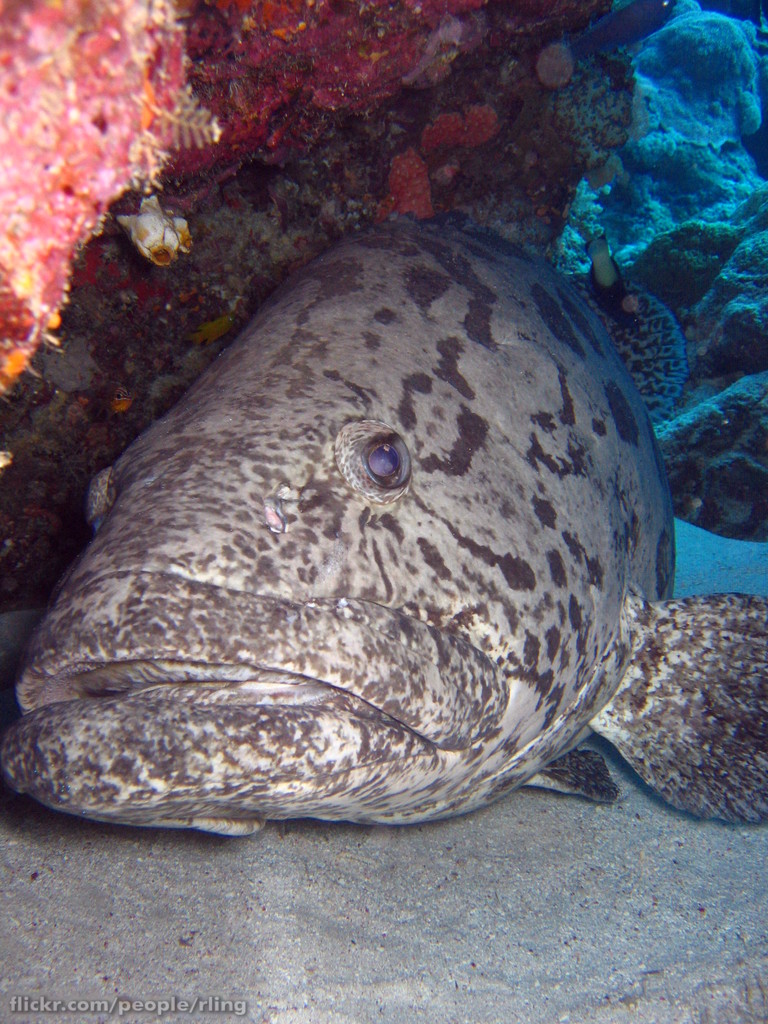
Potato grouper
Large Indo-Pacific reef grouper with dark blotches.
The potato grouper is a large marine fish found across the Indian and Pacific Oceans. It lives on coral reefs and sea mounts, growing up to two metres long. Fishers catch it for food, though it remains common in many areas.
- Grows up to 200 cm and 110 kg
- Named for potato-like dark body blotches
- Found on reefs from Red Sea to Australia
- Protected by law in South Africa and Australia
What it is
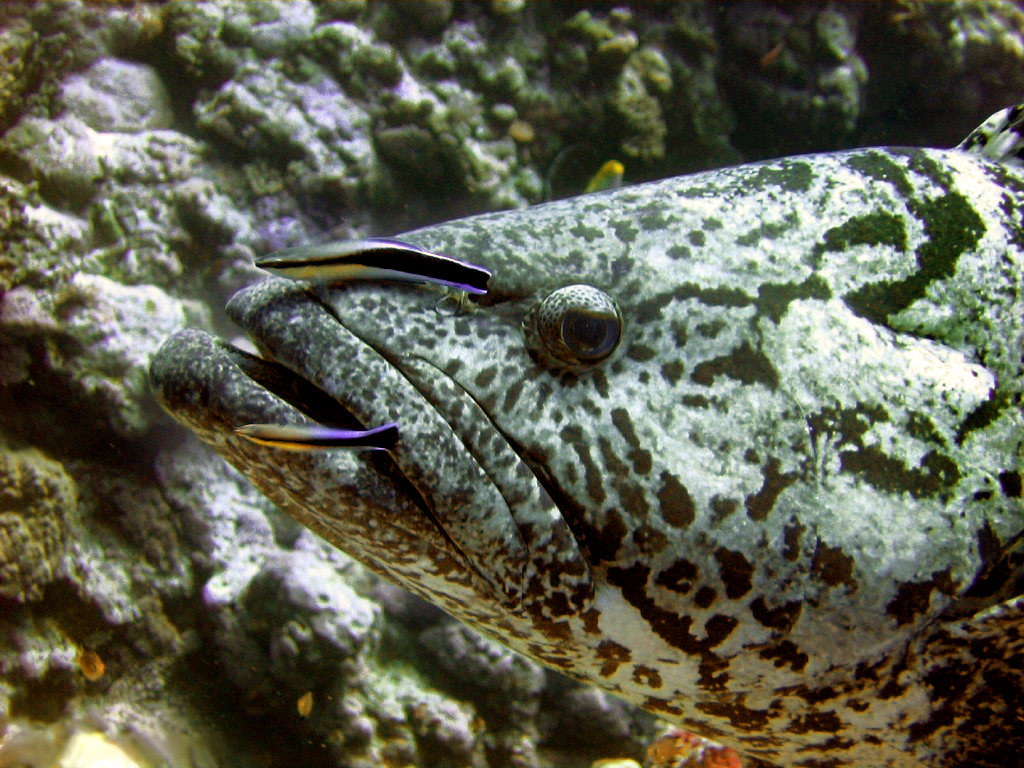
This robust marine fish belongs to the grouper family. It has a pale brownish-grey body covered in large, dark blotches that look like potatoes. Dark lines radiate from its eyes, and small spots mark its fins. The head profile is straight with a rounded preopercle. Adults grow up to two metres long and weigh over one hundred kilograms. Its dorsal fin contains eleven spines and soft rays, while the tail fin is rounded.
Where it lives
The species inhabits the Indian and Pacific Oceans. It is most common along eastern Africa, from the Red Sea to South Africa, and around islands like Madagascar and Seychelles. Its range extends to western India, Sri Lanka, southern Japan, and Australia. In Australia, it lives from Shark Bay to Moreton Bay, including the Great Barrier Reef. It does not appear in the Persian Gulf.
How it lives
These fish live alone and stay within a small home range. Juveniles prefer shallow tidal pools, while adults dwell between ten and one hundred and fifty metres deep. They hide in coral and ambush prey such as small rays, crabs, squid, and lobsters. They swallow their food whole. Although aggressive in defending territory, they are rarely seen in groups except possibly for spawning.
Breeding and life cycle
Sexual maturity occurs at about twelve years of age, when the fish reaches roughly ninety centimetres in length. Evidence from captive specimens suggests they may change sex from female to male, a trait common in groupers. While smaller fish sometimes gather, scientists have not confirmed if this species forms large spawning aggregations in the wild.
Fish and people
Local and artisanal fishers catch this grouper throughout its range. It appears in the live food trade in China and Hong Kong but is not highly prized there. Conservationists consider it vulnerable to overfishing, yet populations remain stable enough for a Least Concern status. Laws in South Africa and Australia protect the species from excessive harvest.
Status and threats
The International Union for Conservation of Nature lists the potato grouper as Least Concern. Overfishing is a potential risk, but it is not currently a major threat to the overall population. Specific national protections exist in Australia and South Africa to help maintain local numbers and ensure the species remains secure in those waters.


Questions people ask about Potato grouper
Why is it called the potato grouper?
The name comes from the large, dark, widely separated blotches on its body. These markings are thought to resemble the shape of potatoes, giving the fish its distinctive common name.
How big does the potato grouper get?
It is a large and robust species. Adults can reach a maximum published length of 200 centimetres and weigh up to 110 kilograms, making it one of the larger groupers in its range.
Is the potato grouper endangered?
No, the IUCN classifies it as Least Concern. While it faces some pressure from fishing, it is not currently considered threatened. It is also legally protected in countries like Australia and South Africa.
Good reading and sources
- Potato grouper on WikipediaEncyclopedia
- More photos on Wikimedia CommonsPhotos
- Wikidata recordOpen data
The facts on this page come from the Wikipedia article "Potato grouper", written by its contributors and used under the CC BY-SA 4.0 licence, and from its Wikidata record (CC0). EveryFish rewrote the text in its own words, with AI assistance, and compares every page with the article to make sure no passage is copied. It may be reused under the same CC BY-SA 4.0 licence with a link back.
It may contain mistakes, and figures change over time. Nothing here is investment or buying advice. If something is wrong, tell us. Last refreshed 2026-11-15.
Like Potato grouper
All perches, basses and snappers 🇺🇸 United States and 3 moreBlack crappie
A spotted freshwater sunfish native to North America, prized by anglers for its sport and table fare.Perch-like · Rivers and lakes · 1856
 WorldBluefin trevally
Large tropical marine predator with electric blue finsPerch-like · Coasts and shelves · 1833
 Southeast AsiaHumpback grouper
A spotted marine fish with a distinctive humped head profile.Perch-like · Coral reefs · 1828
 WorldEmperor red snapper
Large Indo-Pacific reef snapper with distinctive juvenile bands.Perch-like · Coasts and shelves · 1816
More from Serranidae
All of them WorldGiant grouper
A massive Indo-Pacific reef fish and one of the largest bony species on Earth.Reef fish · Coasts and shelves · 1790
 WorldBlue-spotted grouper
A widely distributed Indo-Pacific grouper known for its blue spots and invasive impact in Hawaii.Other · Coasts and shelves
 WorldSea goldie
A colourful reef fish that changes sex.Perch-like · Coasts and shelves
 North AmericaNassau grouper
A large reef fish critical to Caribbean fisheries now facing extinction risks.Perch-like · Coral reefs